Your daily AI intelligence for May 14, 2026.
Daily AI Briefing — 2026-05-14
By Hector Herrera | NexChron
Good morning. Here's your AI intelligence for Thursday, May 14, 2026.
AI IN THE EXAM ROOM
Nearly two-thirds of U.S. physicians consulted OpenEvidence — an AI clinical information platform — during roughly 27 million patient encounters in April 2026. The platform surfaces clinical research, drug interaction data, and treatment guidelines in real time as doctors see patients. Most patients were never told. The scale is striking: one AI tool is now embedded in a significant share of U.S. primary care consultations, with no disclosure standard requiring physicians to say so. Expect the informed consent debate to intensify as usage grows.
REGULATION: CHINA MOVES FIRST ON AI AGENTS
China's top internet, economic, and industrial regulators jointly released the world's first national framework governing AI agents — autonomous systems that can plan, reason, and act across digital environments without human sign-off at each step. The rules cover accountability, transparency, and operational boundaries for agent deployment. No other national government has issued comparable agent-specific regulation. The framework gives China a structural first-mover position in setting how AI agents are built and governed globally — a position that will matter as these systems move deeper into commerce, finance, and critical infrastructure.
FACTORY FLOORS
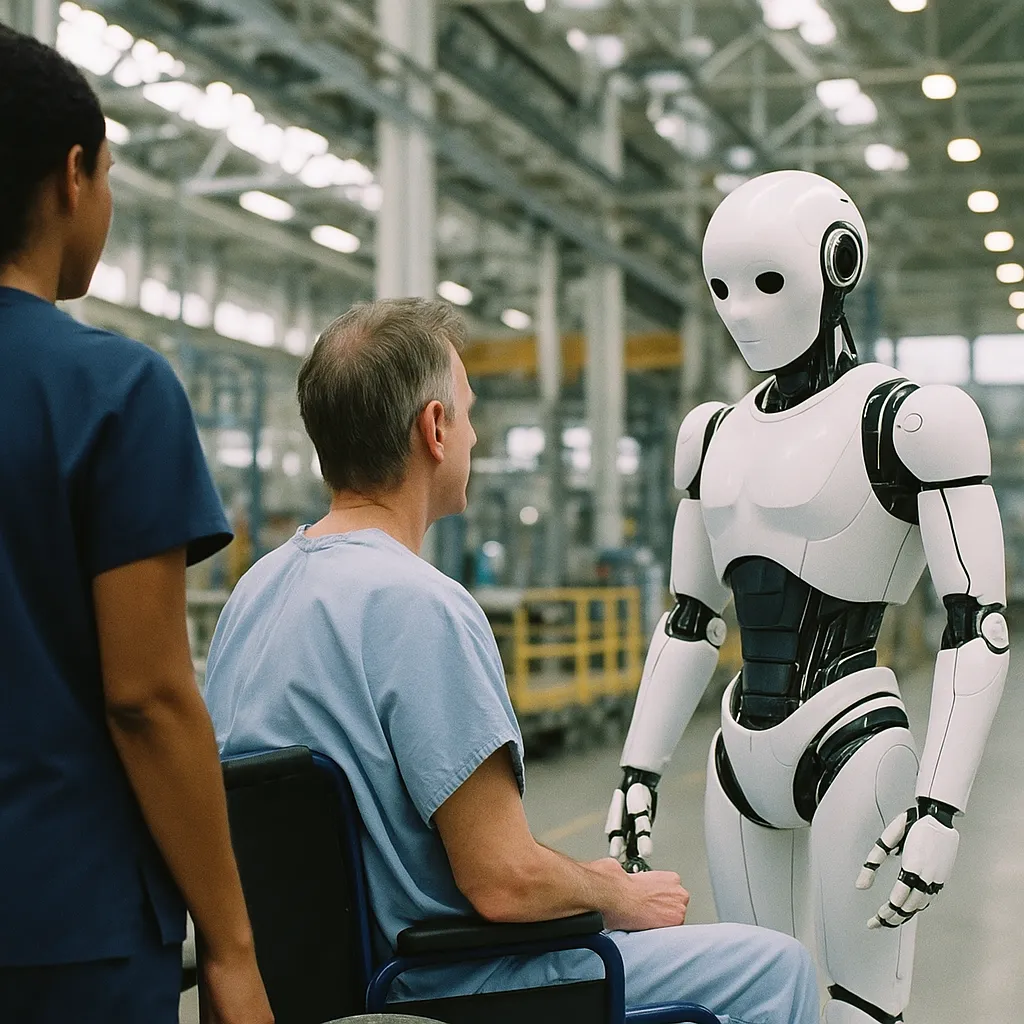
UK startup Humanoid has signed a binding Robot-as-a-Service agreement with Schaeffler to deploy 1,000 to 2,000 wheeled humanoid robots across the industrial company's global manufacturing sites by 2032. It's one of the largest humanoid deployment commitments on record. The RaaS structure is notable: Schaeffler pays for robot use over time rather than absorbing upfront capital costs, which lowers the barrier to humanoid adoption and sets a commercial model others are likely to follow.
Separately, Intrinsic CEO Stefan Nusser made the case this week that conventional factory automation has priced itself out of reach for most manufacturers — too expensive, too rigid, too dependent on specialists. Intrinsic's bet is on AI-driven systems configurable by generalists, not just robotics engineers. The cost equation for factory automation is being rewritten, and it's not being rewritten by the incumbents.
AUTONOMOUS FREIGHT GOES COMMERCIAL IN TEXAS
Volvo Autonomous Solutions and DSV have launched commercial autonomous freight operations on the Dallas-to-Houston corridor, integrating Aurora's self-driving stack into live logistics flows. This is not a pilot. Goods are moving between two major freight hubs under autonomous operation. Texas is now the de facto proving ground for autonomous trucking at commercial scale, with multiple operators running the same corridors. The question has shifted from whether the technology works to which operators get to unit economics first and make the transition irreversible.
Get this in your inbox.
Daily AI intelligence. Free. No spam.
TELECOM: THE CONFIDENCE GAP
Nokia has embedded AI agents and natural language interfaces into its core broadband management platforms, pulling data from 600 million broadband lines to move from AI-assisted decisions to fully agentic network operations. The system reasons about network conditions and acts — without waiting for human approval at each step.
An Ericsson survey of 455 senior telecom executives frames the broader industry picture: 90% are confident AI and 5G standalone networks will unlock new revenue. 70% haven't started implementing either. Confidence and deployment remain deeply disconnected across the sector. Nokia's move is the exception, not the norm.
ENERGY: AI IS OUTRUNNING POLICY
A World Economic Forum analysis finds that AI-enabled tools — not government mandates or incentives — have become the primary driver of renewable energy deployment speed. Global renewables added 793 gigawatts in 2025 and surpassed coal in electricity generation for the first time. The implication is significant: the pace of the energy transition is now more dependent on AI tool adoption than on the policy environment. That changes what levers actually matter for accelerating decarbonization.
BANKING AND FINTECH
NatWest named eight startups for its 2026 Fintech Programme. Five of them are autonomous AI agents. The cohort signals where UK banking is heading — from AI assistants that support human decisions to AI systems that act independently on compliance, onboarding, and transaction monitoring tasks. The shift is from augmentation to delegation, and NatWest's selection process is an early benchmark for what banks consider production-ready.
AI CREDIT DECISIONS, HUMAN ACCOUNTABILITY FRAMEWORKS
Machine learning drives loan approvals worldwide. The legal and governance frameworks governing those decisions were written for human underwriters and haven't been updated. When an algorithm denies credit or prices risk differently, existing structures struggle to assign clear responsibility or provide meaningful recourse. Lenders and regulators are running AI at scale inside governance architecture that predates it. That gap is becoming harder to ignore as deployment accelerates.
PRECISION FARMING AND THE BROADBAND DIVIDE
AI-connected farm equipment is generating data demands that rural broadband cannot meet. The Fiber Broadband Association concludes that existing rural network standards must be fundamentally updated — not incrementally patched. The equity dimension is direct: large operations in well-connected regions capture precision agriculture's efficiency gains while smaller farms in underserved areas are effectively locked out. Federal farm and broadband policy are pointed at the same problem without yet being coordinated around it.
Home Assistant's May 2026 release adds reasoning transparency to its AI assistant — the system now surfaces what it reasoned before it acted, giving users visibility into the logic chain before an automation executes. That's a meaningful departure from black-box smart home behavior. The release also adds Matter lock PIN management and 14 new device integrations.
WHAT TO WATCH TODAY
AI agent governance spreading. China's national agent framework is the first of its kind. The EU and the U.S. are now under pressure to respond — either by matching the framework or by explicitly taking a different approach. How Western regulators react to this first-mover positioning will shape how agent infrastructure is built globally.
Autonomous trucking commercialization. The Volvo-DSV Texas launch adds to a cluster of commercial freight operations running on the same corridors. The milestone question is unit economics: which operators reach the cost structure that makes autonomous freight self-sustaining and irreversible.
AI governance in lending. Credit algorithms are deployed at scale now. The gap between where AI is operating and where governance frameworks have caught up is widening. Watch for enforcement actions or updated guidance from banking regulators as the mismatch attracts regulatory attention.
NexChron — Your daily AI intelligence.
Did this help you understand AI better?
Your feedback helps us write more useful content.
Get tomorrow's AI briefing
Join readers who start their day with NexChron. Free, daily, no spam.