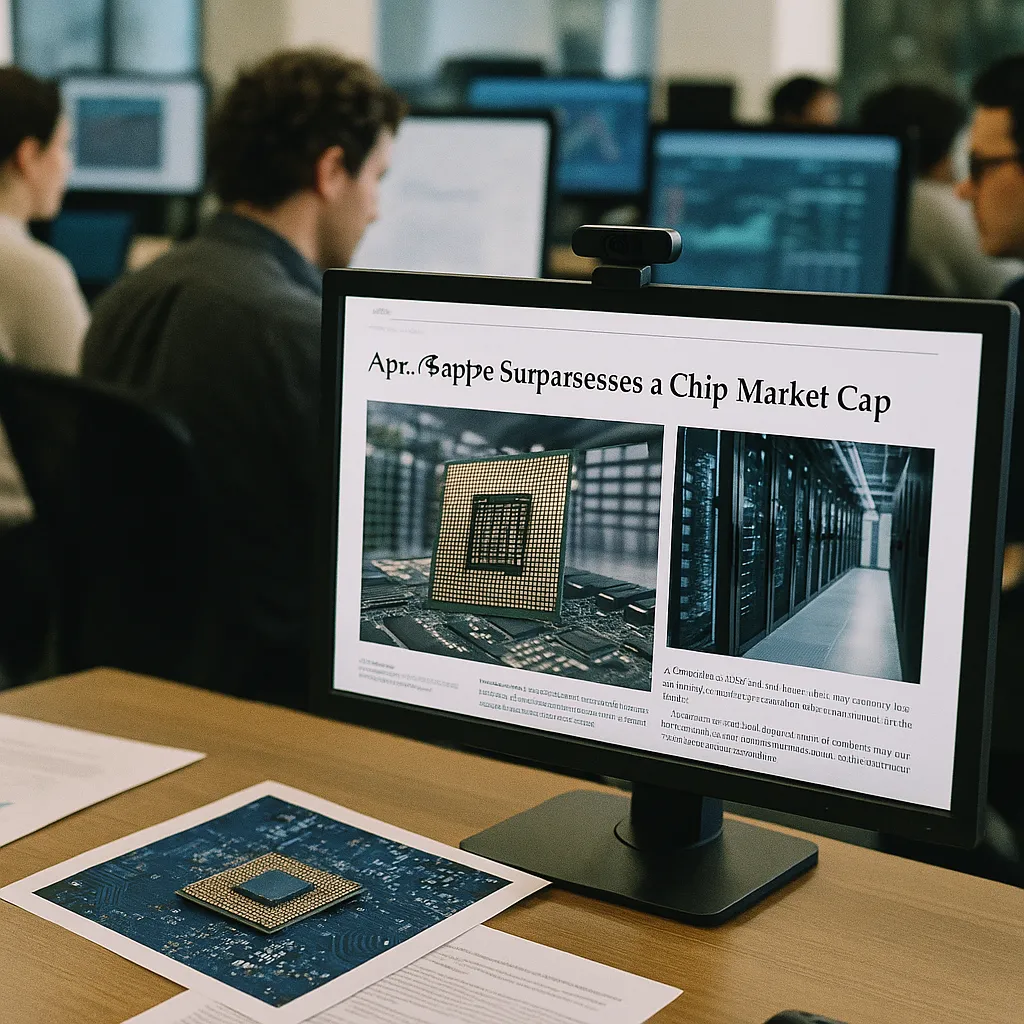
Alphabet briefly overtook Nvidia in market capitalization this week, capping a 160% stock rally as investors concluded that owning the entire AI stack is worth more than dominating any single layer.
Alphabet Briefly Surpasses Nvidia in Market Cap as Full-Stack AI Bet Pays Off
By Hector Herrera | May 12, 2026
Alphabet briefly overtook Nvidia in market capitalization in after-hours trading this week, capping a 160% stock rally over the past year as investors concluded that owning the entire AI stack — from data centers to models to distribution — is worth more than dominating any single layer. The moment marks a striking reversal: in early 2023, Wall Street was writing Google's obituary after ChatGPT launched.
How We Got Here
Eighteen months ago the dominant investor narrative was that Alphabet faced an existential threat. OpenAI had launched a product that could answer questions without sending users to a Google search results page. Advertisers were nervous. Analysts debated whether Google Search was permanently impaired.
What happened instead: Alphabet quietly assembled a more complete AI position than any other company on Earth. Google DeepMind produces frontier research. Google Cloud sells AI infrastructure. Google Search integrated AI Overviews into its core product. YouTube leverages AI across recommendations and creation. And Gemini, Alphabet's model family, is embedded across Android devices used by more than 3 billion people.
The Full-Stack Advantage
The investor thesis that drove Alphabet's rally centers on what analysts now call full-stack ownership — controlling chips (Google's TPUs), data centers, models, applications, and distribution simultaneously. No other company has all five.
Nvidia owns chips and CUDA, the software framework that runs most AI workloads — but it does not own models, applications, or consumer distribution. OpenAI owns a leading model and a fast-growing consumer product, but is entirely dependent on Microsoft's Azure infrastructure and Nvidia's hardware. Meta owns distribution through its social platforms but purchases compute from Nvidia and Microsoft.
Get this in your inbox.
Daily AI intelligence. Free. No spam.
Alphabet, uniquely, is vertically integrated across the full value chain. That integration creates compounding advantages: proprietary training data from Search and YouTube, hardware that isn't subject to Nvidia supply constraints, and a distribution surface that reaches billions of users before any competitor's model is involved.
The Numbers
- Market cap at peak: Alphabet briefly exceeded Nvidia's valuation in after-hours trading, though intraday positions fluctuated
- 12-month return: Alphabet shares up approximately 160% year-over-year as of the crossing
- Nvidia context: Nvidia remains the world's most valuable semiconductor company and one of the top two or three most valuable companies globally — this was a crossing, not a collapse
The crossing was brief and conditions-dependent, but the symbolism matters. Nvidia's dominance of AI hardware spending made it the defining beneficiary of the AI boom's first phase. Alphabet's ascent signals that the market is beginning to price in Phase Two: the companies that will capture sustained value from AI at the application and platform layer.
What It Means for the AI Industry
For Nvidia: Nothing fundamental changes. Data center spending on Nvidia GPUs is accelerating, not slowing. Alphabet's TPUs do not threaten Nvidia's third-party customer base, which includes every major AI lab and enterprise cloud provider. The market cap comparison reflects investor rotation into diversified AI plays, not a verdict against chips.
For Microsoft: The comparison puts pressure on Microsoft to demonstrate that its OpenAI partnership provides durable advantages, not just first-mover momentum. Microsoft has deep integration across Office, Azure, and GitHub Copilot — a real full-stack position — but its model dependence on OpenAI is a structural vulnerability Alphabet does not share.
For enterprise buyers: The market is signaling that AI platforms with integrated infrastructure and distribution will have more pricing power and stickiness than point solutions. Enterprise buyers should expect Google Cloud AI bundles to become more aggressive in competing for workloads currently running on Azure OpenAI.
For investors: The full-stack thesis has won, at least for now. Pure-play AI companies — those that own one layer of the stack — face higher risk of commoditization as the platform companies invest to close capability gaps.
What to Watch
The key question is whether Alphabet can convert its structural position into revenue growth that justifies the valuation. Google Cloud's AI segment must continue growing faster than Azure's. Gemini adoption metrics — monthly active users, enterprise API revenue, Android integration depth — will be the indicators that matter. Watch the Q2 2026 earnings call in July for the first data points that will either confirm or challenge the full-stack narrative.
Hector Herrera covers AI business and technology at NexChron. Source: CNBC
Did this help you understand AI better?
Your feedback helps us write more useful content.
Get tomorrow's AI briefing
Join readers who start their day with NexChron. Free, daily, no spam.