Siemens and NVIDIA are expanding their partnership to build an Industrial AI Operating System — and a factory in Erlangen, Germany will be the first site to run entirely on it.
Siemens and NVIDIA Are Building an Industrial AI Operating System — Starting With One Factory in Germany
By Hector Herrera | June 15, 2026 | Manufacturing
Siemens and NVIDIA are expanding their partnership to build what they're calling an Industrial AI Operating System — a platform that spans the entire manufacturing lifecycle from design and engineering through production and supply chain, with the goal of enabling factories to simulate changes virtually and apply validated results directly on the shop floor. The first proof of concept will be Siemens' own Electronics Factory in Erlangen, Germany, targeted to become the world's first fully AI-driven adaptive manufacturing site.
This is not a product announcement. It's a blueprint for what industrial AI looks like when it runs an entire factory rather than assisting individual tasks.
What the Partnership Actually Builds
According to the NVIDIA Newsroom, the Industrial AI OS integrates four domains that have historically been managed in separate software silos:
- Design — generative and AI-assisted engineering of products and facilities
- Engineering — simulation, validation, and testing before physical production
- Manufacturing — real-time monitoring, adaptive control, and autonomous adjustment on the shop floor
- Supply chain — AI-coordinated procurement, inventory, and logistics
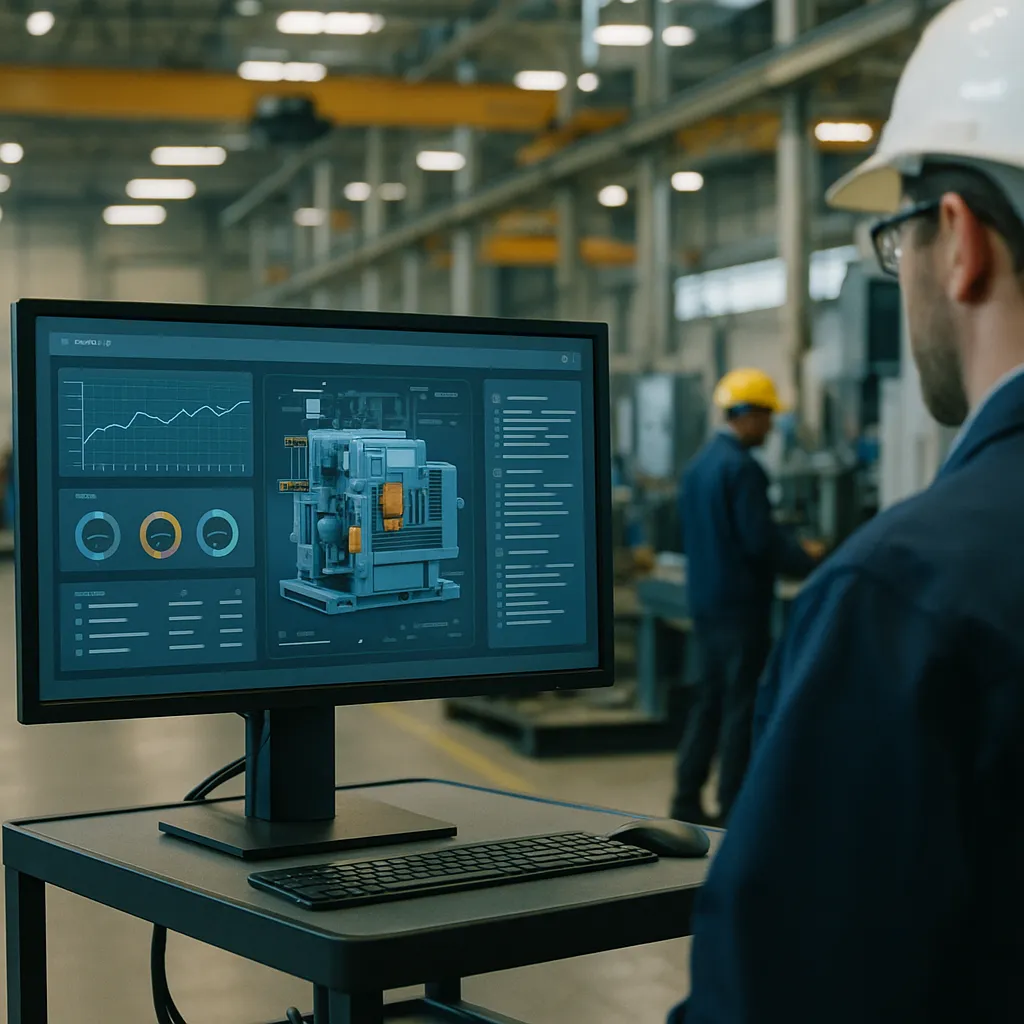
The connecting layer is NVIDIA's physical AI platform — specifically its Omniverse-based digital twin infrastructure — combined with Siemens' industrial automation software and its Xcelerator platform. The idea is that a change anywhere in the system (a new product variant, a supply disruption, a machine fault) triggers a cascade of AI-coordinated adjustments across all four domains simultaneously, rather than human operators translating decisions across disconnected systems.
Siemens is also launching its Digital Twin Composer on the Xcelerator Marketplace in mid-2026 — a tool that allows manufacturers to build and manage digital twins of their facilities without starting from scratch.
The Erlangen Factory as a Living Demonstration
The Siemens Electronics Factory in Erlangen, Germany is not a greenfield site built to showcase AI. It's an active manufacturing facility producing industrial electronics — exactly the kind of complex, multi-product environment where AI coordination is genuinely difficult.
Get this in your inbox.
Daily AI intelligence. Free. No spam.
Targeting it as the world's first fully AI-driven adaptive manufacturing site means Siemens is betting its own production on the technology, not just licensing it to customers. That matters because Siemens is both the technology provider and the customer in this case. If it doesn't work in Erlangen, the sales pitch to other manufacturers falls apart.
What "fully adaptive" means in practice:
- Machines that detect their own deviations from spec and recalibrate without human intervention
- Production schedules that reoptimize in real time based on order changes, material availability, and machine status
- Quality control that uses computer vision and sensor fusion to catch defects earlier than human inspection can
- Energy consumption that adjusts dynamically based on demand, utility pricing, and grid conditions
Siemens hasn't published performance targets for Erlangen, but comparable AI-driven factory initiatives — including Foxconn's "lights-out" facilities and BMW's AI manufacturing rollouts — have reported 15-30% efficiency gains and significant reductions in unplanned downtime.
Why This Partnership Matters Beyond Siemens
The Siemens-NVIDIA combination is significant because both companies bring capabilities that neither has alone.
NVIDIA's contribution is the physical AI infrastructure: Omniverse for digital twins, Isaac for robotics simulation, and CUDA-accelerated AI workloads that can run at factory speed. NVIDIA's recent push into "physical AI" — AI systems that operate in the real world, not just on text or images — is built around exactly this use case.
Siemens' contribution is operational technology (OT) credibility. Industrial manufacturers are deeply skeptical of consumer-tech giants selling factory software. Siemens has been in factory floors for 175 years. Its TIA Portal and SIMATIC systems run a significant fraction of the world's industrial automation. An AI OS built on Siemens' infrastructure will be evaluated differently than the same technology sold by a software company with no manufacturing lineage.
For manufacturers evaluating AI adoption, the Industrial AI OS represents a different architectural choice than the current dominant pattern — which is point-solution AI tools (vision inspection here, predictive maintenance there, demand forecasting somewhere else) stitched together by integration work. An integrated OS approach reduces integration overhead but creates deep dependency on a single vendor's ecosystem. That trade-off will dominate procurement conversations for the next several years.
What to Watch
The Erlangen Factory's results in late 2026 will be the first real evidence of whether the Industrial AI OS concept works at production scale. Watch for Siemens to publish productivity and quality metrics — if those numbers are strong, expect rapid adoption by European automotive and electronics manufacturers who already run Siemens automation. Also watch the Digital Twin Composer launch on Xcelerator: the tool's adoption rate will indicate whether the broader manufacturer market is ready to move toward AI-driven operations, or whether the concept remains in pilot mode.
Hector Herrera covers AI in manufacturing and industrial technology for NexChron.
Did this help you understand AI better?
Your feedback helps us write more useful content.
Get tomorrow's AI briefing
Join readers who start their day with NexChron. Free, daily, no spam.