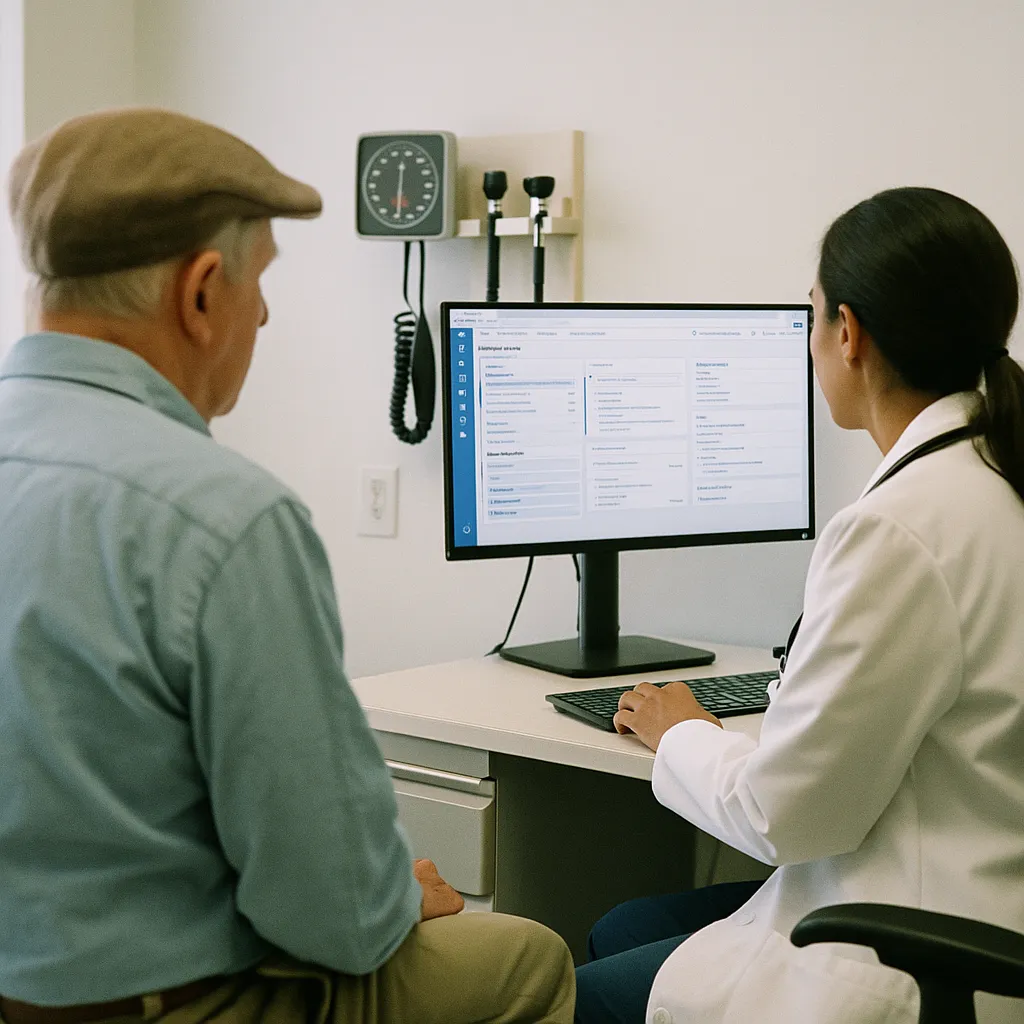
Hoppr and Nvidia built a foundation model approach that lets hospitals train clinical AI on hundreds of patient records instead of 100,000 — opening hospital-grade AI to community health systems.
Hoppr and Nvidia Just Collapsed the Data Requirement for Hospital AI from 100,000 Records to Hundreds
Hoppr and Nvidia have developed a foundation model approach that allows hospitals to train clinical AI on a few hundred patient records instead of the 100,000 previously considered the minimum viable threshold, according to MedCity News. That single change — a 99.9% reduction in required training data — directly removes the barrier that has kept diagnostic and predictive AI confined to major academic medical centers for the past five years.
Context
The 100,000-record floor wasn't arbitrary. Machine learning models trained on clinical data are statistically unreliable below certain thresholds — prone to overfitting (memorizing patterns in a small dataset rather than learning generalizable rules) and to amplifying demographic biases in underrepresented training populations. Large academic hospitals — Mayo Clinic, Cleveland Clinic, Mass General — have spent years assembling the massive, structured datasets required to produce models that actually work.
Community hospitals, rural health systems, and safety-net providers never had that option. They see different patient populations, have different disease prevalence rates, and often have the greatest need for AI-assisted clinical decision support — precisely because they operate with thinner specialist coverage. The data requirement locked them out of tools designed, in many cases, to solve their problems.
Foundation models — large AI systems pre-trained on broad datasets that can then be fine-tuned for specific tasks — have been disrupting this dynamic across industries. Hoppr and Nvidia's work applies that logic specifically to clinical environments with the constraints hospitals actually face.
How It Works
A foundation model is trained once, at scale, on a vast and diverse dataset. That pre-training imbues it with general knowledge about patterns, relationships, and structure in the domain — in this case, clinical data. A hospital then fine-tunes that pre-trained model on its own records. Because the model already "knows" the underlying domain, the fine-tuning process requires far fewer examples to produce reliable results.
Hoppr, a healthcare AI company focused on radiology and clinical imaging, built its approach on Nvidia's healthcare AI infrastructure. The technical collaboration targets a workflow where Nvidia's compute and model architecture handles the foundational training, while Hoppr's clinical data pipelines manage the fine-tuning layer that hospitals actually interact with.
Get this in your inbox.
Daily AI intelligence. Free. No spam.
The result: a community hospital with a few hundred relevant patient records can now deploy a locally-calibrated clinical AI model. Previously, that same hospital would have needed to either pool data with external partners (raising privacy and consent complications) or rely on generic models trained elsewhere — which often performed worse on local patient populations.
What Changes for Hospitals
Small and mid-size hospitals are the direct beneficiaries. A 200-bed regional hospital seeing a high prevalence of a specific condition — respiratory disease in a coal mining region, diabetes complications in a low-income urban system — can now train a model on its own patient cohort and deploy it for clinical decision support without a data-sharing agreement or a partnership with an academic center.
Diagnostic AI is the most immediate application. Radiology, pathology, and lab result interpretation are areas where AI has demonstrated consistent value but where local calibration matters — because what counts as "abnormal" varies with population and geography.
Predictive models — 30-day readmission risk, deterioration alerts, sepsis prediction — are the next layer. These are the tools that reduce preventable complications and hospital costs. They've been deployed at scale at large health systems for three to five years. Smaller systems have been watching from the outside.
Why This Matters Beyond the Technical
The United States has roughly 6,000 hospitals. The vast majority are not major academic centers. The AI tools that could reduce diagnostic errors, predict patient deterioration, and flag medication interactions have been deployed at a fraction of those facilities — those with the data, the technical staff, and the capital to build compliant AI programs.
Collapsing the data threshold doesn't eliminate all barriers. Hospitals still need the regulatory and compliance infrastructure, the clinical workflow integration, and the staff capacity to operate AI systems responsibly. But data volume has been the primary technical bottleneck. Removing it opens a realistic deployment path for thousands of facilities that have had no viable on-ramp.
If the results hold in production environments, this is the most consequential shift in the clinical AI access gap since the FDA began approving AI-assisted diagnostic tools in 2018.
What to Watch
The key question is validation. The approach works in controlled development conditions — the critical test is whether models trained on hundreds of records in real hospital environments perform at a clinically acceptable level across diverse patient populations. Peer-reviewed validation studies and early production deployments will determine whether this becomes an industry standard or remains a promising technique limited to specific use cases.
By Hector Herrera | NexChron | April 29, 2026
Did this help you understand AI better?
Your feedback helps us write more useful content.
Get tomorrow's AI briefing
Join readers who start their day with NexChron. Free, daily, no spam.