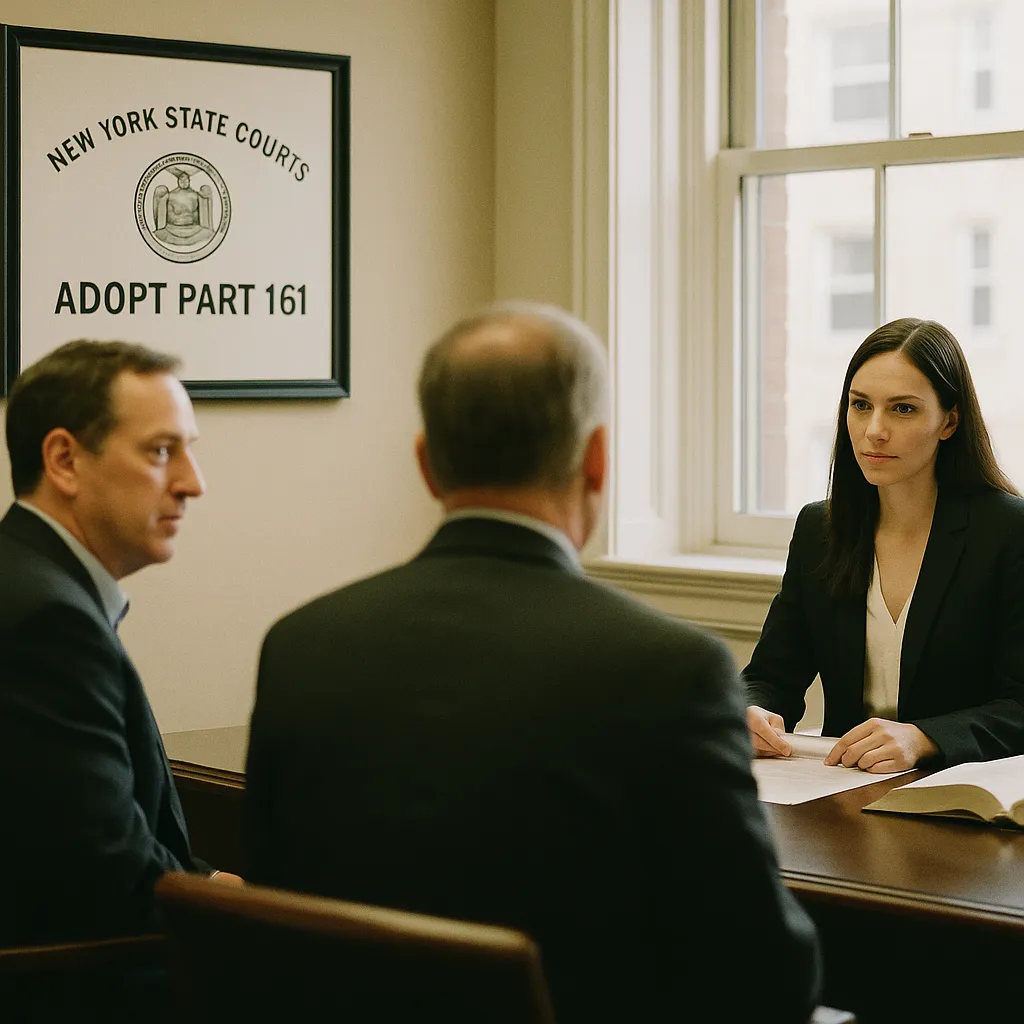
New York's court system codified AI rules effective June 1, 2026—attorneys may use AI to prepare filings but must independently verify submissions contain no fabricated cases or statutes.
New York State Courts Adopt Part 161: Attorneys Must Verify AI Submissions for Fabricated Cases
By Hector Herrera | June 17, 2026 | Legal
Disclaimer: This article covers a legal rule and is for informational purposes only. It is not legal advice. Attorneys should consult the official rule text and their professional responsibility obligations directly.
New York State's court system—one of the largest and most influential in the United States—formally codified how attorneys must handle AI-generated legal submissions as of June 1, 2026. Part 161 of the Rules of the Chief Administrator permits lawyers to use AI tools to help prepare court filings but places a direct professional responsibility obligation on each attorney to verify that AI-assisted submissions do not contain fabricated cases, statutes, or legal citations that don't exist.
The rule doesn't require disclosure that AI was used. It requires something more fundamental: that anything an attorney files in a New York state court is accurate, regardless of what tools generated the draft. That distinction matters because it places the accountability burden squarely on the practicing lawyer rather than on the AI vendor.
Why New York Acted
The rule didn't emerge from abstract concern. Courts across the US have seen a documented surge in AI-generated legal filings that contain fabricated case citations—a phenomenon lawyers and judges now refer to informally as "hallucinated citations." When a generative AI tool like ChatGPT or Claude drafts a legal brief, it sometimes invents plausible-sounding case names and citation numbers for cases that don't exist. Attorneys who file those briefs without verification have faced sanctions, fee awards against them, and in some instances case dismissals.
The most prominent early example was the 2023 Mata v. Avianca case in federal court, where a New York plaintiff's attorney filed a brief containing multiple AI-invented citations. The presiding judge sanctioned the attorneys involved. That case—and dozens of smaller incidents since—pushed courts nationwide to clarify their expectations.
Federal courts have moved in varied directions: some districts now require disclosure of AI use, others require certification that AI outputs have been verified. New York state courts chose a different approach with Part 161: no mandatory disclosure, but an explicit and enforceable verification obligation tied to existing professional responsibility rules.
What Part 161 Actually Requires
The rule does three things:
Get this in your inbox.
Daily AI intelligence. Free. No spam.
1. Permits AI use in legal preparation. Attorneys may use AI tools to research, draft, organize, and revise submissions for New York state courts. The rule does not prohibit, limit, or require disclosure of that use.
2. Requires independent verification. Before filing any AI-assisted submission, the attorney must independently verify that no content contains fabricated legal authority—cases that don't exist, statutes that don't say what the brief claims, or citations to real cases that don't stand for the propositions attributed to them.
3. Ties compliance to existing professional responsibility obligations. Part 161 is written to operate alongside the New York Rules of Professional Conduct, particularly rules governing candor toward tribunals and competent representation. A violation of Part 161's verification requirement is also a professional conduct violation, creating a dual accountability track: sanctions from the court and potential disciplinary proceedings from the attorney grievance system.
What Part 161 does not do is tell attorneys how to verify AI outputs. That's a practice management question, not a rule question. In practice, verification means reading every cited case, confirming that cited statutes say what the brief claims, and ensuring that any quotation or paraphrase is accurate. That is precisely the work that junior associates and legal researchers have traditionally done—and the work that firms exploring AI-assisted legal drafting are now trying to automate further.
The Enforcement Mechanism
Courts have two channels to enforce Part 161. First, judges can sanction attorneys whose filings contain fabricated or inaccurate AI-generated content under existing inherent court authority and Rule 11-equivalent provisions in state civil practice. Second, opposing counsel who discover AI-generated inaccuracies in an adversary's filing can bring those inaccuracies to the court's attention and move for sanctions, costs, or other relief.
The practical enforcement reality is that most Part 161 violations will surface through the adversarial process—opposing attorneys reviewing filings who notice that cited cases don't support the claimed propositions. In high-stakes commercial litigation, where opposing counsel routinely verify citations, the verification failure risk is acute. In less-adversarial proceedings or lower courts where filings receive less scrutiny, the rule may be harder to enforce.
What This Means for Law Firms
The New York bar has approximately 180,000 active attorneys, making this one of the largest single-jurisdiction AI compliance mandates in the US legal system. Large firms that have already deployed AI legal research tools—Westlaw AI, Lexis+ AI, Harvey, and others—will need to confirm that their verification workflows satisfy Part 161's requirements.
For smaller firms and solo practitioners who may be using general-purpose AI tools to reduce research and drafting costs, Part 161 imposes a clearer obligation than many practitioners previously understood: AI output is a starting point, not a finished product. Every citation that goes into a New York state court filing must be independently confirmed.
The practical implications:
- Law firms should document their AI verification protocols and ensure they apply systematically to all state court filings, not just federal ones.
- Legal AI vendors (Harvey, Casetext, EvenUp) will face questions from law firm clients about how their tools support compliance with verification requirements—potentially accelerating development of built-in citation-checking features.
- Courts in other states will watch New York's approach closely. The no-disclosure-required, verification-required structure may appeal to other jurisdictions that want accountability without mandating transparency about which tools attorneys use.
What to Watch
New York's Part 161 joins an accelerating national effort to create enforceable AI standards in legal proceedings. As of June 2026, federal district courts in jurisdictions including Texas, California, and Illinois have adopted AI disclosure or certification requirements, and the Judicial Conference of the United States is working toward model guidance for all federal courts. The outstanding policy question—whether courts should require disclosure of AI use or simply require verification of accuracy—is exactly what New York's approach tests.
The first enforcement actions under Part 161 will be closely watched by the legal profession. Sanctions that cite the rule explicitly, rather than general candor obligations, will give it precedential weight and accelerate adoption of formal AI verification protocols across the state bar.
— Hector Herrera
Did this help you understand AI better?
Your feedback helps us write more useful content.
Get tomorrow's AI briefing
Join readers who start their day with NexChron. Free, daily, no spam.