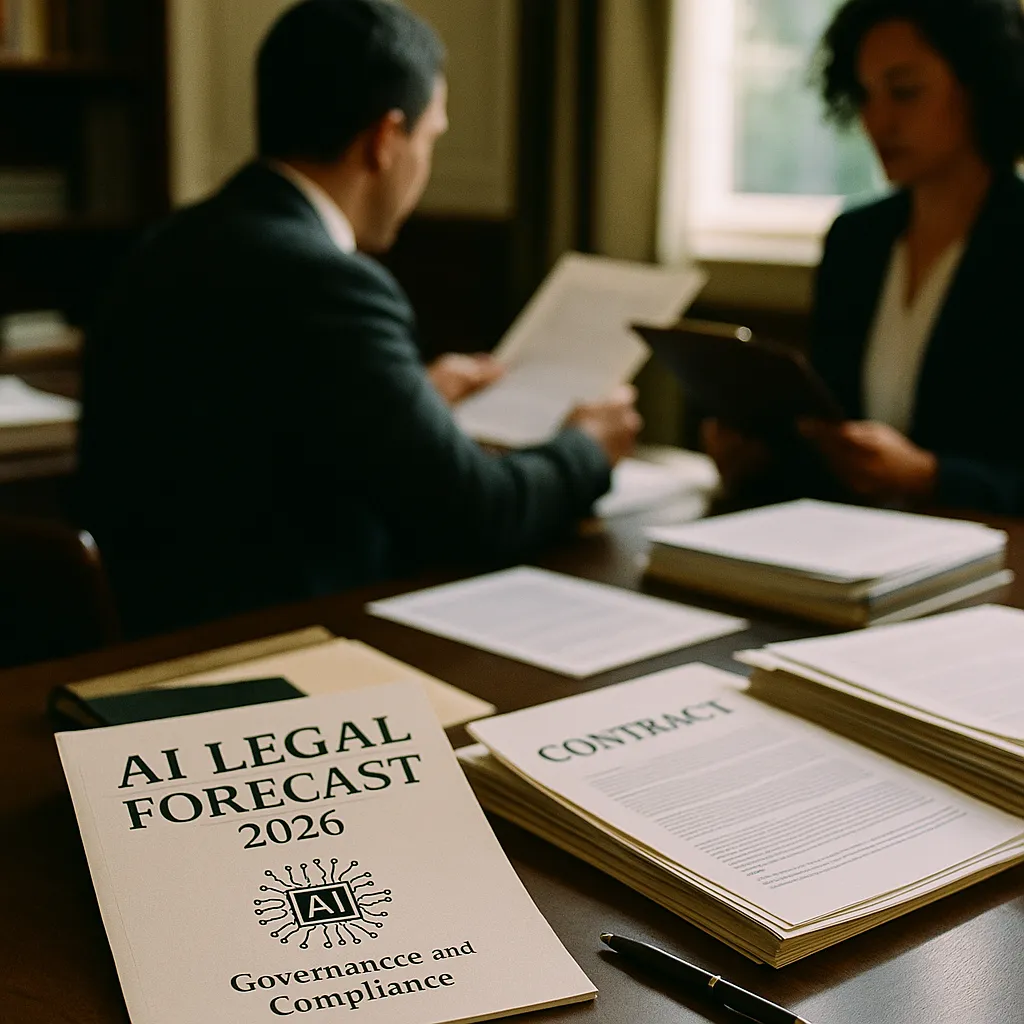
Baker Donelson's 2026 AI legal forecast marks a clear inflection: the industry has moved from experimentation to governance as the defining challenge, driven by autonomous AI agents that can execute contracts and stress-test agency law.
AI Legal Forecast 2026: Governance and Compliance Replace Experimentation as the Core Challenge
By Hector Herrera | May 25, 2026 | Legal
The legal industry's AI story has moved through three distinct phases in three years: experimentation in 2024, accountability in 2025, and now — in 2026 — governance as the defining challenge. That's the central finding of Baker Donelson's 2026 AI Legal Forecast, which maps how autonomous AI agents capable of executing code, signing contracts, and booking transactions are stress-testing legal frameworks that were built for human actors.
The practical consequence: general counsels who have been watching AI develop from a safe distance are now being pushed — by boards, regulators, and insurers — to develop purpose-built governance strategies before compliance deadlines arrive.
How We Got Here
Law firms and in-house legal teams spent 2024 testing AI tools, primarily for document review, contract analysis, and legal research. The tools were impressive enough to adopt; the governance frameworks were sparse enough to ignore.
2025 changed the tone. Courts began issuing sanctions for AI-generated hallucinations in legal filings. Regulators published first guidance. A handful of high-profile incidents — AI-drafted contracts with material errors, autonomous agents that committed to transactions without authorization — made liability concrete rather than theoretical.
In 2026, Baker Donelson's forecast finds the industry at a different inflection: AI obligations are no longer future risks to manage — they're current compliance requirements to meet. The window for treating AI governance as optional closed.
The Three Pressure Points Reshaping Legal AI Strategy
1. Autonomous agents and the limits of agency law
Traditional legal frameworks assume a human or corporate principal behind every action. An agent — whether a lawyer, employee, or contractor — acts on behalf of a principal, and liability runs back to that relationship. Agentic AI systems don't map cleanly onto this structure.
When an AI agent independently drafts and sends a legal communication, executes a financial transaction, or commits to a contractual term during an automated negotiation, who authorized the action? Courts are increasingly being asked to answer that question — and the answers are inconsistent. Baker Donelson's forecast flags that unauthorized autonomous actions and AI hallucinations that result in material errors are the liability scenarios with the most active litigation in 2026.
Get this in your inbox.
Daily AI intelligence. Free. No spam.
For legal teams, this means any AI system that can "act" — not just analyze — requires explicit authorization boundaries, audit trails, and clear documentation of who is responsible when the system acts outside its intended scope.
2. Compliance deadlines are arriving, not approaching
The EU AI Act's requirements for high-risk AI deployments are no longer theoretical. Organizations using AI in hiring, credit decisions, legal judgments, and critical infrastructure are subject to documentation, transparency, and oversight requirements that took effect in 2025 and are now being enforced.
At the US state level, Colorado, Connecticut, and a growing list of jurisdictions have enacted AI governance frameworks. These laws apply based on where consumers are located, not where a company is headquartered — which means a company based in Texas that uses AI in decisions affecting Connecticut residents must comply with Connecticut's AI rules. Baker Donelson's forecast notes that multi-jurisdiction AI compliance is now a standard problem for mid-size companies, not just multinationals.
3. General counsel as AI governance owner
Perhaps the most significant organizational shift Baker Donelson identifies: AI governance has landed on the general counsel's desk as a primary responsibility. Three years ago, AI risk sat in IT or innovation teams. In 2026, boards are asking legal to certify AI risk management, insurers are requiring AI governance documentation as a condition of coverage, and regulators are treating legal oversight as the expected control.
What purpose-built AI governance looks like in practice:
- AI use policies that distinguish what employees can use AI for, under what conditions, and with what disclosure requirements
- Vendor due diligence frameworks that assess AI suppliers not just for capability but for liability allocation, data handling, and audit rights
- Contract clauses addressing AI liability — who is responsible when a counterparty's AI system makes an error that affects your transaction
- Audit trails for automated decisions that may be subject to regulatory scrutiny or litigation discovery
What This Means for Businesses Beyond Legal Departments
The governance pressure Baker Donelson describes in the legal sector is indicative of a broader shift. Companies that deployed AI in 2024-2025 without systematic governance are now retrofitting policies to meet obligations — often more expensively than building governance in from the start would have been.
The cost of retrofitting isn't just financial. It's operational: pausing or restricting AI systems while governance frameworks are built, retraining staff on new use policies, renegotiating vendor contracts that didn't account for AI liability.
Companies that treated 2024 and 2025 as learning years and embedded governance discipline then are in a substantially better position in 2026 than those that treated AI as a pure capability race with governance as friction.
What to Watch
The second half of 2026 will test whether state AI governance laws survive preemption pressure. Industry lobbying for a federal AI framework — one that would preempt state laws and create a single national standard — is intensifying. Whether Congress acts, and what a federal standard looks like, will determine whether today's multi-jurisdiction compliance burden simplifies or compounds.
Also watch the court docket. Every judicial ruling on AI liability, authentication standards for AI-generated documents, and attorney responsibility for AI-generated filings is creating the case law that will define the governance baseline for the next decade. The rules being written now — by courts, legislatures, and regulators — will be much harder to change once they calcify.
Hector Herrera covers AI, governance, and the legal frameworks shaping how intelligent systems operate. Follow NexChron for daily AI intelligence.
Did this help you understand AI better?
Your feedback helps us write more useful content.
Get tomorrow's AI briefing
Join readers who start their day with NexChron. Free, daily, no spam.