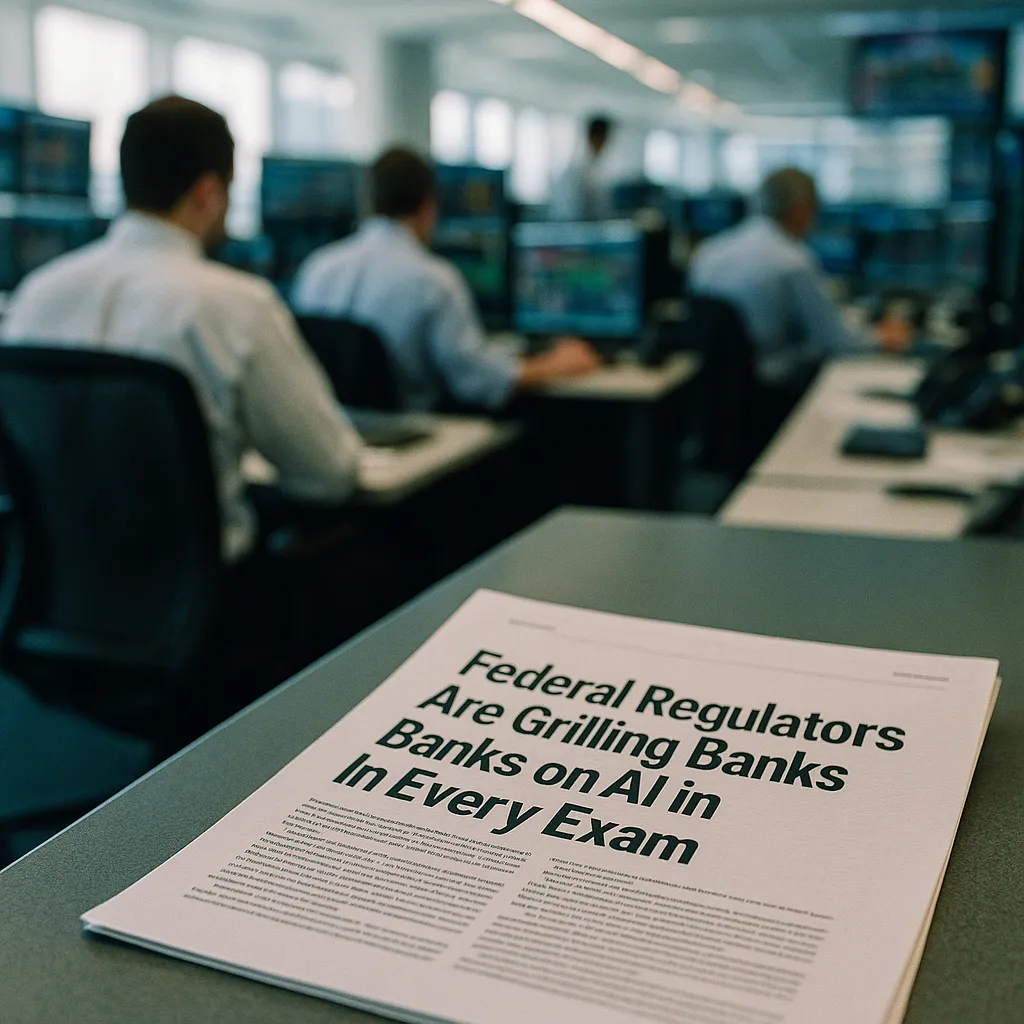
Major banks have crossed a threshold in 2026: autonomous AI agents are running in production across lending, fraud detection, and compliance — not just pilots.
Banks Are Deploying Autonomous AI Agent Fleets at Production Scale in 2026
Major banks have crossed a threshold in 2026: AI is no longer confined to pilots and proofs of concept. Autonomous agents — AI systems that take actions, make decisions, and complete multi-step workflows without human intervention — are now running in production across customer onboarding, loan processing, fraud detection, and compliance operations at some of the world's largest financial institutions.
FinTech Futures reports the industry has reached an inflection point where the question is no longer whether to deploy AI agents but how fast to scale them — and how to manage the risk of systems that learn and act continuously without a human in the loop for every decision.
From Pilots to Fleets
The pattern of the last three years was familiar: a bank would run an AI proof of concept in one department, demonstrate cost savings or speed improvements, and then face a multi-year slog to move it into production across the organization. Internal procurement, compliance review, integration with legacy core banking systems, and regulatory approval all slowed the pace.
That bottleneck is clearing in 2026. Analysts tracking the sector describe a structural shift: instead of deploying individual AI tools, banks are now building coordinated fleets of autonomous agents — systems that can hand tasks to one another, escalate exceptions to human reviewers, and continuously update their behavior based on outcomes.
A customer applying for a mortgage might have their application reviewed by an agent that pulls and analyzes credit data, a second agent that flags risk factors based on internal models, a third that cross-references regulatory requirements for the jurisdiction, and a fourth that drafts the final recommendation — all before a human loan officer sees the file. The human's role shifts from processing to reviewing and overriding.
The Numbers
The financial sector's AI investment is substantial and accelerating. According to FinTech Futures, the AI market in banking is projected to grow from $38 billion in 2024 to $190 billion by 2030 — a compound annual growth rate that reflects both the depth of AI integration already underway and the runway still ahead.
The use cases generating the most investment in 2026:
Get this in your inbox.
Daily AI intelligence. Free. No spam.
- Fraud detection and prevention — real-time transaction monitoring by agents that can identify novel fraud patterns without predefined rules
- Customer onboarding — automated KYC (know your customer) and identity verification, reducing onboarding time from days to minutes
- Loan underwriting — agents that pull, score, and synthesize data across income, credit, collateral, and market conditions
- Regulatory compliance — continuous monitoring of transactions and communications for compliance violations, replacing periodic manual audits
- Customer service — autonomous agents handling account inquiries, dispute initiation, and routine service requests end-to-end
What Changes When AI Agents Scale
The shift from isolated AI tools to coordinated agent fleets changes the operating model of a bank in ways that aren't always visible from the outside.
Speed compresses dramatically. Decisions that took days now take minutes. Loan applications that required five business days of processing can complete in under 30 minutes when agents handle the intake, verification, scoring, and documentation pipeline.
Error patterns change. Human processors make individualized mistakes. AI agents make systematic ones — the same error applied consistently across thousands of cases until it's caught and corrected. This means quality control requires a different discipline: less about catching individual mistakes and more about monitoring for drift, bias, and failure modes at scale.
Accountability becomes harder to trace. When multiple agents each contribute to a decision, it can be difficult to reconstruct why a specific outcome occurred. Regulators in the U.S. and EU are increasingly focused on this challenge, requiring banks to maintain explainable audit trails for automated credit and compliance decisions.
Workforce composition shifts. Banks deploying agent fleets are reporting that the roles most affected aren't front-line tellers — it's back-office processing functions: loan operations staff, compliance reviewers, and data entry roles. The work doesn't disappear, but the volume of manual processing drops sharply.
The Risks the Industry Is Managing
Production-scale AI agents in banking introduce risks that weren't present in the pilot phase. Among the concerns FinTech Futures flags:
Model drift — AI agents that learn continuously can gradually shift their behavior in ways that introduce bias or regulatory exposure. Banks need monitoring infrastructure that detects behavioral drift before it produces regulatory violations or discriminatory outcomes.
Concentration risk — if multiple major banks source their agents from the same AI vendors, a failure or vulnerability in a shared model could create correlated risk across the financial system simultaneously.
Regulatory lag — the pace of agent deployment is currently faster than the pace of regulatory guidance. Banks are making autonomous agent decisions now in areas where the rules about explainability, human review requirements, and liability haven't been fully settled.
What to Watch
The next test for production-scale banking AI is how it performs in a period of market stress. Agents trained on benign credit conditions may behave unpredictably when defaults spike or liquidity tightens. Regulators at the Federal Reserve and OCC are watching this closely. Expect guidance on autonomous agent governance in financial services before the end of 2026 — banks that have invested in audit infrastructure and explainability tooling will be better positioned when the rules arrive.
By Hector Herrera
Did this help you understand AI better?
Your feedback helps us write more useful content.
Get tomorrow's AI briefing
Join readers who start their day with NexChron. Free, daily, no spam.