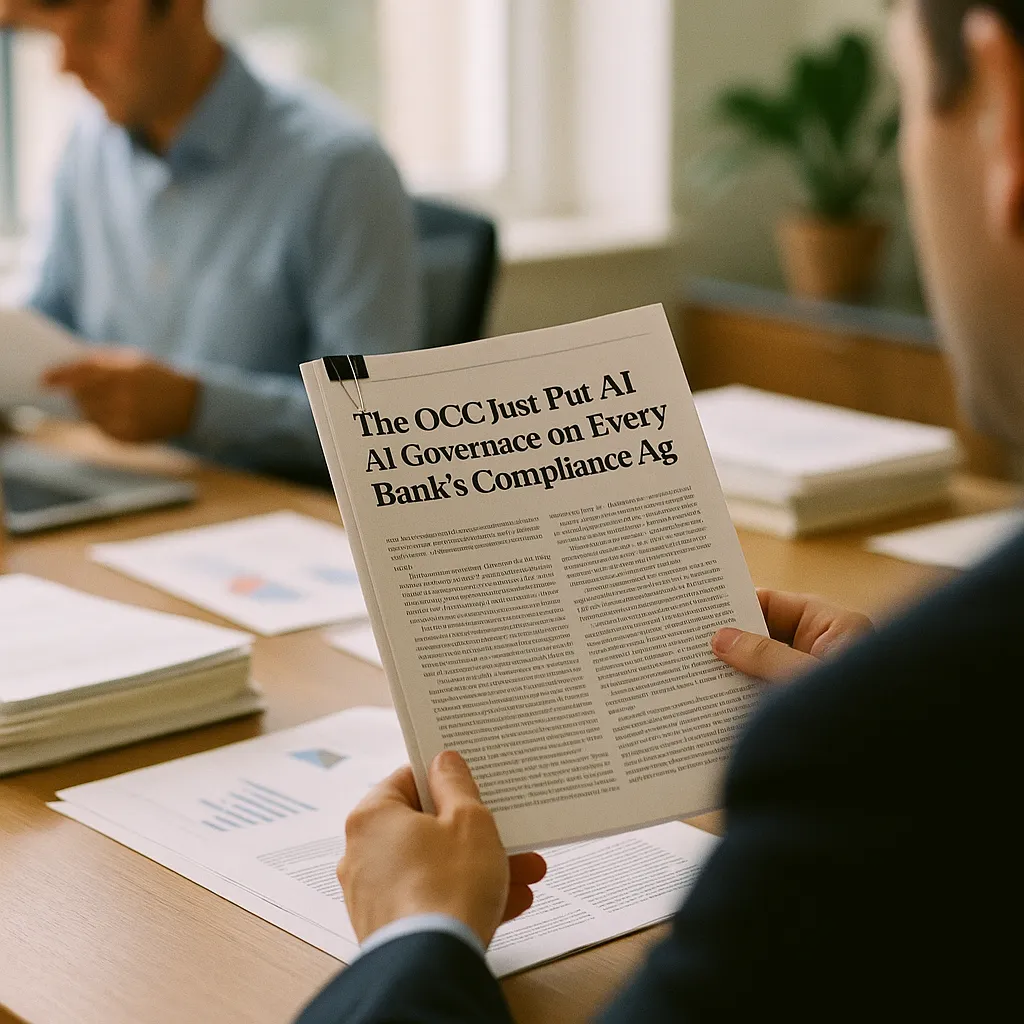
The country's top bank regulator just declared AI is "significantly transforming" cybersecurity—and banks that can't document their AI decision-making are now squarely in regulators' crosshairs.
The OCC Just Put AI Governance on Every Bank's Compliance Agenda
By Hector Herrera | May 22, 2026
The Office of the Comptroller of the Currency (OCC)—the federal regulator that charters and supervises national banks—has signaled in its May 2026 Semiannual Risk Perspective that formal AI model governance guidance is coming. Banks that have not yet built documentation frameworks for their AI systems should treat that signal as a fire alarm. The OCC does not publish risk perspectives without follow-up action.
What the OCC Said
According to Consumer Finance Insights, the OCC's spring 2026 report declared that AI is "significantly transforming" the cybersecurity threat landscape for national banks. The agency identified two distinct vectors:
Offensive AI: AI tools are lowering the technical bar for fraud, phishing, and synthetic identity creation—enabling attackers who previously lacked the skill to execute sophisticated attacks at scale. The cost of a convincing spear-phishing campaign has dropped dramatically. Synthetic identity fraud, where AI generates plausible-looking identity documents backed by real data fragments, is accelerating.
Defensive AI: Banks are deploying AI to detect anomalies, flag suspicious transactions in real time, and respond to threats faster than human analysts can operate. These systems are increasingly the first and last line of defense for transaction monitoring.
The dual-edged nature of AI in bank security isn't new analysis. What's new is the OCC naming it explicitly in a Semiannual Risk Perspective while simultaneously signaling that formal AI model governance guidance for national banks is in preparation. That pairing is a regulatory tell.
Get this in your inbox.
Daily AI intelligence. Free. No spam.
The Documentation Gap
Many banks have been deploying AI in credit decisions, fraud detection, and customer-facing applications for years. The governance challenge is that many of these systems were built before robust documentation standards existed—or before anyone expected regulators to ask hard questions about them.
Regulators want audit trails that answer:
- What data did the model use to produce this output?
- What was the decision threshold—at what score does the model say yes versus no?
- Who approved this model for production use?
- How is the model monitored for performance drift over time?
- What happens when it produces a wrong answer at scale?
Banks that built AI systems in 2022 and 2023 are now in the position of retroactively constructing governance documentation for systems already running in production. That is harder and more expensive than building governance in from the start, and it creates legal exposure if the documentation is incomplete when regulators come asking.
The Fair Lending Dimension
The OCC's concern isn't limited to cybersecurity. AI models that influence credit decisions—who gets a loan, at what rate, under what terms—are subject to the Equal Credit Opportunity Act (ECOA), the Fair Housing Act, and other fair lending statutes that fall squarely within OCC supervisory authority.
If an AI model ingests behavioral data, alternative credit signals, or other non-traditional inputs to score creditworthiness, banks need to be able to demonstrate that the model is not producing discriminatory outcomes by race, gender, national origin, or other protected characteristics. That requires purpose-built explainability tooling—the ability to decompose a model's output into the inputs that drove it.
Most large banks have this capability for traditional scorecards. Many do not have it fully operational for the machine learning models that have been layered in over the past three years.
What to Watch
Expect formal OCC AI guidance in the second half of 2026. The most likely framing will treat AI systems as a subset of existing model risk management frameworks—specifically the Federal Reserve's SR 11-7 guidance and the OCC's own 2011-12 guidance, both of which govern model validation and risk management—with AI-specific addenda covering explainability, ongoing monitoring, and vendor AI risk.
Banks with concentrated AI exposure in credit underwriting and fraud detection should be building model inventories, audit trails, and human review thresholds now, before formal guidance lands and creates a retroactive compliance gap. The window for getting ahead of this voluntarily is measured in months, not years.
Source: Consumer Finance Insights
Did this help you understand AI better?
Your feedback helps us write more useful content.
Get tomorrow's AI briefing
Join readers who start their day with NexChron. Free, daily, no spam.