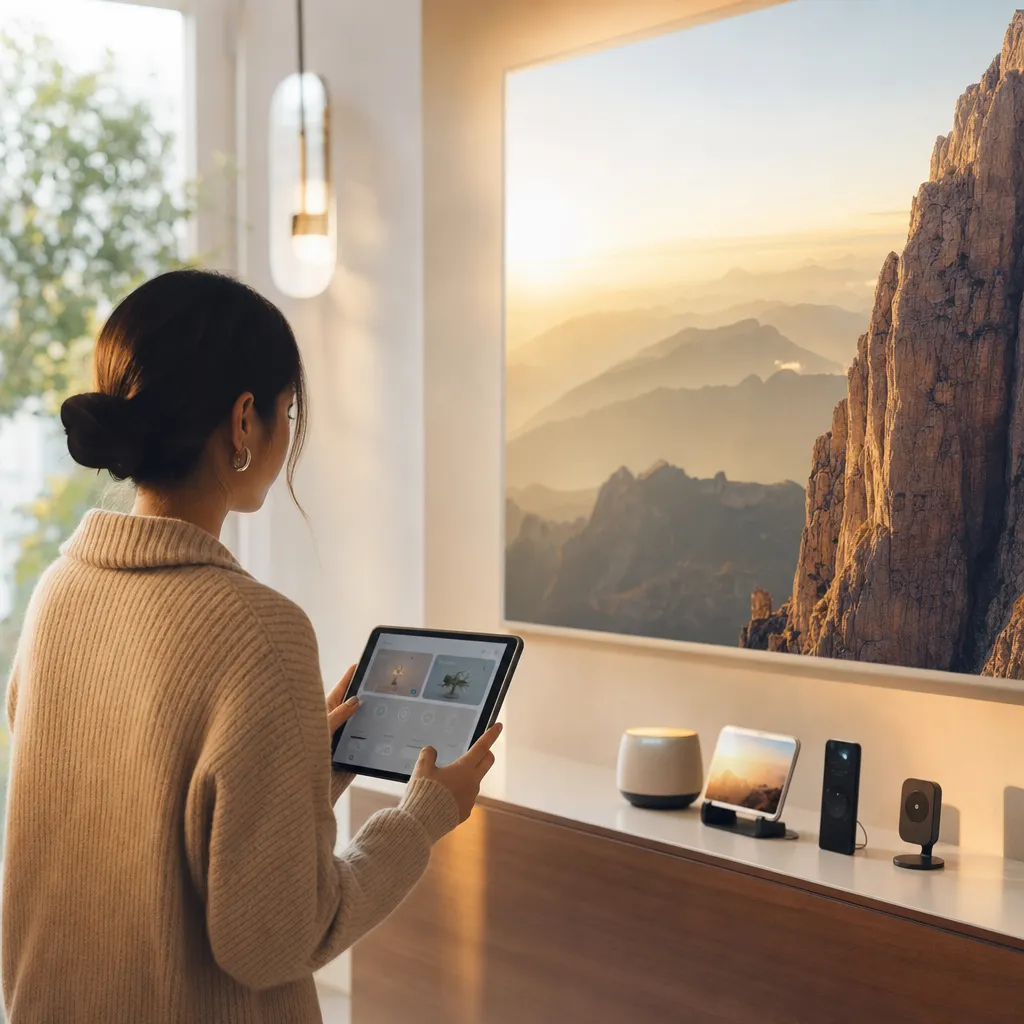
Samsung announced an experimental ChatGPT integration for SmartThings, enabling natural language control of connected appliances, thermostats, lights, and locks — positioning the platform as AI-agnostic.
Samsung announced an experimental integration of ChatGPT with its SmartThings home automation platform, enabling users to control connected appliances, thermostats, lights, and locks through natural language conversation with OpenAI's assistant. The move positions SmartThings as AI-agnostic — accepting external models alongside Samsung's native Bixby — and accelerates a pattern emerging across every major smart home platform.
What the Integration Does
According to the Korea Herald, Samsung's ChatGPT integration for SmartThings allows users to:
- Control connected devices via natural language — "turn off everything in the bedroom except the air purifier" rather than navigating menus or setting up separate automations
- Ask contextual questions about home status — "is my front door locked?" or "what temperature is the living room right now?"
- Set up complex automations in plain language rather than through rule-building interfaces that require multiple steps
- Chain multi-device commands across different SmartThings device categories in a single instruction
The integration is currently experimental and accessible through the SmartThings app for users who connect their OpenAI account. Samsung described it as a preview feature, suggesting broader rollout is contingent on performance and user feedback.
Bixby, Samsung's own AI assistant, remains the primary smart home AI for most SmartThings functions. ChatGPT is being positioned as an optional enhancement — a third-party upgrade path, not a Bixby replacement.
Why Platform Openness Is the Strategy Now
This move follows similar third-party AI integrations by Google Home and Amazon Alexa in 2026. The pattern signals a structural shift in smart home AI strategy:
Smart home platforms are becoming AI connectors, not AI builders. Rather than each platform racing to build the most capable AI assistant in-house, the leading platforms are opening up to external AI while retaining control of the device integration layer — the proprietary piece that actually translates AI commands into device actions (which requires deep hardware partnerships, protocol expertise, and years of ecosystem development).
Get this in your inbox.
Daily AI intelligence. Free. No spam.
For users, this means:
- Choice between AI models — the assistant you prefer can run your home
- Richer natural language understanding — ChatGPT's conversational capabilities exceed what Bixby has historically offered for complex multi-step or ambiguous requests
- Continuity with other ChatGPT use — users already familiar with ChatGPT's behavior and limitations can apply the same interaction patterns to home automation
For Samsung, the strategic value is retaining SmartThings users who might otherwise migrate to competing platforms with more capable native AI, while avoiding the cost and development timeline of building a ChatGPT-equivalent in-house.
The Competitive Context
The smart home market has consolidated around a few platform layers:
- Device protocols: The Matter standard (backed by Apple, Google, Amazon, and Samsung) has largely solved interoperability at the device connection level
- AI command layer: This is where new competition is emerging — which AI models power voice and text control
- Platform value: The control app, automation engine, and ecosystem lock-in remain the primary competitive moats
Samsung's SmartThings has the second-largest smart home platform by installed device base after Amazon Alexa, with an estimated 180 million connected devices globally. Opening that platform to ChatGPT gives OpenAI significant real-world integration surface at no acquisition cost — and gives Samsung a claim to being the most AI-flexible major smart home ecosystem. Both parties benefit.
Google's move in this direction — integrating Gemini with Google Home as the primary assistant while also opening APIs for third-party model access — provides the template. Amazon has taken a slightly different approach with Alexa+, emphasizing its own model upgrades rather than third-party openness.
Privacy Considerations
The experimental status of this integration comes with a caveat worth attention. Routing home automation commands through OpenAI's servers means OpenAI receives data about home device states, usage patterns, and potentially audio input depending on how the integration is structured.
Samsung has not yet published a detailed privacy policy for the ChatGPT integration specifically. Users controlling security-sensitive devices — locks, cameras, alarm systems — through the integration should review data handling disclosures before opting in. The question is not whether this integration is trustworthy; it's whether the data flow is what users would choose if they understood it explicitly.
What to Watch
The metric that determines whether this remains a preview feature or becomes a core SmartThings capability: whether Samsung adds ChatGPT integration to the main SmartThings app navigation. Right now it requires deliberate opt-in and account linking — the signal for a full rollout is when it surfaces as an onboarding default.
The broader trend to watch: as Matter-compatible devices proliferate and AI model capabilities improve, the smart home market's value may shift from "which platform has the best hardware compatibility" (largely solved) to "which platform has the best AI layer." That shift favors platforms willing to integrate best-in-class AI rather than building it internally — which is exactly what Samsung's move here signals.
Did this help you understand AI better?
Your feedback helps us write more useful content.
Get tomorrow's AI briefing
Join readers who start their day with NexChron. Free, daily, no spam.