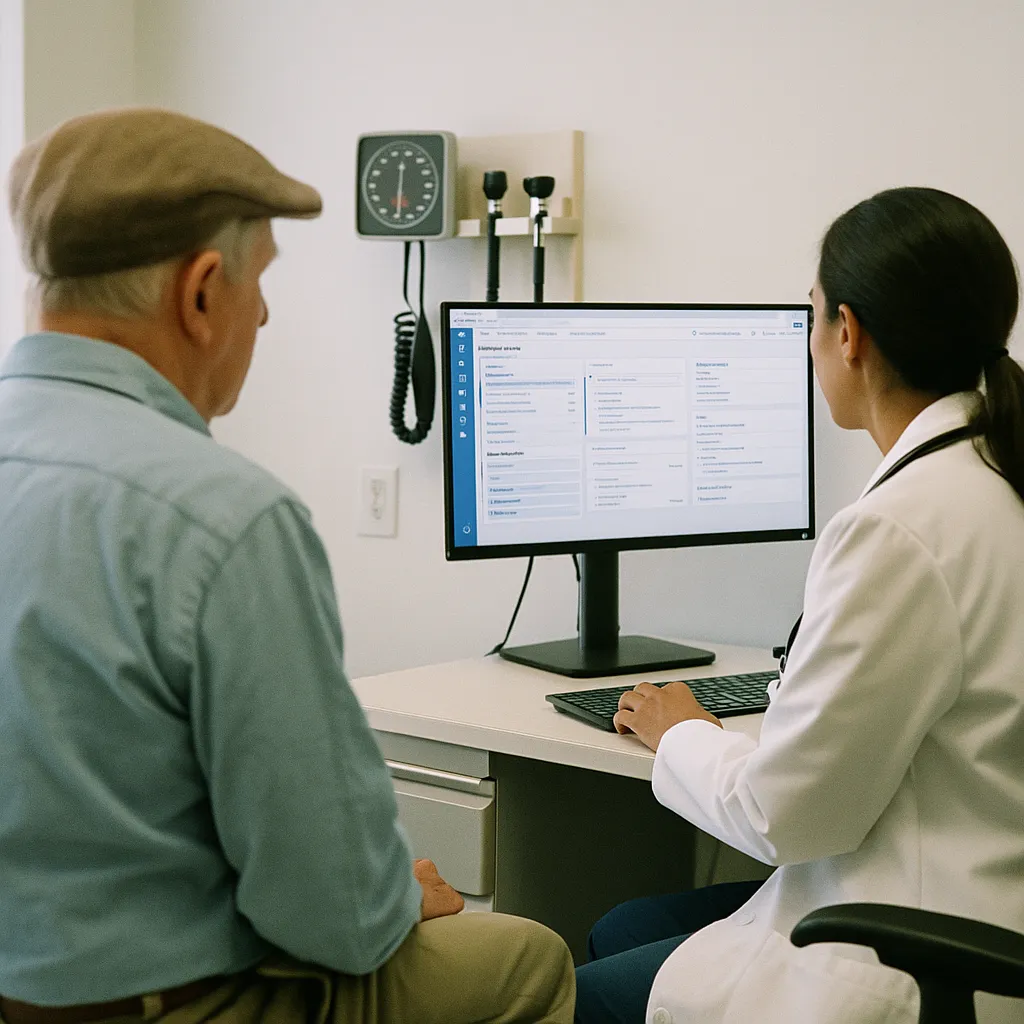
OpenAI and Anthropic both launched dedicated clinical healthcare product lines this week, marking the moment frontier AI labs stop treating medicine as a downstream use case and start treating it as a strategic vertical with the FDA having cleared more than 1,000 AI clinical tools.
OpenAI and Anthropic Both Launch Dedicated Clinical Healthcare Product Lines
By Hector Herrera | June 16, 2026 | NexChron.com
OpenAI and Anthropic both launched dedicated healthcare product lines this week — simultaneously and independently — marking the moment frontier AI labs stop treating medicine as a downstream use case and start treating it as a strategic vertical. With the FDA having cleared more than 1,000 AI-powered clinical tools to date, the race to own clinical AI infrastructure has become the new model-capability arms race.
The context: For the past three years, AI in healthcare meant one of two things: a startup building a narrow diagnostic tool, or a hospital IT department quietly deploying a general-purpose model through an enterprise agreement. What has changed is that the two leading frontier labs are now building healthcare-specific product lines with dedicated go-to-market, regulatory positioning, and clinical workflow integration. That is a different level of commitment — and a different level of market signal.
What Each Company Launched
According to the AI in [Healthcare and](/health/ge-healthcare-deephealth-ai-breast-screening) Digital Health digest for June 15, the launches are:
OpenAI:
- A dedicated clinical workflow product line targeting documentation, prior authorization, clinical decision support, and patient communication automation
- The offering is positioned at health system CIOs and clinical operations teams, not individual clinicians
- The launch follows OpenAI's earlier integration with Epic Systems and its work with hospital networks on ambient documentation tools
Anthropic:
- Claude for Healthcare — targeting clinical operations, patient safety documentation, and care coordination
- Claude for Life Sciences — targeting drug development workflows, regulatory submission preparation, and research synthesis
- Both products incorporate Anthropic's constitutional AI framework as a safety layer for high-stakes clinical decisions
The two product lines are distinct in positioning. OpenAI is going after workflow efficiency inside existing health system infrastructure. Anthropic is going after both clinical operations and the drug development pipeline — a wider surface area, with higher regulatory complexity.
Why the FDA's 1,000-Clearance Milestone Matters
The FDA's clearance of more than 1,000 AI-powered clinical tools is not just a milestone number — it is a market maturation signal. Regulatory clearance is the unlock condition for clinical AI. Without it, AI tools can assist but cannot be formally positioned as clinical decision support in contexts where reimbursement, liability, and documentation requirements apply.
Get this in your inbox.
Daily AI intelligence. Free. No spam.
The 1,000-clearance threshold means:
- The regulatory pathway is now well-understood and repeatable
- Health systems have established procurement and validation frameworks for AI clinical tools
- Insurance and reimbursement codes are beginning to account for AI-assisted procedures in some specialties
For OpenAI and Anthropic, this means they are entering a market that has crossed from experimentation into institutionalization — the hardest part of the regulatory groundwork has already been done by the companies that preceded them.
The Strategic Logic
Why are both companies moving simultaneously? Three forces are converging:
1. Revenue ceiling on consumer and SMB AI. The consumer AI market is increasingly competitive and margin-thin. Healthcare, by contrast, involves multi-year institutional contracts, high switching costs, and reimbursement-linked revenue that compounds over time. Health systems that build workflows around a specific AI vendor are not going to switch easily.
2. The safety positioning advantage. Both companies have leaned heavily on safety and reliability as differentiators from open-source and Chinese competitors. Healthcare is the environment where that positioning translates most directly into purchasing decisions. A hospital system choosing between Claude for Healthcare and a general-purpose API wrapper has a clear fiduciary reason to choose the former.
3. The life sciences pipeline is enormous. Anthropic's Claude for Life Sciences targets drug development — a sector where a single approved drug can generate billions in annual revenue, and where AI-assisted trial design, regulatory submission, and research synthesis can meaningfully compress development timelines. The addressable market in pharma and biotech AI is measured in tens of billions of dollars annually.
What Health Systems Should Know
The simultaneous launch from two frontier labs does not mean the products are equivalent or ready for all clinical use cases.
Key considerations for health system CIOs evaluating these offerings:
- HIPAA compliance infrastructure must be explicitly verified — neither "Claude for Healthcare" nor OpenAI's clinical tools should be assumed to be HIPAA-compliant without a signed Business Associate Agreement and a review of data handling terms
- Clinical validation data for specific workflows should be requested before deployment; general model capability benchmarks do not substitute for clinical task-specific performance studies
- Integration complexity with EHR systems (Epic, Cerner/Oracle Health, Meditech) varies significantly; ask for reference health systems on the same EHR before committing
- Liability allocation in the event of an AI-assisted clinical error remains legally unsettled; contracts should be reviewed for indemnification terms
The healthcare AI reimbursement wall — insurers' reluctance to reimburse AI-assisted services without outcome data — remains a significant adoption friction point that these product launches do not eliminate.
What to Watch
Both launches will be tested by health system procurement cycles that move slowly. The real indicator of success will be announced partnerships with major health networks and academic medical centers over the next 12 months. Watch also for FDA engagement: if either company positions its clinical tools as clinical decision support software (CDSS) rather than productivity tools, that triggers a regulatory pathway with its own timeline and requirements. The distinction between "tool that helps clinicians document" and "tool that supports clinical decisions" will become a significant commercial and legal line over the next year.
Sources: LucidQuest Ventures AI in Healthcare Digest — June 15, 2026 | Healthcare AI reimbursement wall
Did this help you understand AI better?
Your feedback helps us write more useful content.
Get tomorrow's AI briefing
Join readers who start their day with NexChron. Free, daily, no spam.