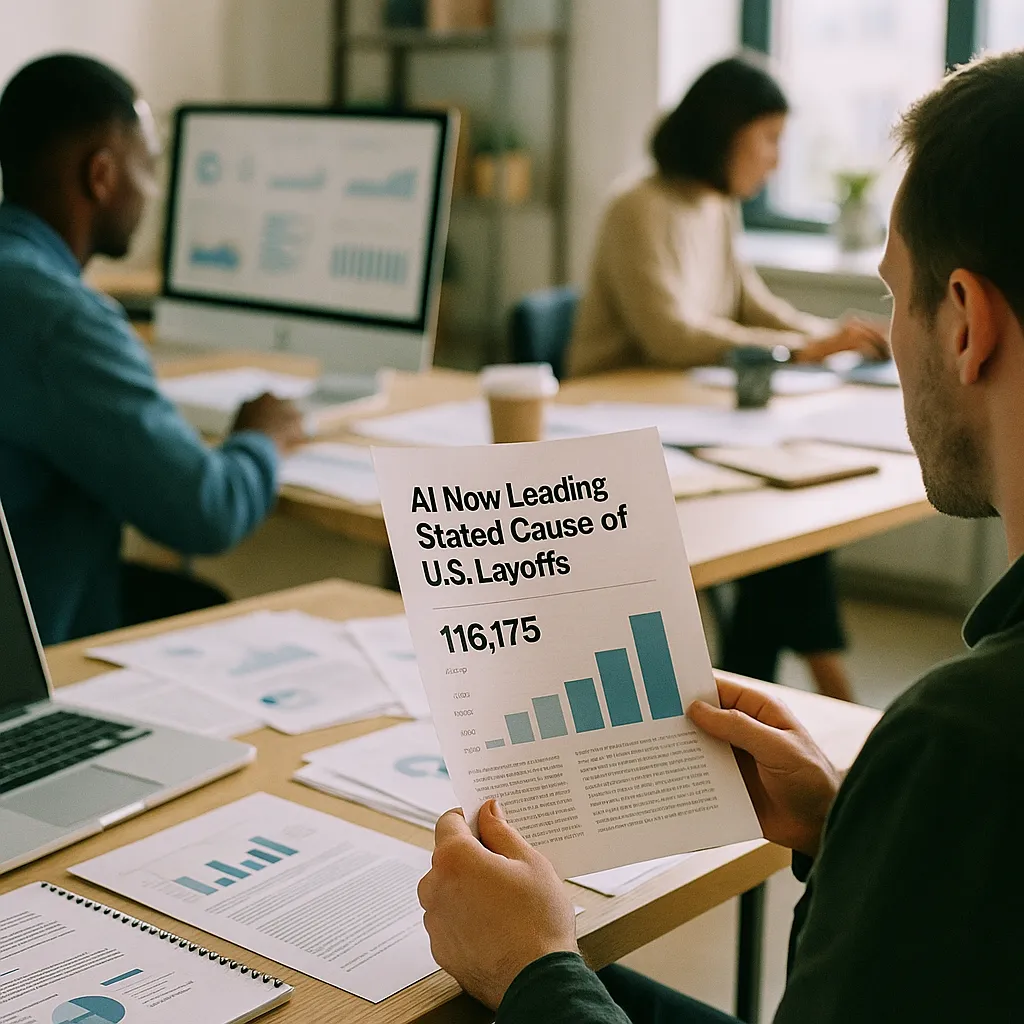
AI isn't eliminating jobs wholesale — it's removing the entry-level tasks that teach people how to do their jobs, quietly destroying the career ladders that made white-collar professions accessible.
AI Is Erasing the Entry-Level Job — and the Career Ladder That Came With It
By Hector Herrera | May 12, 2026
AI is not eliminating jobs at the scale economists feared — but it is systematically removing the entry-level work that taught people how to do their jobs. That distinction, documented in a CNN investigation published this week, may prove more consequential for long-term workforce health than headline job loss numbers suggest.
The pattern: companies keep senior employees to supervise AI systems while cutting junior and mid-level positions. The AI writes the first draft. The AI builds the initial code. The AI produces the baseline analysis. A senior person reviews and ships it. The junior person who would have spent three years learning by doing those tasks never gets hired.
Why This Is Different From Normal Automation
Every wave of workplace automation eliminated tasks. The spreadsheet replaced the bookkeeper's arithmetic. Word processing eliminated the typing pool. This was always painful for those displaced, but the pattern historically produced new roles for new entrants — different tasks emerged as old ones disappeared.
What's different now is the specificity of what's being removed. Previous automation targeted repetitive, lower-skill tasks. AI in 2026 is highly capable at exactly the tasks that constitute early-career learning: writing first drafts, building initial code, generating preliminary research, producing analysis from structured data. These aren't just jobs — they're the apprenticeship layer of white-collar professions.
Law firms used to hire associates to research memos. Those associates became partners. Consulting firms hired analysts to build decks. Those analysts became principals. Media organizations hired junior reporters to chase sources and write briefs. Those reporters became editors. The learning happened in the doing.
The Pattern Across Industries
The CNN report documents consistent behavior across sectors:
Law: Firms are reducing associate hiring while maintaining partner headcount. AI handles document review, initial contract drafting, and case research. Associates used to do that work for three to seven years before becoming substantively useful in negotiations or courtrooms.
Finance: Investment banks and consulting firms are cutting analyst classes — the entry-level cohorts that historically fed the entire career pipeline. AI generates financial models, sector analyses, and first-pass due diligence.
Software: Junior developer roles are shrinking as AI code generation handles boilerplate, initial feature builds, and bug fixes. Senior engineers review and merge. The junior developer who would have spent two years learning the codebase by writing it doesn't get onboarded.
Get this in your inbox.
Daily AI intelligence. Free. No spam.
Media and content: Editorial assistants, junior writers, and research staff positions are being eliminated at scale. AI generates drafts; editors supervise and publish.
What the Data Shows
The workforce impact is not yet visible in aggregate unemployment numbers — which remain near historic lows in most developed economies — because the effect is a hiring slowdown, not mass termination. Companies aren't firing their junior staff en masse; they're not replacing them when they leave, and they're reducing incoming class sizes dramatically.
This makes it almost invisible in unemployment statistics while quietly restructuring who enters the workforce and what opportunities they find when they do.
Economists call this a cohort effect: the workers who are early-career in 2024-2028 will have materially different skill development trajectories than those who entered five years earlier. If the pattern holds, the 2030 workforce could have a significant experience gap between a generation that learned by doing and one that learned by supervising AI outputs they never produced themselves.
The Upward Mobility Question
The deeper concern is what this does to economic mobility over time.
White-collar careers have historically been one of the more accessible paths for first-generation college graduates, immigrants, and those without existing professional networks. The entry-level job was not just a stepping stone — it was often the point of access for people who couldn't get hired straight into senior roles based on credentials alone.
If those entry points disappear, the pool of candidates for senior roles in 2035 will consist primarily of people who had the right internships, family connections, or attended the specific schools where employers still recruit directly. The career ladder doesn't disappear — it just becomes shorter, starting higher up, and accessible to fewer people.
This is the employment risk that aggregate job statistics don't capture.
What Companies Are Getting Wrong
The short-term logic is sound: AI produces a first draft faster and cheaper than a junior employee. The senior person reviews it. Output improves, headcount drops, margins expand.
The medium-term problem: the senior people who are reviewing AI output today are the ones who spent years doing that work themselves. They know what a good first draft looks like because they wrote thousands of bad ones. They know what a correct financial model looks like because they built hundreds of wrong ones. They have the judgment to evaluate AI outputs because they developed it the hard way.
The next generation of "senior" employees will have spent their formative years approving or rejecting AI outputs — without having produced the underlying work themselves. Whether that produces equivalent judgment is an open empirical question. The early evidence is not encouraging.
What to Watch
The leading indicators to track are not unemployment rates but hiring volume at the entry level in law, finance, software, and media — sectors where AI capability is most advanced and the career ladder most clearly defined. If junior class sizes at major firms contract by 30-50% over the next three years, the structural damage to career pipelines will be measurable by 2030.
Congress and regulators have not engaged meaningfully with this dimension of the AI labor question. The policy debate has focused on mass displacement. The actual near-term risk is quieter, slower, and harder to litigate: not robots taking jobs, but AI absorbing the entry points that made careers possible.
Hector Herrera covers AI, labor, and the economy at NexChron. Source: CNN Business
Did this help you understand AI better?
Your feedback helps us write more useful content.
Get tomorrow's AI briefing
Join readers who start their day with NexChron. Free, daily, no spam.