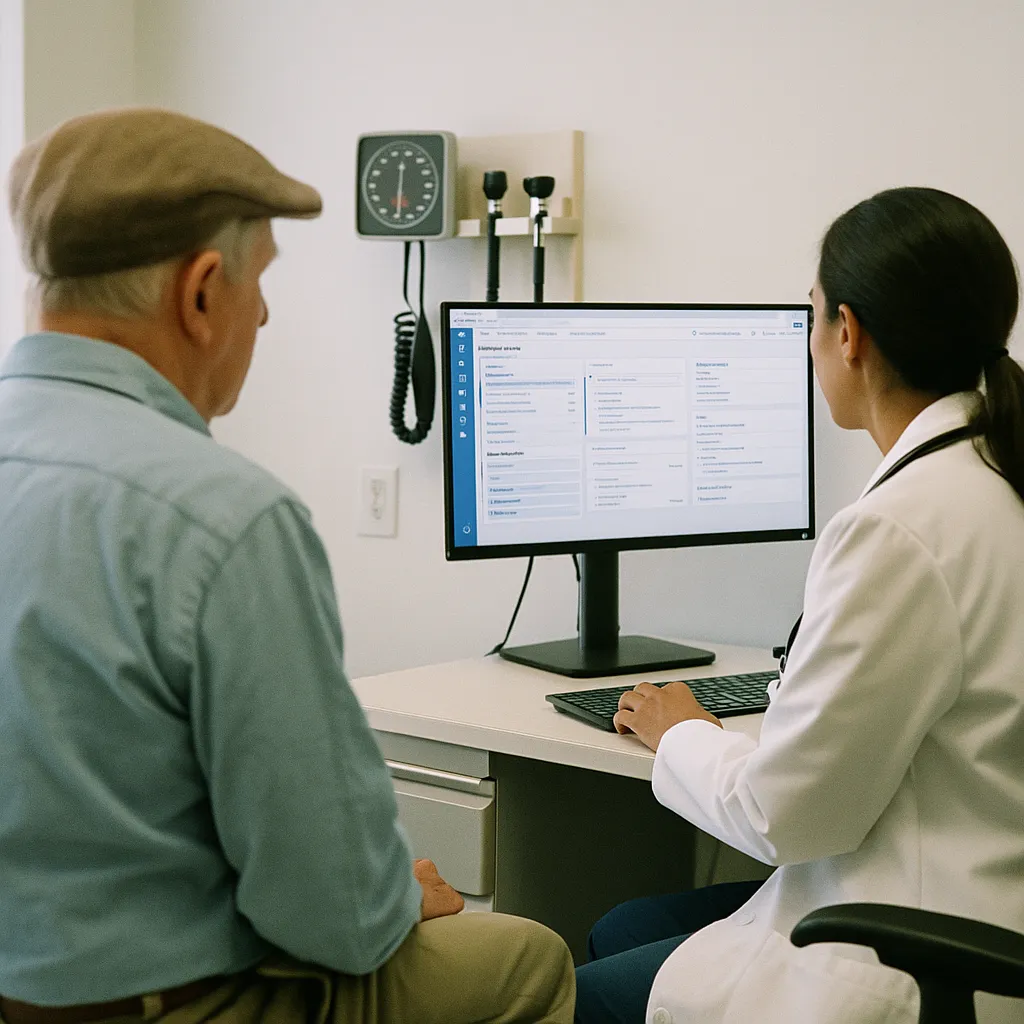
Massachusetts doctors are caught between AI tools patients bring to appointments and AI systems hospitals are deploying — and neither side is clearly in control of how those tools shape diagnosis.
Massachusetts Physicians Are Wrestling With AI in the Exam Room — and Losing Control of the Narrative
By Hector Herrera | May 8, 2026 | Health
Massachusetts doctors are caught in a widening gap between the AI tools patients are bringing into appointments and the AI tools hospitals are procuring for clinical workflows — and neither side is clearly in control of how those tools shape diagnosis. The friction, documented in a WBUR investigation published this week, reflects a national reckoning: the question is no longer whether AI is in the exam room, but who put it there and what it's doing.
What's Actually Happening in Massachusetts Clinics
The WBUR reporting describes two parallel pressures landing on physicians simultaneously. On one side, patients are arriving with AI-generated symptom analyses, differential diagnoses, and treatment suggestions from tools like ChatGPT and consumer health apps. On the other side, hospital systems are quietly deploying AI-assisted diagnostic tools — ambient documentation software, clinical decision support systems — without always giving physicians adequate training or override authority.
The result is a diagnostic environment where AI input is present whether doctors invite it or not.
The split among physicians is striking. Some clinicians interviewed for the report said AI tools help surface considerations they might have deprioritized, particularly in complex multi-system cases. Others said patient-initiated AI diagnoses create adversarial dynamics — patients who arrive convinced of a diagnosis and resistant to clinical reframing. A third group flagged something more structural: hospital-procured AI tools that flag alerts or suggest pathways can subtly shift the locus of decision-making away from the physician, even when the system formally preserves physician authority.
The Diagnostic Relationship Is the Core Issue
What makes the Massachusetts situation more than a technology adoption story is what it reveals about the diagnostic relationship — the dynamic between patient and physician through which symptoms become diagnoses and diagnoses become treatment plans.
Get this in your inbox.
Daily AI intelligence. Free. No spam.
That relationship has always involved negotiation. Patients describe symptoms through the lens of what they already believe is wrong. Physicians weigh clinical evidence against patient history, affect, and context. The process is imprecise, often uncomfortable, and deeply human. AI doesn't eliminate that imprecision; it introduces a third party into the negotiation with the apparent authority of algorithmic certainty — which patients and sometimes administrators treat as a tie-breaker.
This isn't Massachusetts-specific. A 2025 study in JAMA Network Open found that patients who consulted AI symptom checkers before appointments were more likely to arrive with a specific diagnosis in mind and less likely to update that belief after physician consultation. The Massachusetts reporting puts clinical flesh on those statistics.
What Hospitals and Physicians Are Doing About It
A few patterns are emerging from early adopters in Massachusetts and nationally:
- Disclosure protocols. Some practices are now asking patients upfront whether they consulted AI tools before the appointment, and documenting the response. This doesn't resolve the tension but surfaces it for clinical discussion.
- AI governance committees. Hospital systems are beginning to create internal review structures that evaluate AI clinical tools before deployment — assessing not just accuracy but how the tool positions its output relative to physician judgment.
- Physician training. The American Medical Association has been pushing for AI literacy as a component of continuing medical education, recognizing that physicians who understand how these tools work are better positioned to evaluate their output critically.
None of these measures are universal, and few are codified in Massachusetts state policy.
The Regulatory Gap
Massachusetts has no AI-specific clinical guidelines governing diagnostic AI tools, either for patient-facing applications or hospital-procured systems. The federal picture is equally thin: the FDA regulates AI/ML-based software as a medical device under its Software as a Medical Device (SaMD) framework, but consumer AI tools used for symptom checking typically fall outside that framework.
The gap means that tools with real influence over clinical decisions operate without transparency requirements, accuracy disclosure standards, or liability frameworks. A hospital that deploys a clinical decision support system that contributes to a misdiagnosis faces uncertain legal terrain. A patient who acts on an AI symptom analysis faces none — but bears the consequences.
What to Watch
The Massachusetts legislature has a pending bill that would require hospitals to disclose AI use in clinical settings to patients — a transparency measure, not a capability restriction. Whether that advances in 2026 will serve as an early indicator of how states approach clinical AI governance. Nationally, the AMA's policy positions on AI in medicine are expected to be updated at the June 2026 annual meeting, with diagnostic AI accountability a likely focus.
The deeper question — who owns the diagnostic relationship when AI is in the room — won't be answered by legislation alone. It will be worked out one appointment at a time, in clinics that are already behind.
Did this help you understand AI better?
Your feedback helps us write more useful content.
Get tomorrow's AI briefing
Join readers who start their day with NexChron. Free, daily, no spam.