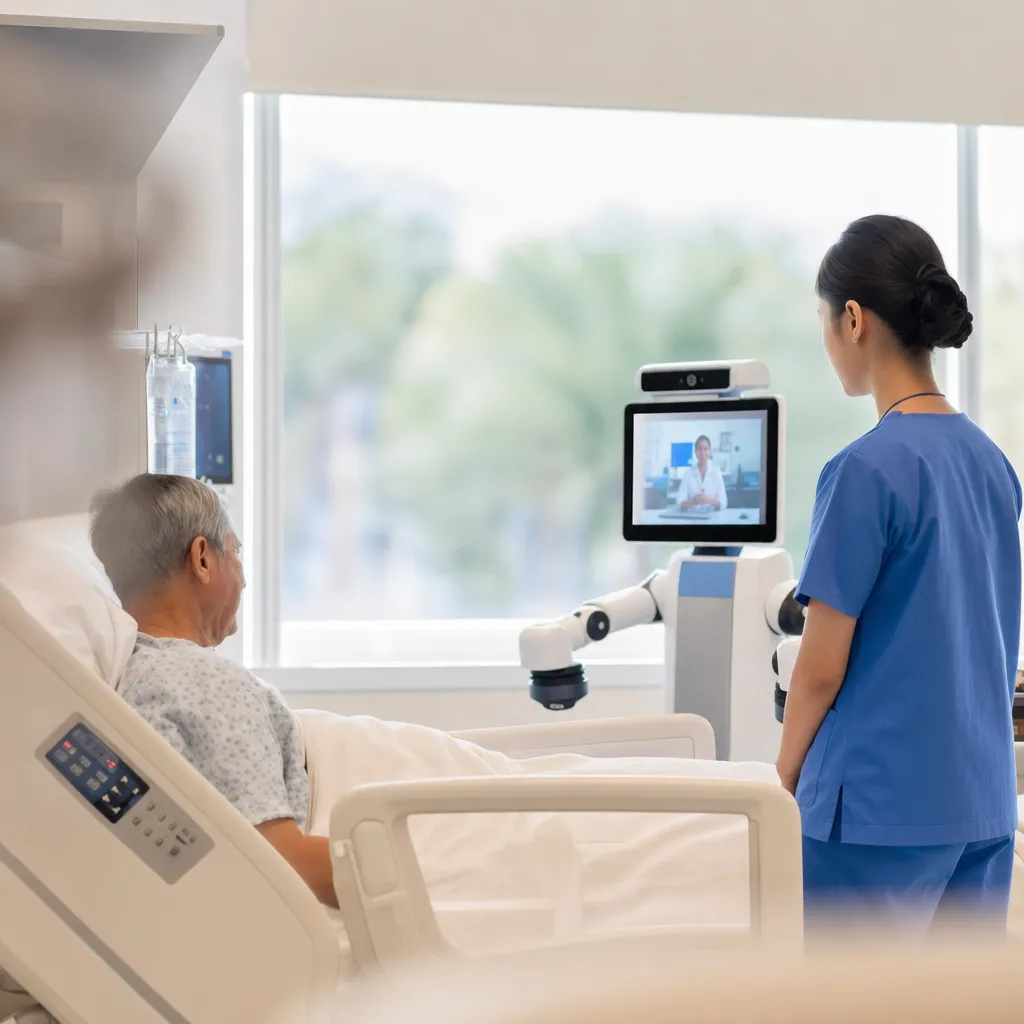
King Faisal Specialist Hospital presented its operational AI deployment across nursing workflows and patient-experience monitoring at the Economist AI in Health Summit, offering a rare look at a major hospital that has moved AI from pilot to operational scale.
King Faisal Hospital Showcases AI Nursing and Patient Experience at Economist Health Summit
By Hector Herrera | November 5, 2026 | Health
King Faisal Specialist Hospital and Research Center — one of the most cited hospital systems in the Middle East — has moved AI from pilot projects to operational-scale nursing and patient-experience workflows. The hospital presented its deployment at the Economist AI in Health Summit on November 3, offering a rare first-person account of what hospital AI looks like when it moves beyond proof-of-concept.
Most hospital AI announcements describe what a system will do or is being tested to do. King Faisal's presentation was different: AI tools are running in active nursing workflows, and the hospital is reporting outcomes rather than projections.
What KFSH Presented
The Economist AI in Health Summit brought together hospital systems, health technology providers, and policy researchers to examine where clinical AI has reached genuine operational scale. KFSH's session focused on two deployment areas:
Nursing workflow AI: Tools that assist nurses with documentation, patient monitoring alert prioritization, and care coordination across shift handoffs. The goal is reducing the administrative burden on nursing staff so clinical attention can focus on direct patient care rather than paperwork.
Patient experience monitoring: AI systems that analyze patient feedback signals — including structured survey data and unstructured communication — to surface dissatisfaction patterns before they escalate. This is distinct from traditional patient satisfaction surveys, which are retrospective. AI-driven monitoring is designed to flag issues in real time.
Get this in your inbox.
Daily AI intelligence. Free. No spam.
Why This Matters
Nursing is the largest single workforce category in hospital systems globally. It is also the category most directly affected by documentation burden — studies consistently show nurses spend 25–40% of their time on administrative tasks rather than patient care. AI tools that reduce this burden have a direct impact on care quality, nurse retention, and patient outcomes.
KFSH's presentation is significant because it demonstrates operational deployment in a high-stakes, patient-facing context — not in an administrative back office. AI decisions in nursing workflows carry different accountability requirements than AI decisions in billing or scheduling. The hospital's willingness to present operational results signals confidence in both the technology and their governance framework around it.
The Regional Significance
King Faisal Specialist Hospital is a referral hospital in Riyadh, Saudi Arabia, serving patients from across the Gulf region for complex, high-acuity cases. Its AI deployments carry influence beyond its walls: other hospital systems in Saudi Arabia, the UAE, and the broader MENA region watch KFSH's operational decisions as a credibility signal.
The timing also reflects Vision 2030 healthcare priorities in Saudi Arabia, which include AI integration as an explicit goal for hospital system modernization. KFSH's public presentation of operational AI is partly a demonstration to peers and policy stakeholders that the technology is ready for regional adoption.
The Template Problem
The honest limitation of KFSH's presentation is that it is a single institution with unusual resources — KFSH is a government-funded specialist hospital with a research mission, not a typical community hospital navigating budget constraints. The question for the broader hospital market is whether KFSH's operational model is transferable.
The factors that enable KFSH's deployment:
- Dedicated clinical informatics staff to implement and monitor AI systems
- Centralized EMR infrastructure that AI tools can integrate with
- Institutional mandate (not just executive enthusiasm) for AI adoption
- Willingness to invest in the governance layer alongside the technology — policies for when AI recommendations override or inform clinical judgment
Community hospitals without these conditions face a different adoption curve. The technology may be ready; the organizational infrastructure often is not.
What to Watch
KFSH has not disclosed which AI vendors or platforms underlie its nursing workflow tools — that information would be valuable for hospital systems evaluating their own options. Watch for case study publications from KFSH's clinical informatics team, which typically follow summit presentations by 3–6 months. Also watch the Economist AI in Health Summit proceedings: KFSH was likely not the only system presenting operational-scale AI, and the aggregate picture from the summit will be more informative than any single institution's disclosure.
Did this help you understand AI better?
Your feedback helps us write more useful content.
Get tomorrow's AI briefing
Join readers who start their day with NexChron. Free, daily, no spam.