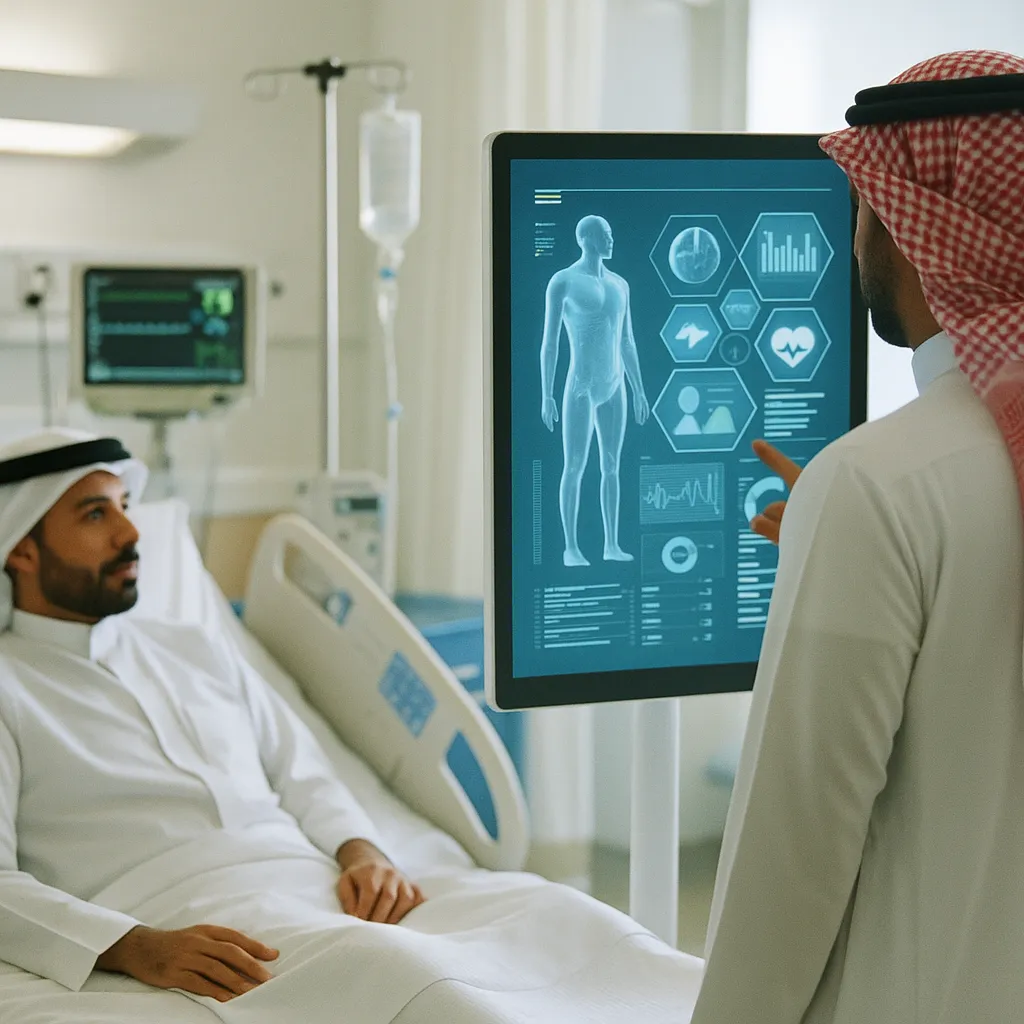
King Faisal Specialist Hospital presented its scalable AI integration framework — covering 30+ clinical applications — at Silicon Valley's C3 Davos of Healthcare Summit, modeling how large health systems can scale AI safely.
Saudi Arabia's King Faisal Hospital Showcases 30+ AI Clinical Applications at Silicon Valley Healthcare Summit
By Hector Herrera | April 28, 2026 | Health
King Faisal Specialist Hospital & Research Centre (KFSH&RC) — one of the Middle East's most influential medical institutions — presented its AI integration framework at the C3 Davos of Healthcare Summit in Silicon Valley on April 27, demonstrating how a major health system can deploy more than 30 AI applications across clinical workflows without compromising patient safety or care equity. The presentation positions KFSH&RC as an unlikely model for large hospital systems globally that are still trying to get their first AI application into production.
The announcement, reported via GlobeNewswire, comes at a moment when major health systems in the U.S. and Europe are struggling to move AI pilots into sustained clinical deployment. KFSH&RC's willingness to showcase its framework publicly — at a summit explicitly designed to surface scalable models — is a deliberate institutional move to share what's working.
What KFSH&RC Has Built
The hospital has deployed AI applications across three primary domains:
Diagnostics. AI tools supporting imaging interpretation — radiology, pathology, ophthalmology — that flag findings for clinician review rather than replacing diagnostic judgment. These are among the most mature clinical AI applications globally, and KFSH&RC's deployments reflect years of integration work to embed them into actual clinical workflow rather than running them as parallel systems clinicians ignore.
Clinical decision support. AI systems that surface relevant patient history, flag drug interaction risks, and surface evidence-based treatment options within the electronic health record (EHR) interface — the kind of tool that only works if it's fast enough and accurate enough that clinicians trust it under time pressure.
Get this in your inbox.
Daily AI intelligence. Free. No spam.
Patient experience monitoring. AI applied to patient-reported outcomes, real-time feedback systems, and operational flow data to identify experience breakdowns before they become complaints — or adverse events.
The 30+ applications figure spans these domains and suggests genuine breadth of deployment, not a showcase of three high-profile pilots.
The Scalability Question
What makes KFSH&RC's framework noteworthy isn't the applications themselves — many of these tools exist as products. It's the hospital's reported success in scaling AI across workflows while maintaining safety standards and ensuring the benefits reach patients across its care system.
That challenge is where most health systems get stuck. Individual AI pilots succeed in controlled conditions and then fail to generalize: the model that worked beautifully on the imaging data from one facility doesn't perform as well on data from another. Or the tool works technically but clinicians don't use it because it adds friction to an already burdened workflow. Or the AI performs well for the majority population but underperforms for patient subgroups underrepresented in training data.
KFSH&RC's value to the global healthcare community is as a case study in overcoming those barriers at scale. The C3 summit presentation is, in effect, a published methodology — one that hospital systems from London to Los Angeles are likely to be studying.
Context: Why This Matters Beyond Saudi Arabia
KFSH&RC sits at the center of a regional AI healthcare investment wave. Saudi Arabia's Vision 2030 initiative has specifically targeted AI-enabled healthcare as a strategic priority, providing institutional backing and capital that's allowed KFSH&RC to move faster than peer institutions constrained by more fragmented funding environments.
But the lessons aren't Saudi-specific. The core challenges — workflow integration, clinician adoption, safety validation, equity of outcomes — are universal. Any large hospital system deploying AI at scale is navigating the same problems. KFSH&RC's willingness to present its model publicly at a high-profile Silicon Valley forum is an invitation for the global healthcare community to learn from what it's built.
What to Watch
Watch whether the KFSH&RC framework gets formally published in a peer-reviewed medical informatics journal or presented at major health IT conferences like HIMSS or the Journal of the American Medical Informatics Association (JAMIA). If the methodology gets published with clinical outcome data attached — not just deployment counts — it becomes a significantly more powerful reference point for health systems evaluating their own AI investments. The summit presentation is the opening move. The follow-through will determine its lasting influence.
Did this help you understand AI better?
Your feedback helps us write more useful content.
Get tomorrow's AI briefing
Join readers who start their day with NexChron. Free, daily, no spam.