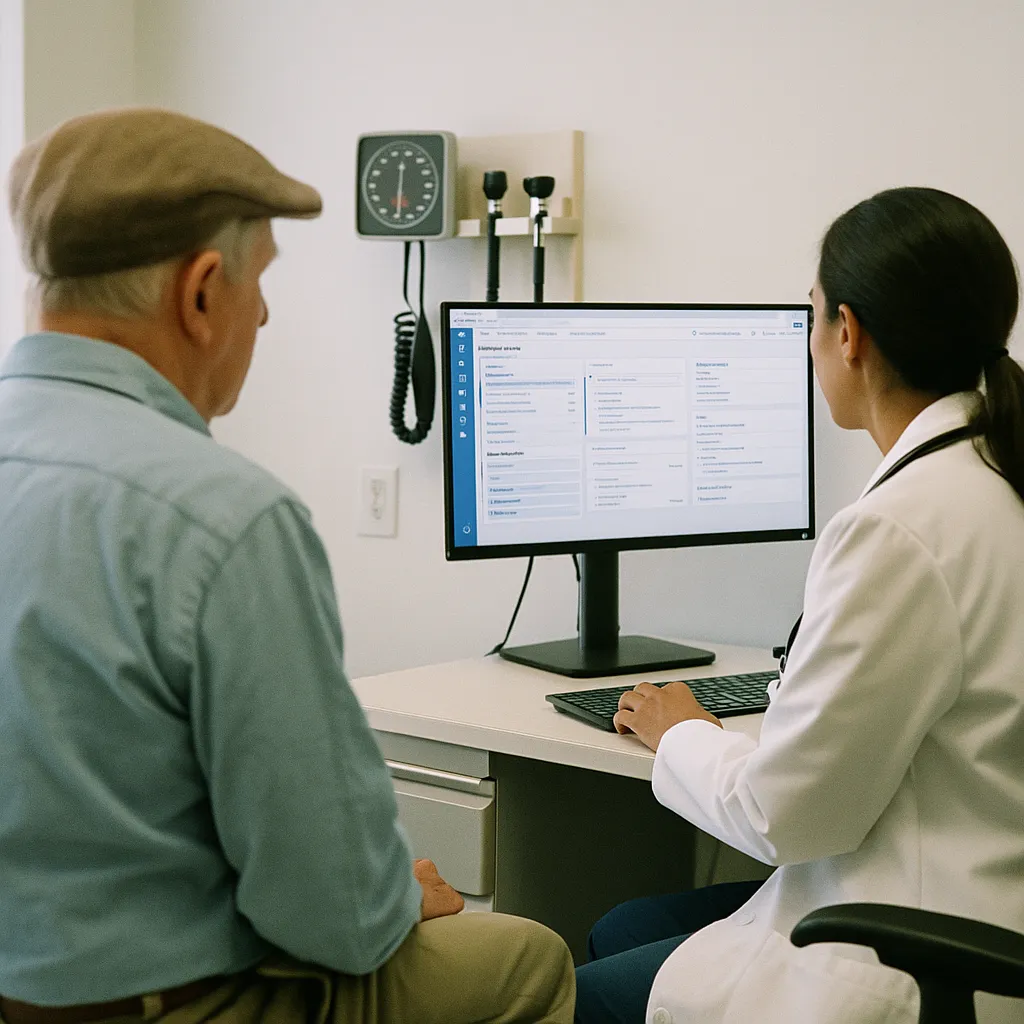
Just 59% of healthcare organizations have standardized processes to track deployed AI agent performance, while 68% of nurses report insufficient training and 60% lack confidence in their organization's AI governance.
Only 59% of Healthcare Orgs Track AI Agent Performance as Nurse Confidence Collapses
By Hector Herrera | May 18, 2026
Healthcare organizations are deploying AI agents faster than they can govern them. A new survey published May 17 by Healthcare IT Today finds that just 59% of healthcare organizations have standardized processes to track the performance of deployed AI agents — meaning four in ten systems operating in clinical environments have no formal accountability mechanism. That is not a minor administrative gap. It is a patient safety risk embedded in the infrastructure of modern care delivery.
The finding lands alongside two equally troubling data points from the same survey: 68% of nurses report receiving insufficient AI training, and 60% say they lack confidence in their organization's AI governance. Together, these numbers describe a sector that has accelerated well past its own safety infrastructure.
The Deployment-Governance Gap
Hospitals and health systems have moved unusually fast on AI adoption, driven by staffing shortages, cost reduction mandates, and genuine clinical wins in areas like imaging analysis and predictive deterioration. Diagnostic tools, clinical documentation assistants, patient-facing chatbots, and now autonomous AI agents — capable of querying records, drafting care summaries, and triaging alerts — have been deployed at scale over the past 18 months.
The problem is that deployment speed and governance infrastructure rarely scale together. In most industries, a governance lag creates operational friction. In healthcare, it creates patient safety exposure.
Tracking deployed AI performance means having a standardized process to monitor whether an AI agent is producing accurate outputs, flagging errors, and catching drift — where a model's performance degrades over time as real-world data diverges from what it was trained on. When 41% of healthcare organizations have no such process, that is not an edge-case risk. It is a systemic vulnerability operating inside clinical settings, every day.
What the Nurse Data Actually Means
The nursing numbers add a human layer to the technical governance failure. When 68% of nurses say their AI training was insufficient and 60% say they don't trust their organization's AI oversight, the implication is direct: the people most likely to catch AI errors at the bedside are not equipped to do so.
Get this in your inbox.
Daily AI intelligence. Free. No spam.
Nurses are not passive recipients of AI outputs. In most care settings, they serve as the last human checkpoint before an AI recommendation translates into patient action — adjusting medications, flagging abnormal results, acting on risk scores generated by predictive algorithms. When that workforce lacks both training and confidence in the systems they work alongside, the safety margin those systems were supposed to provide becomes unreliable.
The core failure chain: An AI agent generates a flawed output inside an organization that has no performance tracking. The error is not caught by the system. The nurse managing that patient has not been trained to evaluate the AI's recommendation critically. The error travels further. This is not a hypothetical — it is the condition the survey describes, at scale.
Where the Accountability Gap Sits
The survey results reflect a structural problem in how health systems are buying and deploying AI. Procurement decisions are often made by IT or finance leadership focused on efficiency metrics, while clinical operations — the function that has to live with the AI in practice — is frequently brought in late or not at all.
No standardized tracking means there is no feedback loop. A diagnostic AI that starts generating more false negatives over time, an alert-triage agent that begins missing high-acuity signals, a documentation assistant that systematically misrepresents procedures — none of these will be detected without monitoring infrastructure in place.
The American Nurses Association has called for mandatory AI competency training as a condition of clinical AI deployment. Separately, multiple large health systems encountered similar alignment failures in NexChron's May 13 coverage of enterprise AI scaling challenges — where technical deployment outpaced workforce readiness and governance design.
Regulators are beginning to pay attention. The FDA's AI monitoring expectations for software as a medical device, covered in NexChron's May 10 reporting, apply to regulated devices. But the broader category of clinical AI — documentation tools, workflow agents, decision support systems — sits in a regulatory gray zone where performance monitoring is advisory at best.
Three Things Health Systems Can Fix Now
The survey data points to specific, addressable governance gaps — no waiting for federal mandates required:
- Standardized performance tracking for every deployed AI agent: output accuracy rates, escalation volumes, error logging, and scheduled review cycles
- Nurse-facing AI competency training tied to specific tools in use — not generic AI literacy curricula that teach principles without touching the actual systems staff interact with daily
- Clear human-in-the-loop protocols defining who reviews AI outputs, under what conditions, and how discrepancies are escalated and documented
Health systems that treat AI deployment as a technology procurement decision — rather than a clinical operations decision — are the ones most likely to find themselves explaining a preventable adverse event.
What to Watch
The Joint Commission is expected to address AI oversight standards later in 2026. If accreditors begin requiring documented AI governance frameworks as a condition of hospital accreditation, the 41% of organizations currently tracking nothing will face an abrupt forced reckoning. State health departments in California, New York, and Massachusetts are also drafting clinical AI guidance. The policy gap is closing — but the clinical risk is live right now.
Source: Healthcare IT Today, May 17, 2026
Did this help you understand AI better?
Your feedback helps us write more useful content.
Get tomorrow's AI briefing
Join readers who start their day with NexChron. Free, daily, no spam.