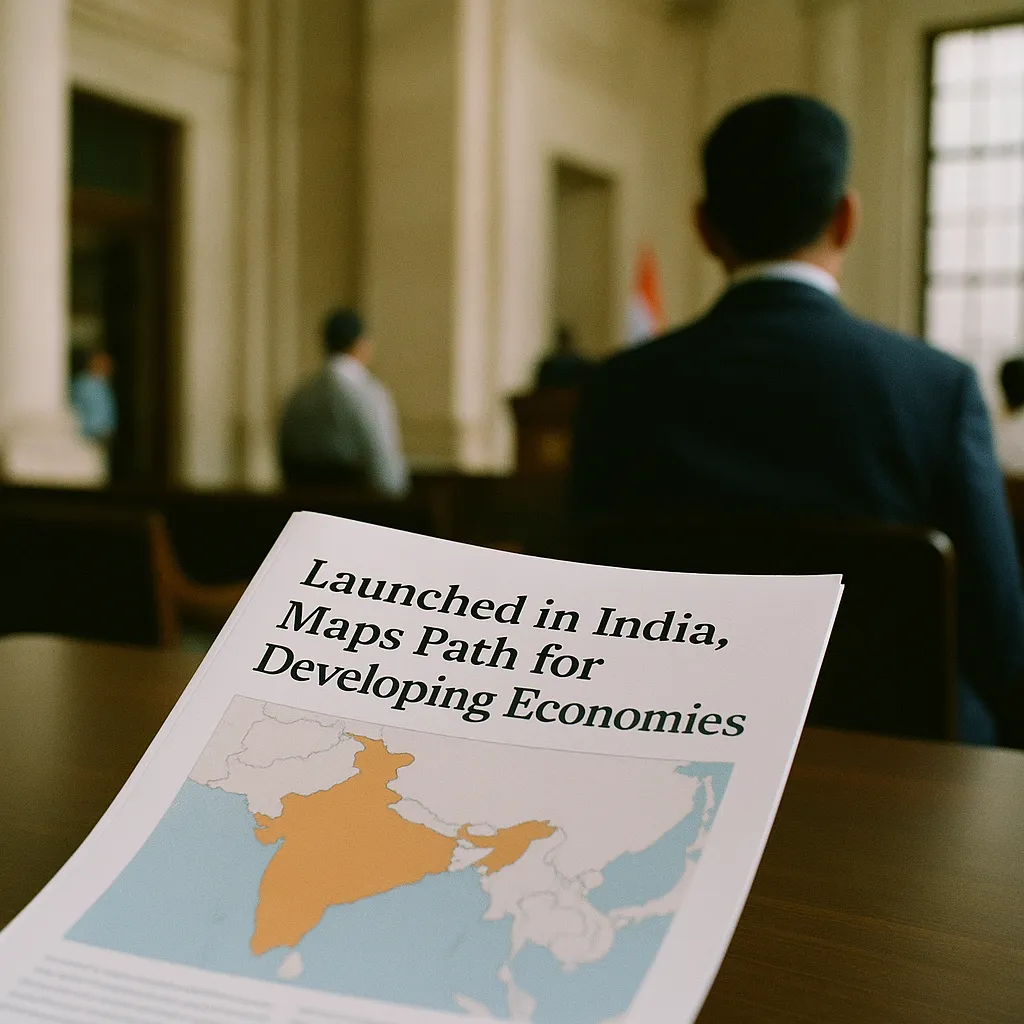
The World Bank released the World Development Report 2026 in New Delhi, its most authoritative analysis of AI's macro-developmental opportunities and labor disruption risks for low- and middle-income countries.
The World Bank released its most authoritative analysis of AI's role in global development on October 9, 2026, formally launching the World Development Report 2026: The Promise of Artificial Intelligence in New Delhi — and the central message is that developing nations have a narrow window to get this right before the gains concentrate elsewhere.
India's Union Minister for Electronics and IT, Ashwini Vaishnaw, co-hosted the launch alongside the IndiaAI Mission and MeitY (Ministry of Electronics and Information Technology). The choice of New Delhi as the launch venue was deliberate: India represents the largest cohort of AI's potential beneficiaries and is among the few low- and middle-income countries with a credible national AI program already underway.
What the Report Says
The WDR 2026 is the World Bank's flagship annual publication — think of it as the most widely read development economics document in the world, read by finance ministers, central bankers, and international donors. This edition is entirely dedicated to AI, which signals how seriously the institution views the technology's macroeconomic impact.
The report maps a three-part framework for how developing economies can use AI productively:
- Adopt — Deploy existing AI tools to improve service delivery in health, education, agriculture, and public administration. The Bank argues the upside here is immediate and doesn't require frontier model development.
- Adapt — Localize AI systems to national languages, datasets, and governance contexts. Generic Western models often fail on local-language queries, crop disease identification in tropical climates, or legal systems that don't follow English common law.
- Advance — For countries with the infrastructure and talent, build sovereign AI capability — national compute, training pipelines, and research ecosystems.
The framework is explicitly tiered. Not every country needs to advance. Most should adopt first.
Get this in your inbox.
Daily AI intelligence. Free. No spam.
The Labor Disruption Warning
The report does not soft-pedal the displacement risk. According to the World Bank's analysis, AI poses the most significant labor disruption threat to workers in routine white-collar tasks — the very jobs that powered the economic rise of countries like India, the Philippines, and Vietnam over the past two decades. Call centers, data processing, back-office financial work: these are the sectors where AI substitution is already measurable.
The Bank estimates that between 9 and 25 percent of current tasks in emerging economies are susceptible to AI-driven automation in the near term, with higher exposure in countries that built service sectors around offshoring.
The flip side: the same report identifies AI as a potential equalizer in healthcare diagnosis, precision agriculture, and financial inclusion — sectors where low-income countries have historically lacked access to skilled professionals at scale.
Why India as the Launch Venue Matters
India's IndiaAI Mission, launched in 2024 with a ₹10,300 crore ($1.2 billion) commitment, is the most visible national AI program among developing economies. It includes a shared compute infrastructure for Indian startups and researchers, indigenous model development, and a push for AI applications in agriculture and health.
By co-hosting the WDR launch, India is positioning itself as the model case for the "adopt, adapt, advance" framework — a signal to other G20 and Global South nations that sovereign AI strategy is achievable without Silicon Valley budgets.
What This Means for Business and Policy
For multinationals operating in developing markets, the WDR 2026 will shape procurement, regulatory expectations, and government AI investment priorities for the next three to five years. When the World Bank says "adopt AI in public health," governments listen — and that translates into tenders, partnerships, and regulatory frameworks that international companies need to track.
For policymakers in low- and middle-income countries, the report provides political cover to invest in AI infrastructure and to push back against the narrative that AI is purely a rich-country technology.
What to Watch
The World Bank will use the WDR 2026 as the analytical backbone for AI-related lending programs and technical assistance across its 189 member countries. Watch for new AI-specific loan programs and policy conditions attached to infrastructure financing — that's where the report's framework gets teeth.
Did this help you understand AI better?
Your feedback helps us write more useful content.
Get tomorrow's AI briefing
Join readers who start their day with NexChron. Free, daily, no spam.