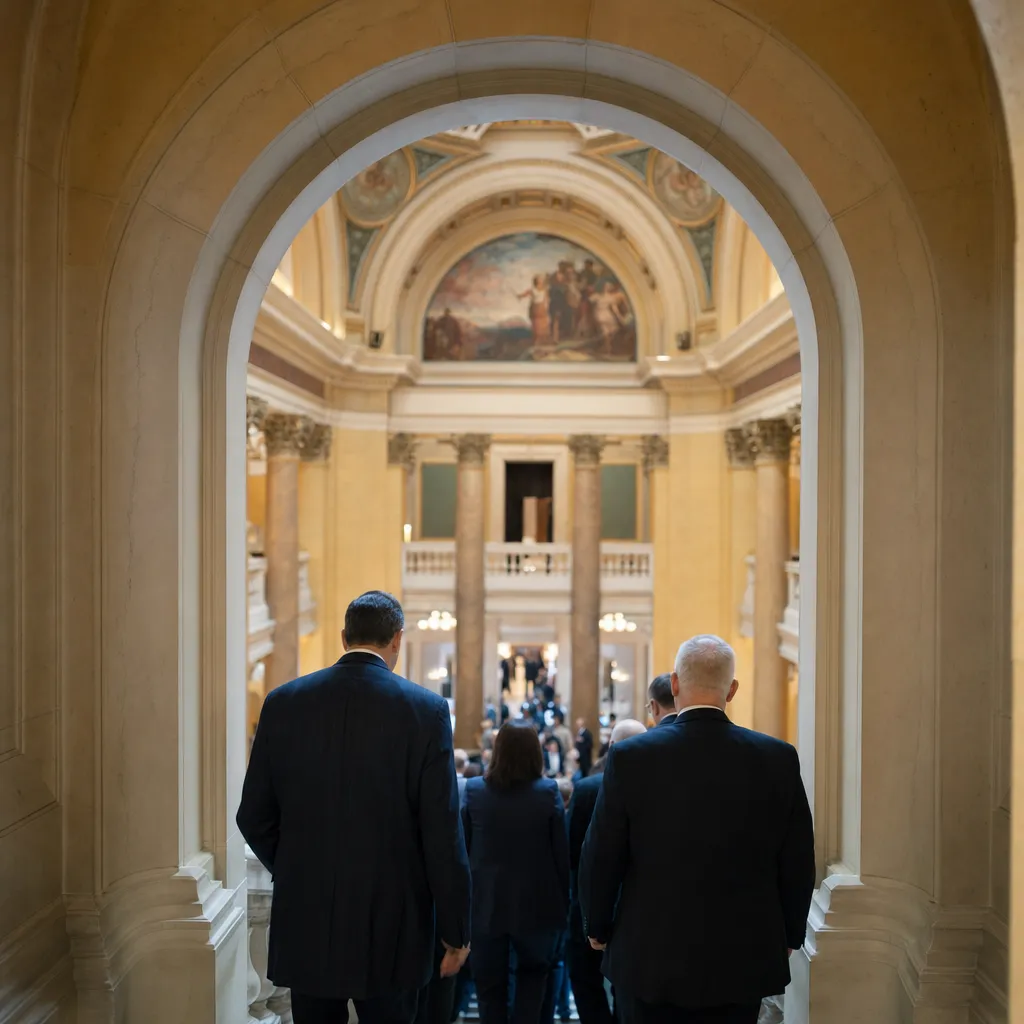
The National Governors Association published bipartisan principles calling on Congress to preserve state authority over AI deployment harms while letting the federal government address national-scale AI risks.
Governors Break Partisan Lines to Push Back on Federal AI Overreach
By Hector Herrera | November 24, 2026
The National Governors Association published a bipartisan set of principles this week calling on Congress to build any federal AI framework around a clear division of authority: federal government handles national-scale AI risks, states retain authority to protect residents from deployment-stage harms. The statement, issued November 22, is unusual for its bipartisan alignment and its specificity — this is not a general call for responsible AI, it's a formal position on the federal-state boundary in AI regulation.
The timing matters. Congress has failed to pass comprehensive AI legislation for three years. More than two dozen states have moved to fill that gap. Governors are now telling Congress to formalize a framework before federal preemption attempts wipe out the state-level protections already in place.
What the NGA Principles Say
The National Governors Association represents all 50 state governors. Its bipartisan statements carry political weight precisely because they signal consensus across governors who disagree on almost everything else. The AI framework principles call for three things:
Federal authority for national-level risks. The federal government should address AI risks that cross state lines or require uniform standards — AI in critical infrastructure, national security applications, federal contracting, and interstate commerce. These are areas where a patchwork of 50 state standards creates genuine coordination problems.
State flexibility preserved for deployment-stage harms. States must retain authority to regulate how AI is deployed in their jurisdictions, including employment decisions, housing, healthcare, insurance, and consumer protection. The logic: a state can observe deployment harms that federal regulators are too distant to track, and state attorneys general are often faster enforcement actors than federal agencies.
No federal preemption without justification. Congress should not preempt existing or future state AI laws unless there is a specific, demonstrated national-interest rationale for uniform standards — not simply to reduce compliance costs for industry.
Get this in your inbox.
Daily AI intelligence. Free. No spam.
What's Driving the Urgency
The NGA statement arrives against a backdrop of converging pressure points.
California's AI kill-switch proposal would require any AI system in a high-risk category to include a mandatory human override capability — a standard that, if enacted, would effectively become a de facto national requirement for companies selling into California's $3.6 trillion economy.
A new House AI Safety and Innovation Caucus launched this week with more than two dozen members, signaling that at least some House members see AI governance as an affirmative agenda item rather than a regulatory threat to manage.
Industry-backed preemption bills have circulated in draft form, arguing that a patchwork of state laws creates compliance complexity that disadvantages US AI companies globally. The NGA statement is a direct counter to that argument — governors are saying the solution to state diversity is a federal floor, not federal occupation of the entire regulatory space.
Background: How the Patchwork Developed
In the absence of federal AI legislation, states have acted independently. Illinois enacted the Artificial Intelligence Video Interview Act in 2019. Colorado passed an algorithmic auditing requirement for employment decisions in 2024. Texas enacted disclosure requirements for AI-generated content. California has the most comprehensive framework, with the California AI Safety Act and multiple sector-specific rules.
The result is exactly the patchwork the technology industry complains about. But the governors' argument is that the solution is cooperative federalism — not federal preemption. The Clean Air Act model, where federal standards set a floor and states may exceed them, is the analogy they're implicitly invoking.
What This Means
The NGA's unusual bipartisan alignment represents a significant political development for anyone following AI legislation. Republican governors in Texas, Florida, and Georgia joining Democratic governors in California, Illinois, and New York on a governance position is not the norm. That alignment makes it substantially harder for Congress to pass broad preemption language without facing political blowback from both parties' governors.
For AI developers and deployers, the governors' framework signals that state-level compliance requirements are not going away — the question is whether a federal floor will simplify or complicate them. A well-designed federal-state framework with clear lanes could actually reduce compliance complexity by eliminating ambiguity about which standards apply to which activities.
For federal regulators, the NGA position is a mandate to move faster. If Congress doesn't establish a framework, states will continue building one piece at a time, and the patchwork will only grow denser.
What to Watch
Watch whether the new House AI Safety and Innovation Caucus incorporates the NGA's framework principles into draft legislation, and whether any Senate companion effort emerges. Also watch California's kill-switch proposal — if it advances to a floor vote, it will accelerate the pressure on Congress to either preempt or codify a federal-state division.
Did this help you understand AI better?
Your feedback helps us write more useful content.
Get tomorrow's AI briefing
Join readers who start their day with NexChron. Free, daily, no spam.