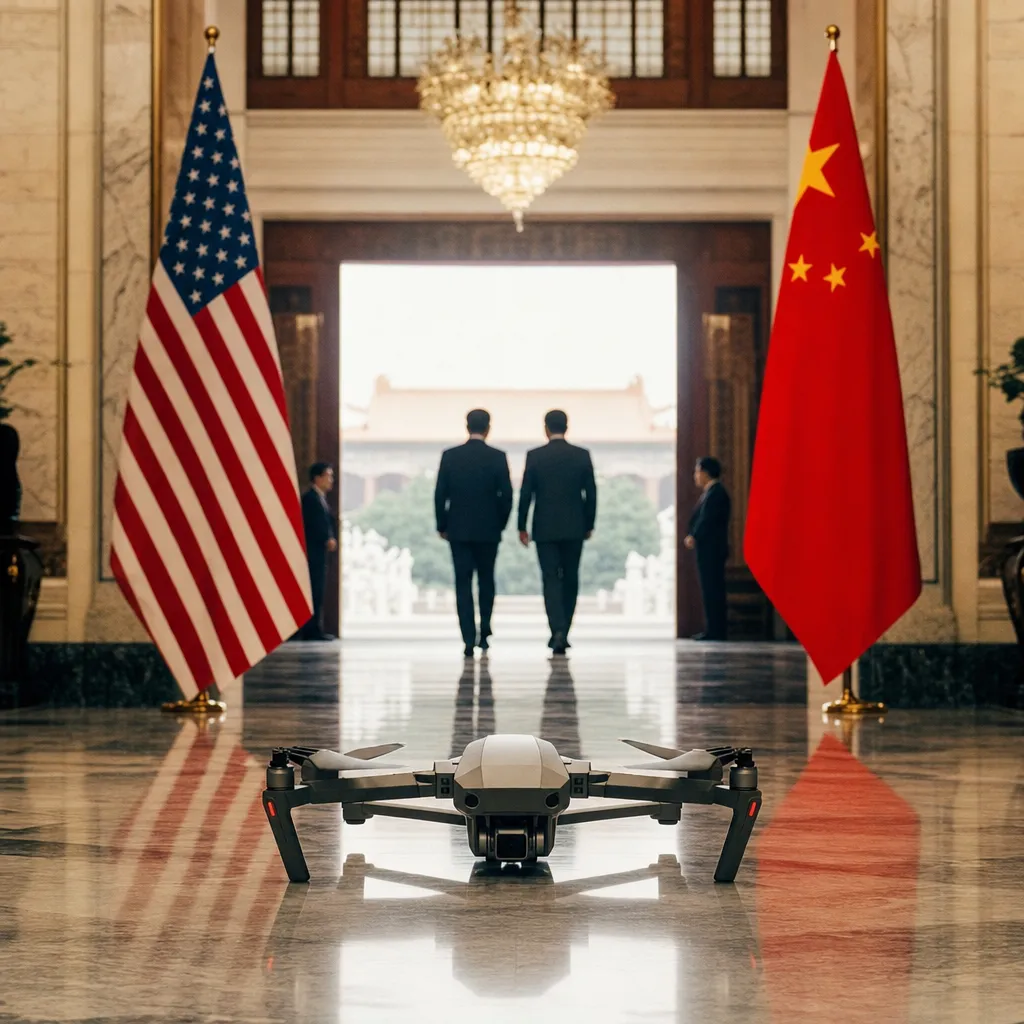
The US and China have established a direct hotline for reporting serious AI incidents — covering AI attacks on critical infrastructure and frontier models showing signs of losing control. Ambassador Perdue confirmed the agreement on November 11.
The United States and China have agreed to establish a direct communications channel for reporting serious AI incidents — the first formal bilateral mechanism designed to prevent an AI system failure from triggering a geopolitical crisis.
Ambassador David Perdue confirmed the agreement on November 11 following the Trump–Xi summit. The Nano AI reported that the channel will cover two specific scenarios: AI agents attacking critical infrastructure, and frontier models displaying signs of losing control. Both governments are also planning a bilateral "Super Intelligence" dialogue on AI risks and benefits.
Why This Matters
This is a hotline — not a treaty. It won't stop AI development or slow the competition between the two countries. What it does is create a mechanism to prevent a technical malfunction from being read as an act of war.
The concern is straightforward: an AI system operated by one nation's military or intelligence apparatus behaves unexpectedly and causes damage — a power grid fluctuation, a network disruption, an autonomous drone acting outside its parameters. Without a communication channel, the other side has no way to distinguish an accident from an attack. Escalation becomes a real risk not because anyone chose it, but because the information wasn't there to prevent it.
The US and Soviet Union established the Moscow–Washington hotline in 1963 after the Cuban Missile Crisis for exactly this reason — not because either side trusted the other, but because misread signals are as dangerous as deliberate ones. This AI incident channel follows the same logic, applied to a new class of risk.
What the Channel Covers
According to the confirmed details, the channel is scoped to two categories:
Get this in your inbox.
Daily AI intelligence. Free. No spam.
- AI agents attacking critical infrastructure — This covers scenarios where autonomous AI systems, potentially operating with limited human oversight, cause damage to power grids, financial systems, communication networks, or other critical infrastructure.
- Frontier models showing signs of losing control — This is the more novel category. It anticipates scenarios where a highly capable AI system behaves outside its intended parameters in ways that could have cross-border consequences.
The scope is deliberately narrow. This isn't a channel for discussing AI policy differences or trade disputes. It's an emergency line for the specific category of AI-related incident that could be catastrophically misread.
The Broader Diplomatic Context
The Super Intelligence dialogue announced alongside the hotline is a separate track — more policy-oriented, covering both risks and benefits of advanced AI. This mirrors the structure of past technology diplomacy, where crisis communication mechanisms and policy dialogue proceed in parallel but serve different functions.
For US interests: The channel gives American officials a way to signal intent and receive information if a Chinese AI system causes collateral damage affecting US interests — and vice versa. It also creates implicit pressure to maintain human oversight of high-consequence AI systems, since neither side wants to explain an incident it can't fully account for.
For China: Participation legitimizes China's role as a co-equal actor in managing AI risk globally. It also gives Beijing a direct line to communicate if it believes a US AI system has crossed a line.
For the AI industry: This kind of government-level infrastructure signals that policymakers in both countries view advanced AI systems as capable of causing serious unintended harm — and are building governance structures accordingly. That's a signal to developers and operators of high-consequence AI systems that accountability expectations are rising.
What This Doesn't Do
It's worth being precise about what this agreement doesn't cover:
- It doesn't restrict AI development or competition between the two countries.
- It doesn't address commercial AI, consumer products, or most enterprise AI deployments.
- It doesn't create a joint governance body or shared standards.
- It doesn't prevent either side from using AI for military or intelligence purposes.
The channel is a narrow safety mechanism, not a détente. The underlying competition in AI — for talent, chips, capabilities, and strategic advantage — continues unchanged.
What to Watch
The first real test of this channel will be its use: whether both sides staff it seriously, whether information flows quickly when incidents occur, and whether it actually de-escalates when something goes wrong. Watch for follow-up details on the Super Intelligence dialogue timeline, and whether other nations push to be included in similar bilateral frameworks.
Did this help you understand AI better?
Your feedback helps us write more useful content.
Get tomorrow's AI briefing
Join readers who start their day with NexChron. Free, daily, no spam.