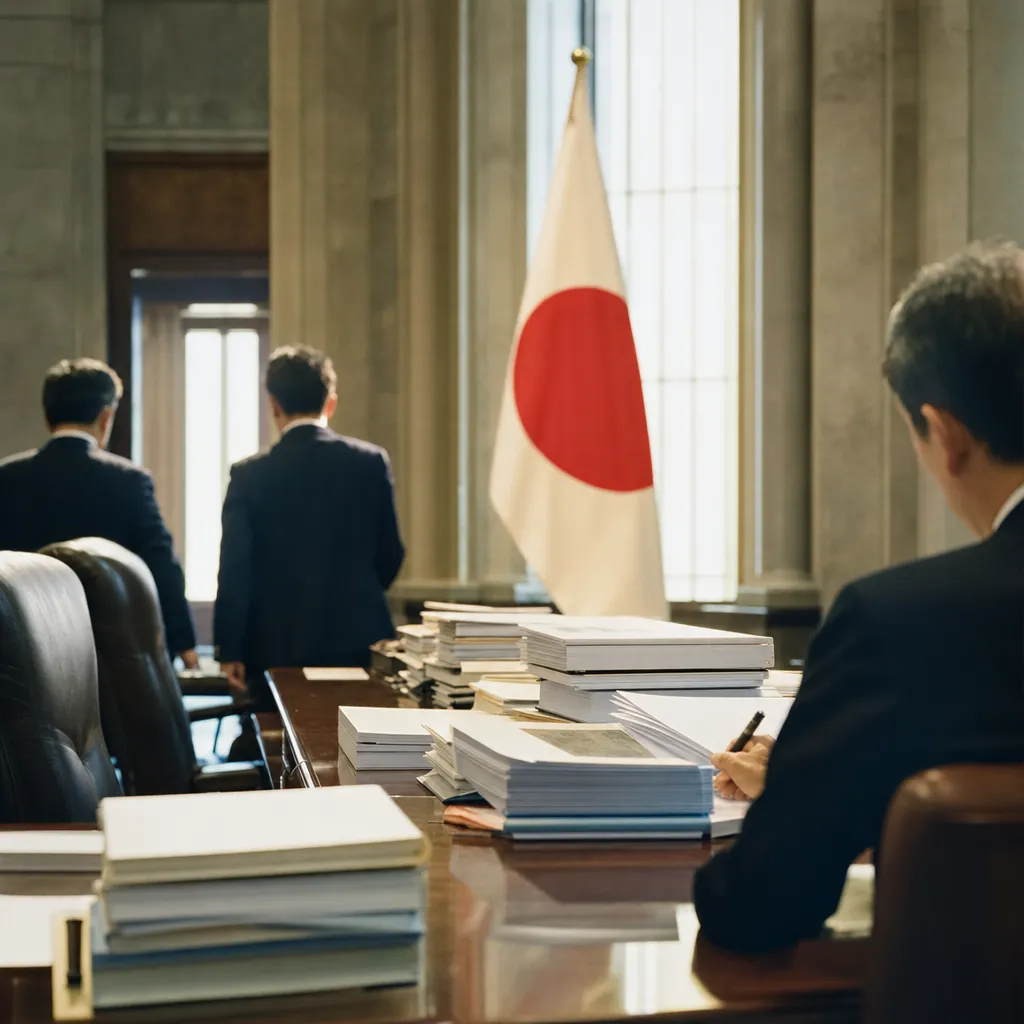
Japan is encoding AI supremacy into its three core national security documents for the first time, treating AI capability as inseparable from future diplomacy and defense — not just economic competitiveness.
Japan Embeds AI Nation Leadership Goal in Core National Security Documents
By Hector Herrera | November 26, 2026 | Government
Japan is treating AI capability as a national security imperative — not just an economic one — and is encoding that position into its three core national security documents for the first time.
The Japanese government announced on November 25 that it will formally enshrine the goal of becoming a leading AI nation — explicitly defined as third in the world, after the United States and China — when those documents are revised before year-end 2026. Officials framed AI capability as inseparable from future diplomacy and national defense. This is the first time AI leadership has been coded into Japan's core security strategy.
Why This Is a Different Kind of AI Policy
Most national AI strategies are framed as economic competitiveness documents: invest in AI to grow GDP, attract investment, and create jobs. Japan's decision to route this through national security documents does something different — it places AI capability on the same policy tier as military readiness, alliance management, and energy security.
The practical implication is that AI investment is now shielded from budget-cutting pressures that affect discretionary economic programs. National security commitments in Japan's planning framework carry different political weight than industrial policy.
The plan has four stated pillars:
Get this in your inbox.
Daily AI intelligence. Free. No spam.
- Reduce AI dependence on foreign countries — specifically, Japan's reliance on US cloud infrastructure and AI foundation models, which officials view as a strategic vulnerability
- Accelerate autonomous driving and physical AI — sectors where Japanese manufacturers already hold competitive positions
- Build domestic AI supply chains — from semiconductor fabrication through model development and deployment infrastructure
- Integrate AI capability into national defense planning — logistics, surveillance, threat analysis, and autonomous systems
Context: Why Japan Is Making This Move Now
Japan sits in a structurally uncomfortable position in the global AI race. It has world-class robotics and automotive manufacturing expertise, a strong university research base, and established chip packaging capabilities through companies like Ibiden and Shinko Electric. But it lacks a hyperscaler, lacks a dominant foundation model, and has watched South Korea and Taiwan receive preferred treatment in US chip access arrangements that bypassed Japan's existing industrial relationships.
The national security framing is partly about procurement leverage. If AI development is a security matter, Japan can use defense budget mechanisms — which face fewer WTO trade restrictions — to fund domestic AI infrastructure in ways that pure industrial policy cannot. It also shifts the conversation with Washington: Japan asking for access to advanced AI as a security ally is a different request than Japan asking as a commercial competitor.
What This Means for Businesses
Japanese companies in autonomous vehicles (Toyota, Honda), robotics (Fanuc, Yaskawa, DENSO), and industrial AI (Fujitsu, NTT, NEC, Preferred Networks) are the clearest beneficiaries. Government procurement and R&D co-investment will flow toward domestic suppliers first under a security framing.
Foreign AI companies operating in Japan — including Microsoft Azure, AWS, and Google Cloud — should expect increased pressure to establish domestic data infrastructure, model training facilities, and technology transfer arrangements as the price of market access under the new framework.
Semiconductor suppliers looking for offtake commitments from Japan's government will find the security angle useful. TSMC's Kumamoto fab (opened in 2024) and planned expansions in Japan were already supported by government subsidies; the AI nation declaration extends that logic further into compute and model layers.
The Third-Place Target Is a Meaningful Commitment
Japan explicitly naming third place — behind the US and China, ahead of Europe — is a more precise and consequential statement than most national AI strategy documents, which tend toward aspirational generality. It creates a benchmark against which Japanese government investment decisions will be evaluated, and against which foreign governments will calibrate their technology-sharing posture toward Tokyo.
It also implicitly acknowledges the gap. Japan is not claiming it will overtake China in foundation model development within the security strategy horizon. The goal is strategic autonomy — building enough domestic AI capability that Japan's foreign policy options are not constrained by dependence on AI infrastructure controlled by either rival superpower.
What to Watch
The document revisions are expected before December 31. The most important signal to watch is whether specific budget commitments follow in Japan's spring 2027 fiscal planning cycle — that is where stated policy becomes actual spending. Also watch how the announcement affects Japan's AI-related negotiations with the United States under the existing security alliance framework, and whether South Korea or Australia respond with their own security-layer AI policy updates.
Source: The Japan Times
Did this help you understand AI better?
Your feedback helps us write more useful content.
Get tomorrow's AI briefing
Join readers who start their day with NexChron. Free, daily, no spam.