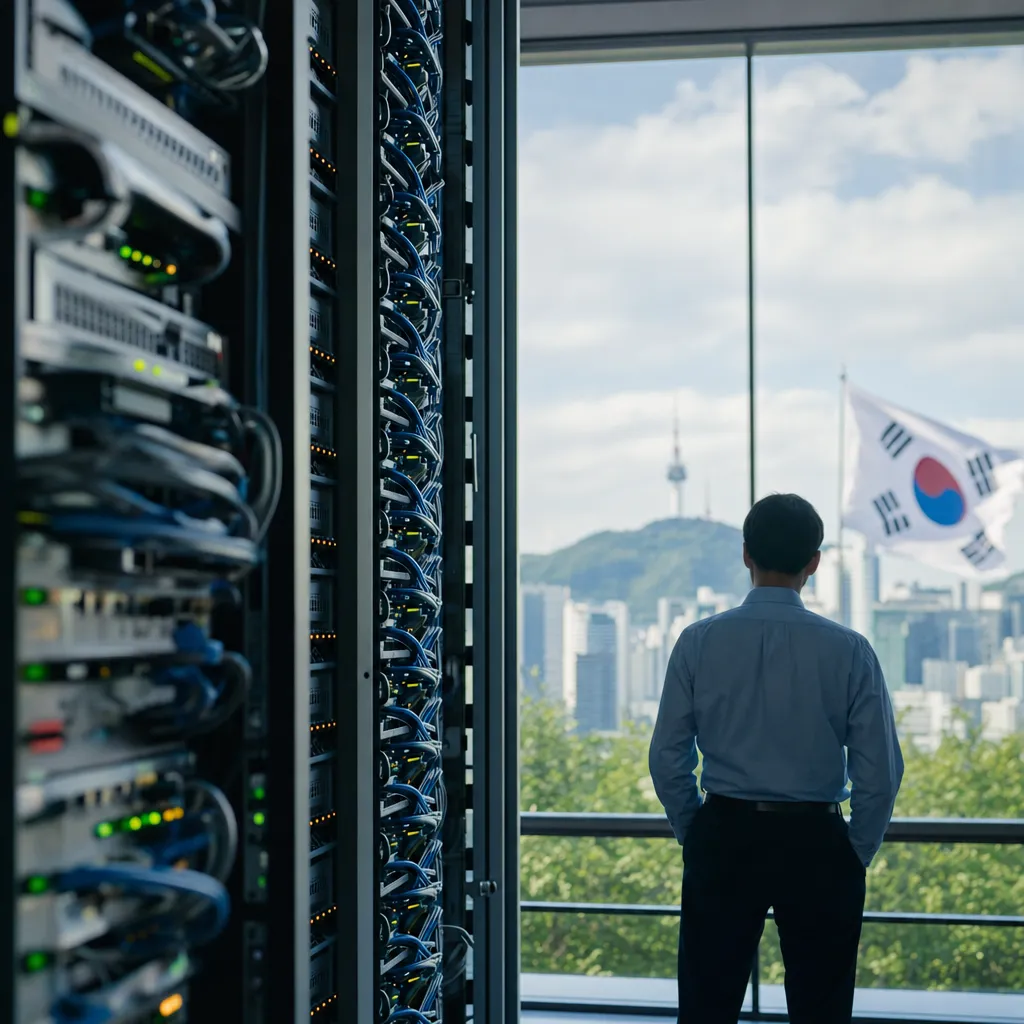
South Korea will invest $16 billion in AI, semiconductors, and data centers in 2027 — including $3.5 billion for a sovereign foundation model — nearly doubling this year's allocation.
South Korea is committing 21.3 trillion won — roughly $16 billion — to AI, semiconductors, and data centers in 2027, nearly doubling this year's allocation. The move signals a government-level bet that falling behind in sovereign AI infrastructure is an economic and national security risk it can't afford.
President Lee Jae Myung announced the plan on November 2 alongside a record proposed 12.8% increase in overall government spending. The AI and chips investment is the largest single-sector allocation in South Korea's modern budget history.
The Breakdown
The 21.3 trillion won package covers four main categories:
- AI development: Building a world-leading sovereign AI model, with 4.7 trillion won (~$3.5 billion) earmarked specifically for this
- Semiconductor R&D: Next-generation chip design and manufacturing capacity
- Physical AI: Robotics and AI hardware integration — industrial and logistics applications
- Data center infrastructure: Compute capacity to support both domestic AI workloads and international demand
The sovereign AI model investment is the headline figure. Most nations either license models from U.S. or Chinese providers, or build relatively small domestic models for narrow public-sector tasks. South Korea is explicitly targeting a "world-leading" foundation model — meaning competitive at the frontier, not just sufficient for government use.
Why Now
South Korea's timing reflects a convergence of pressures. Its semiconductor sector — anchored by Samsung and SK Hynix — sits at the center of global AI infrastructure, yet the country lacks a comparably strong AI software layer. That asymmetry leaves it dependent on foreign models to run on its own chips.
Get this in your inbox.
Daily AI intelligence. Free. No spam.
The budget announcement also comes as Japan, China, the EU, and the United States have each announced multi-year AI infrastructure commitments. South Korea's 2026 AI budget, while significant, had been criticized domestically as insufficient to keep pace with state-backed Chinese AI investment and the scale of U.S. private capital flowing through hyperscalers.
The 12.8% overall spending increase — the largest in recent memory — gives the AI package political cover. It's not a reallocation from other sectors; it's new capacity.
What It Means for the Industry
For chipmakers: Samsung and SK Hynix stand to benefit directly from domestic R&D funding and data center buildout contracts. The physical AI component creates demand for advanced packaging and on-device inference chips — an area where both companies are investing heavily.
For AI developers: A government-funded sovereign model could become a national default for Korean-language applications — health records, legal systems, education — creating a closed-loop that limits the market for foreign model providers in high-value government contracts.
For geopolitics: South Korea is walking a careful line. It hosts major U.S. military installations and is deeply integrated into Western supply chains, but its largest trading partner is China. A sovereign AI model — one not built on OpenAI, Anthropic, or Chinese infrastructure — is partly a hedge against being forced to choose sides in an AI cold war that is increasingly defined by model access.
What to Watch
The 2027 budget still requires National Assembly approval. South Korea's political environment has been volatile; opposition parties may push back on the scale of deficit spending implied by a 12.8% increase. Watch for budget negotiations in November and December to see how much of the AI package survives intact — and whether the sovereign model target gets diluted into a more modest domestic AI initiative.
Source: The Japan Times
Did this help you understand AI better?
Your feedback helps us write more useful content.
Get tomorrow's AI briefing
Join readers who start their day with NexChron. Free, daily, no spam.