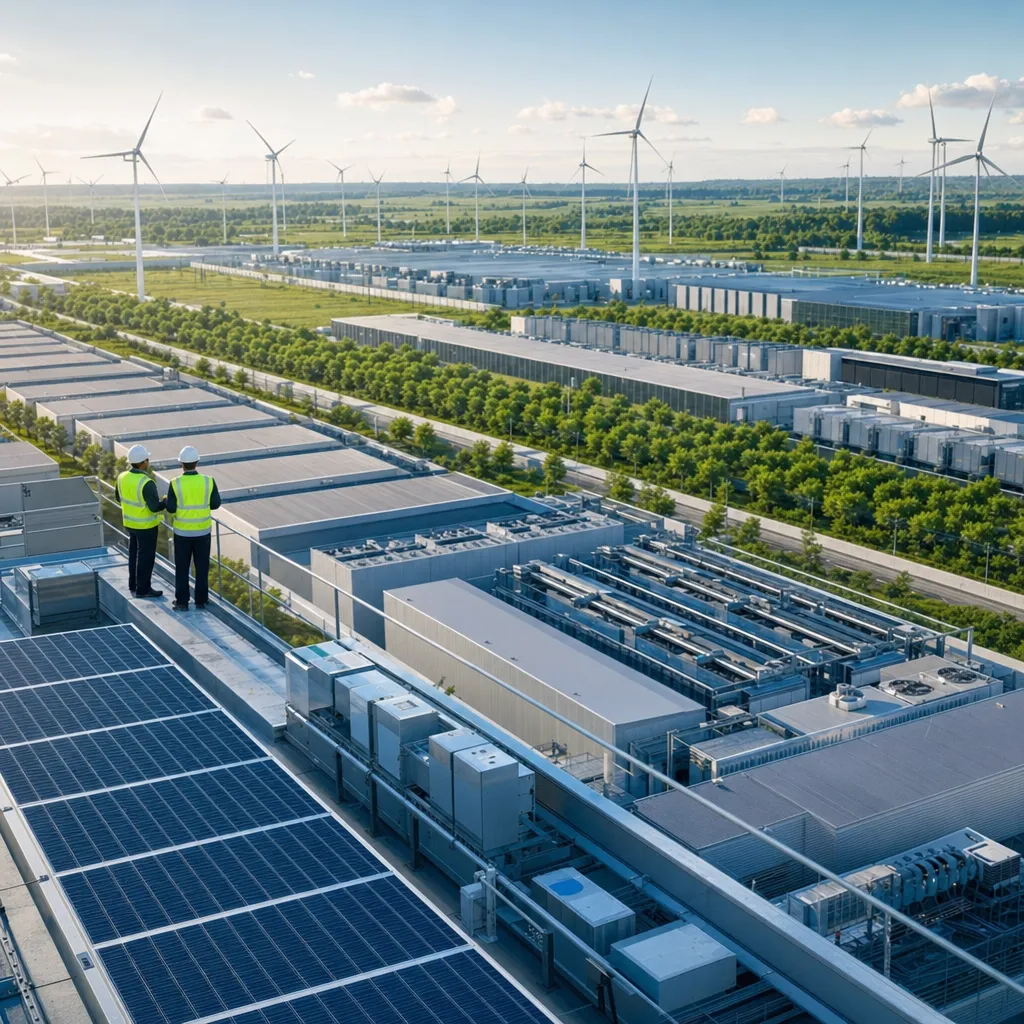
The Department of Energy has launched AI-FORTS, tasking Argonne National Laboratory with building the first foundation AI model that understands grid interdependencies — to detect coordinated AI-driven cyberattacks that point-solution tools miss.
DOE Launches AI-FORTS Program to Defend U.S. Power Grid From AI-Enabled Cyberattacks
By Hector Herrera | November 26, 2026 | Energy
The U.S. Department of Energy has acknowledged a uncomfortable reality about the power grid's cybersecurity: the same technology that makes it vulnerable is the only tool capable of defending it at the speed attacks now occur.
The DOE launched AI-FORTS — an AI cybersecurity program for critical energy infrastructure — with Argonne National Laboratory tasked with training the first foundation AI model designed to understand the grid's interdependent systems at a level that can distinguish normal operational patterns from coordinated adversarial intrusions.
The Problem: AI Attacks the Grid Can't Handle With Traditional Defenses
The U.S. power grid was designed in an era of isolated industrial control systems. SCADA (supervisory control and data acquisition) networks — the software layer that monitors and controls grid equipment — were originally air-gapped from the internet. Over two decades of modernization, that isolation has eroded. Smart meters, distributed renewable generation, demand response platforms, and cloud-connected grid management tools have created a vastly larger attack surface.
Traditional intrusion detection systems work by matching known attack signatures — essentially, looking for patterns that match previous breaches. Against AI-enabled attacks, that approach is structurally insufficient. AI-driven attackers can:
- Probe at machine speed — testing thousands of access points simultaneously, far faster than human defenders can monitor
- Adapt in real time — modifying attack vectors in response to detected defenses
- Coordinate across entry points — making component-level anomalies look normal while executing a system-level attack
The result is an AI-versus-AI adversarial dynamic that existing grid security infrastructure was not built to handle.
What AI-FORTS Is Building
The program's centerpiece is a foundation AI model at Argonne National Laboratory trained on the grid's interdependent systems. Unlike point-solution security tools that monitor individual substations or transmission lines in isolation, a foundation model approach aims to understand the grid as a system — learning what normal looks like across the full interconnect so that multi-point anomalies become detectable even when each individual data point appears benign.
Get this in your inbox.
Daily AI intelligence. Free. No spam.
This matters for the specific threat vector AI enables: distributed, coordinated attacks where no single compromise triggers an alert. A transformer substation that starts drawing 3 percent more power than expected is not notable by itself. Fifty substations showing correlated anomalies simultaneously is a potential attack signature — but only visible at the system-modeling level.
The Argonne model is explicitly described as the first foundation AI model designed to understand grid interdependencies — suggesting that prior AI deployments in grid security have operated at the component level rather than the system level.
Context: The Grid Is Already Under AI-Enabled Attack
The DOE's program launch is not precautionary. U.S. grid operators have reported a significant increase in sophisticated intrusion attempts over the past 18 months, and foreign state-sponsored groups — particularly those operating under Chinese, Russian, and Iranian attribution — have demonstrated the capability to access grid management systems without triggering conventional defenses.
The 2024 Volt Typhoon revelations (Chinese state actor persistent access to US critical infrastructure, disclosed by CISA and NSA) established that adversaries have already pre-positioned for future disruption. The question AI-FORTS is trying to answer is whether a foundation model can detect pre-positioned access and lateral movement that SCADA security tools miss.
Impact for the Energy Sector
Grid operators and utilities face a direct mandate from this announcement: DOE is signaling that AI-enabled security will become a compliance expectation, not just a best practice. Utilities that have not begun integrating AI anomaly detection into their security operations centers should expect regulatory pressure to do so.
Cybersecurity vendors specializing in operational technology (OT) security — companies like Claroty, Dragos, and Nozomi Networks — will be watching Argonne's foundation model development closely. If the model works, it represents either an acquisition target or a competitive threat to their existing grid security products.
Energy infrastructure investors should factor AI-enabled attack risk into their infrastructure risk models. Traditional physical security assumptions are insufficient; a successful grid cyberattack could trigger cascading failures that affect asset values across the entire energy sector.
What to Watch
Argonne's foundation model is in development; there is no published timeline for when it transitions from research to operational deployment. Watch for DOE solicitations for utility pilot partners — that is typically the step between lab development and real-world testing. Also watch for AI-FORTS to become a reference program in CISA (Cybersecurity and Infrastructure Security Agency) guidance for other critical infrastructure sectors, including water systems and natural gas pipelines, which face analogous AI-versus-AI adversarial dynamics.
Source: Forbes — America's power grid AI problem
Did this help you understand AI better?
Your feedback helps us write more useful content.
Get tomorrow's AI briefing
Join readers who start their day with NexChron. Free, daily, no spam.