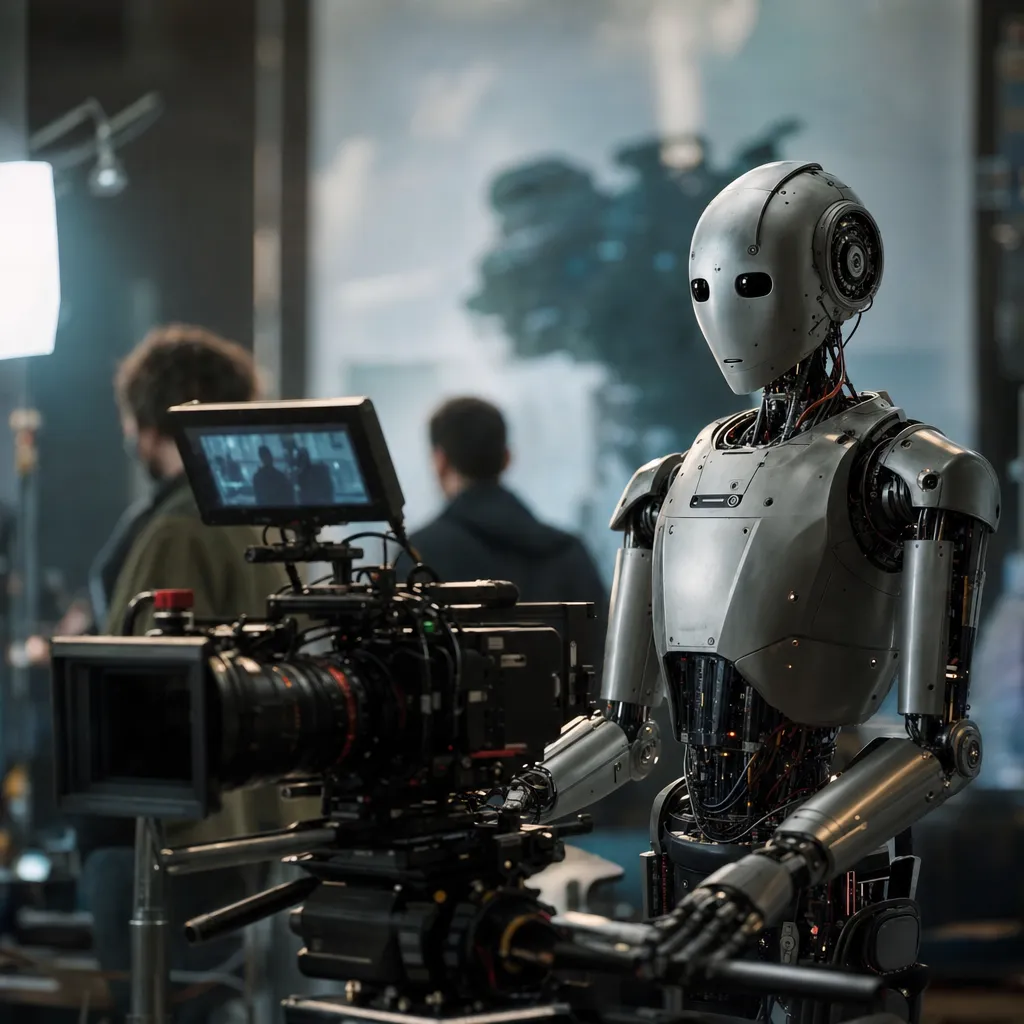
The 34th Camerimage International Film Festival opened with a robot walking to the podium in place of its founder, centering the entire program on AI's disruption of cinematography — confirming the craft film community has moved from resistance to active engagement.
The 34th Camerimage International Film Festival opened in Toruń, Poland this week with a robot walking to the podium in place of founder Marek Żydowicz — a deliberately theatrical gesture that set the terms of a program centered almost entirely on AI's disruption of cinematography, confirming that the craft film community has moved from resistance to active engagement.
Camerimage has spent three decades as a festival defined by specificity: it celebrates the cinematographer, the director of photography, the camera operator — the craft behind the frame rather than the vision in front of it. That specificity had made it one of the last significant international film events to remain relatively insulated from AI's disruption of narrative production. This year, that changed.
The program as argument
Honorary award recipient Darren Aronofsky, who co-founded an AI film studio with Google DeepMind in 2026, used his remarks to argue that AI tools expand cinematographic vision rather than replace it — positioning AI as an instrument of craft rather than a displacement mechanism. The framing reflects where many of the most prominent cinematographers and directors of photography have landed after a year of hands-on experimentation with generative tools.
The festival screened Luca Guadagnino's satirical film Artificial in competition, which IndieWire reports generated the most sustained post-screening discussion of the entire festival program. Guadagnino's film uses AI-generated visual sequences within a live-action narrative frame, making it a focal point for debates about whether AI-generated imagery can carry the intentionality — the deliberate visual decision-making — that defines cinematographic craft at its highest level.
Get this in your inbox.
Daily AI intelligence. Free. No spam.
What actually shifted
The festival's reorientation mirrors a broader industry pattern. Resistance from unions and craft guilds, which peaked during the 2023-2024 strike wave, has given way to conditional engagement: AI tools are increasingly accepted when they augment human creative decisions rather than automate them, when they are credited transparently, and when craftspeople using them retain authorial control.
What Camerimage 2026 represents is an institutional legitimization of that shift. By centering its program on AI, the festival signals to the cinematography community that engaging with AI tools is now compatible with serious craft practice — not a capitulation to industrial automation, but an expansion of the cinematographer's toolkit.
The industrial backdrop
The timing is not coincidental. AI-generated visual content has moved from novelty to production tool across multiple industry segments in 2026. Studios and streaming platforms are using AI for elements traditionally handled by second-unit photography, B-roll acquisition, and certain visual effects categories. Production budgets are being restructured around AI compositing and generation workflows.
For cinematographers, this is not an abstract cultural debate. It is a direct question about which parts of their craft survive industrial automation and which parts become AI-augmented workflows requiring new skills rather than traditional ones. The robot at the podium was a provocation. What it provoked was not outrage — it was a five-day conversation about craft, authorship, and technology that the festival's programming was designed to frame rather than resolve.
What to watch
Camerimage's shift does not represent the full craft community. Watch for how the American Society of Cinematographers and the British Society of Cinematographers respond to AI tool adoption in their training programs, award categories, and membership guidelines. Those institutional responses will shape how the next generation of cinematographers is educated, and what "craft" means in production environments where AI is a standard workflow tool.
Did this help you understand AI better?
Your feedback helps us write more useful content.
Get tomorrow's AI briefing
Join readers who start their day with NexChron. Free, daily, no spam.