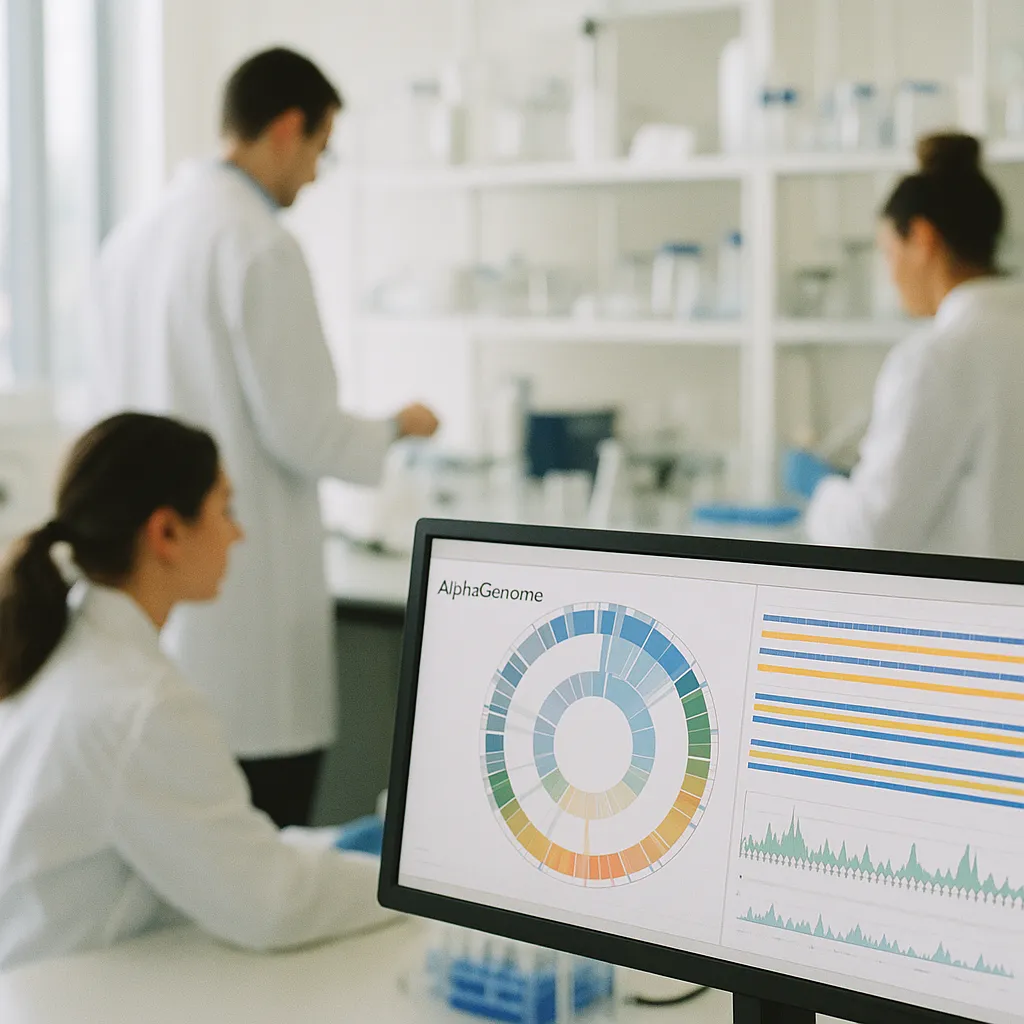
Google DeepMind released a free public database of precomputed predictions for all 9 billion possible human DNA mutations — potentially compressing rare disease diagnosis from months to hours.
Google DeepMind Releases AlphaGenome Atlas, Mapping Every Possible Human DNA Mutation
By Hector Herrera | September 22, 2026
Google DeepMind published AlphaGenome Atlas on September 8, giving researchers instant access to precomputed molecular-effect predictions for every possible single-nucleotide change in the human genome — all 9 billion of them — without writing a single line of code. For the rare disease field, the release converts a months-long computation problem into a lookup query.
Context
The human genome contains roughly 3 billion base pairs. Each position can change to three alternative letters, producing approximately 9 billion possible single-nucleotide variants (SNVs). Until now, predicting what any given change does — to gene expression, regulatory sequences, or protein function — required running DeepMind's underlying AlphaGenome model directly, a process demanding significant compute resources and technical expertise unavailable to most clinical laboratories.
AlphaGenome Atlas eliminates that barrier by precomputing and storing the predictions for all 9 billion variants in a free, publicly accessible database.
What DeepMind released
For each of the 9 billion variants, the atlas stores approximately 27,000 individual molecular predictions alongside a single summary metric called the AlphaGenome Variant Impact (AVI) score — a composite indicator of predicted pathogenicity designed for clinicians who need a quick signal before examining the full prediction set. The prediction set covers:
Get this in your inbox.
Daily AI intelligence. Free. No spam.
- Gene expression changes — how the variant alters transcription levels for nearby genes
- Regulatory effects — impact on enhancers, promoters, and splice sites that control gene activity
- Protein function — downstream consequences for the resulting protein structure and behavior
The interface requires no coding skills, meaning a clinician with a sequencing result can retrieve 27,000 precomputed predictions and an AVI score directly.
Who benefits first
The most immediate beneficiaries are clinical geneticists working on rare disease diagnosis. Roughly 300 million people worldwide live with rare diseases, and the majority go undiagnosed or misdiagnosed for years because interpreting a patient's genetic sequencing data requires cross-referencing thousands of candidate variants — a bottleneck that compounds in under-resourced settings where bioinformatics teams are not available.
AlphaGenome Atlas converts that bottleneck into a direct lookup. A clinician with a candidate variant from a patient's sequencing panel can retrieve the full prediction set immediately.
The second major application is pharmaceutical target validation. When a drug developer hypothesizes that a gene is a useful therapeutic target, they typically seek "human genetic validation" — evidence that natural variants in populations affecting that gene produce the expected health outcomes. That analysis previously required substantial per-target computational investment. The atlas makes it a query.
For clinical geneticists, a third use case is variant of uncertain significance (VUS) reclassification — a persistent bottleneck in returning actionable results from genetic panels — where AVI scores can help prioritize which uncertain variants warrant further experimental characterization.
The competitive dynamic
Most large pharmaceutical companies and several academic medical centers have invested in proprietary variant effect prediction pipelines. A free, comprehensive, precomputed public atlas undercuts the differentiation of those investments while simultaneously accelerating the entire field. That is the consistent pattern in DeepMind's scientific releases — create infrastructure others build on, maximize reach.
What to watch
The critical next step is independent clinical validation: published studies showing AVI scores correlate with pathogenicity classifications from established databases like ClinVar. DeepMind has not yet published peer-reviewed validation studies against large clinical cohorts, and the release is framed as a research tool rather than a diagnostic instrument.
If those correlations prove strong, AlphaGenome Atlas could become an embedded component of clinical variant interpretation pipelines within two to three years. Watch for hospital systems and academic medical centers to announce integrations in early 2027 as clinical informatics teams complete evaluation cycles.
Did this help you understand AI better?
Your feedback helps us write more useful content.
Get tomorrow's AI briefing
Join readers who start their day with NexChron. Free, daily, no spam.