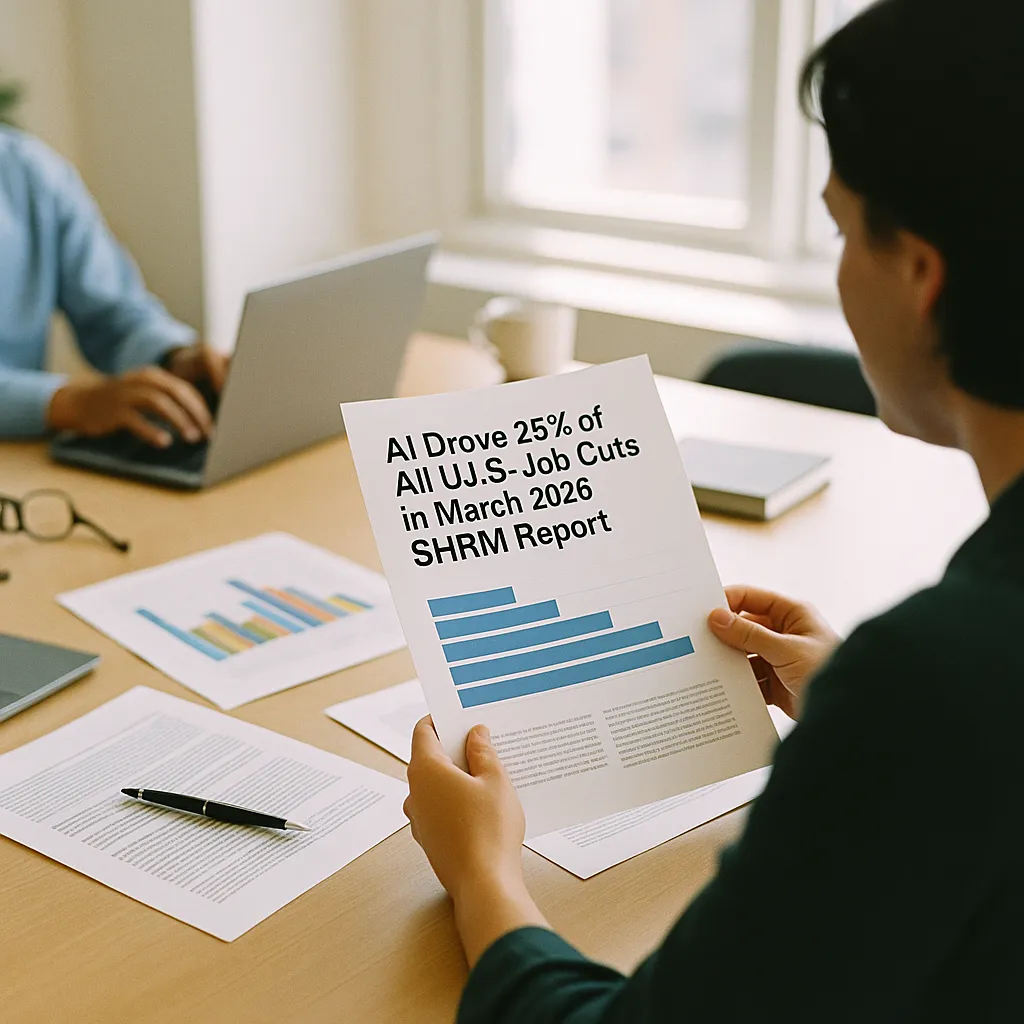
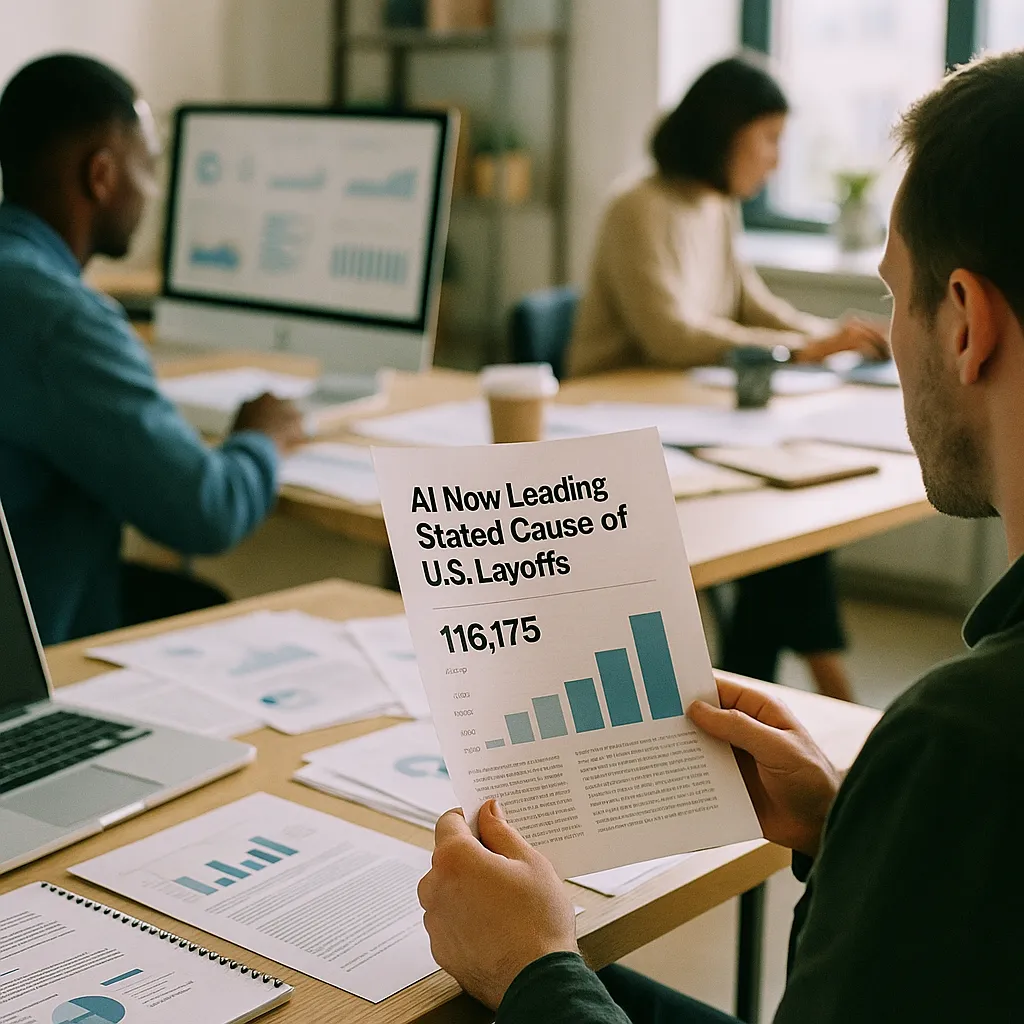
SHRM's 2026 displacement report finds artificial intelligence was directly responsible for 15,341 layoff announcements in March — one in four U.S. job cuts for the month — as AI's share of labor market contraction becomes measurable and accelerating.
AI Drove 25% of All U.S. Job Cuts in March 2026, SHRM Report Finds
By Hector Herrera | June 16, 2026 | NexChron.com
Artificial intelligence was directly responsible for one in four U.S. layoff announcements in March 2026, according to a comprehensive displacement report from the Society for Human Resource Management — the most precise accounting yet of AI's share in the American labor market contraction. The finding reshapes the conversation from "will AI take jobs" to "AI is taking jobs, and at what rate."
The background: Throughout 2024 and 2025, AI's labor market impact was debated but difficult to quantify precisely. Layoffs happened simultaneously with hiring slowdowns, and attributing cuts to AI rather than interest rates, demand softness, or operational restructuring was methodologically contested. SHRM's 2026 report addresses that directly, surveying employers on stated reasons for workforce reductions and cross-referencing against publicly announced layoff data.
The Numbers
SHRM's findings for March 2026:
- 15,341 announced job cuts were directly attributed to AI or automation — out of roughly 61,000 total U.S. layoff announcements for the month
- That equals 25% of all U.S. job cuts in a single month tied explicitly to artificial intelligence
- 1 in 6 employers now expects AI to reduce their headcount in 2026
- Goldman Sachs estimates net AI-attributed U.S. job losses at ~11,000 per month in 2026, accounting for both displacement and AI-adjacent hiring
The March figure is not a one-month anomaly. The report documents a steady acceleration from 2024, when AI attribution in layoff announcements was in the low single digits.
The Mechanism: Hiring Freeze, Not Mass Layoff
The most important finding in the SHRM report is structural, not numerical. AI is primarily eliminating jobs before they are created, not eliminating incumbents.
What this looks like in practice:
Get this in your inbox.
Daily AI intelligence. Free. No spam.
- A company that would have hired 10 junior analysts instead hires 4 and uses AI tools to cover the remaining workload
- An entry-level customer support role that was historically a first job for recent graduates gets automated before it is ever posted
- Promotion pipelines thin out: the junior-to-mid-level progression that built institutional knowledge gets short-circuited when the junior roles disappear
This is measurably different from the displacement narrative of 2023–2024, which focused on incumbents being replaced. The current data pattern looks more like labor market attrition — the workforce doesn't shrink dramatically overnight, but the bottom rungs of the career ladder are quietly being removed.
The SHRM report calls this "anticipatory displacement" — organizations restructuring before the full AI capabilities are even deployed, based on projected productivity gains.
Who Is Most Exposed
The report identifies clear exposure patterns:
- Administrative and data processing roles face the highest immediate displacement rates — document handling, data entry, and routine correspondence are among the first functions to be automated at scale
- Entry-level finance and accounting positions are shrinking as AI handles reconciliation, reporting, and basic analysis that formerly required junior staff
- Customer-facing support and intake roles — including call center, intake processing, and first-tier help desk — are being automated through conversational AI rather than offshored
The sectors showing the highest AI attribution in layoff announcements: financial services, technology, and healthcare administration — all industries with large volumes of structured, repeatable knowledge work.
The Tension: AI Job Creation vs. AI Job Destruction
The 11,000 net monthly job losses estimated by Goldman Sachs is a net figure. Gross AI-attributed job creation — in roles like AI trainer, prompt engineer, AI systems integrator, and AI-adjacent infrastructure — is substantial and growing. The problem is skills mismatch: the jobs being created require different credentials and experience than the jobs being eliminated.
A 52-year-old data entry specialist and a 23-year-old recent finance graduate do not transition easily into AI systems integration roles. The net numbers look manageable; the human reality inside those numbers is considerably more disruptive.
The SHRM data also capture a timing problem. AI job creation is concentrated in a handful of metropolitan markets — San Francisco, New York, Austin, Seattle. AI-driven job displacement is distributed nationally, hitting mid-size cities and rural regions where there are no offsetting AI employer clusters.
What Companies Are Getting Wrong
The report's employer survey surfaces a troubling pattern: most organizations automating roles have not implemented workforce transition programs. Of companies that reported reducing headcount due to AI in the past 12 months:
- Only 34% offered affected employees any form of reskilling support
- 61% described their transition assistance as "informal" or "ad hoc"
- Less than 20% had formal policies governing how AI-driven restructuring decisions are communicated to employees
The legal exposure here is growing. Several state legislatures — including Colorado, with its June 30 AI Act compliance deadline — are beginning to require impact assessments for automated employment decisions. The SHRM data suggest most employers are not yet operating at that standard.
What to Watch
The SHRM report is a baseline. The trajectory — from low single digits in AI attribution in 2024 to 25% of all cuts in March 2026 — suggests the figure will climb further as agentic AI tools reach production deployment across more enterprise functions. The policy question that follows is whether workforce transition obligations become mandatory at the federal level, or whether companies are allowed to manage this as an internal HR matter while the entry-level job pipeline continues to thin.
Sources: SHRM 2026 AI and Job Displacement Report | Colorado AI Act deadline coverage
Did this help you understand AI better?
Your feedback helps us write more useful content.
Get tomorrow's AI briefing
Join readers who start their day with NexChron. Free, daily, no spam.