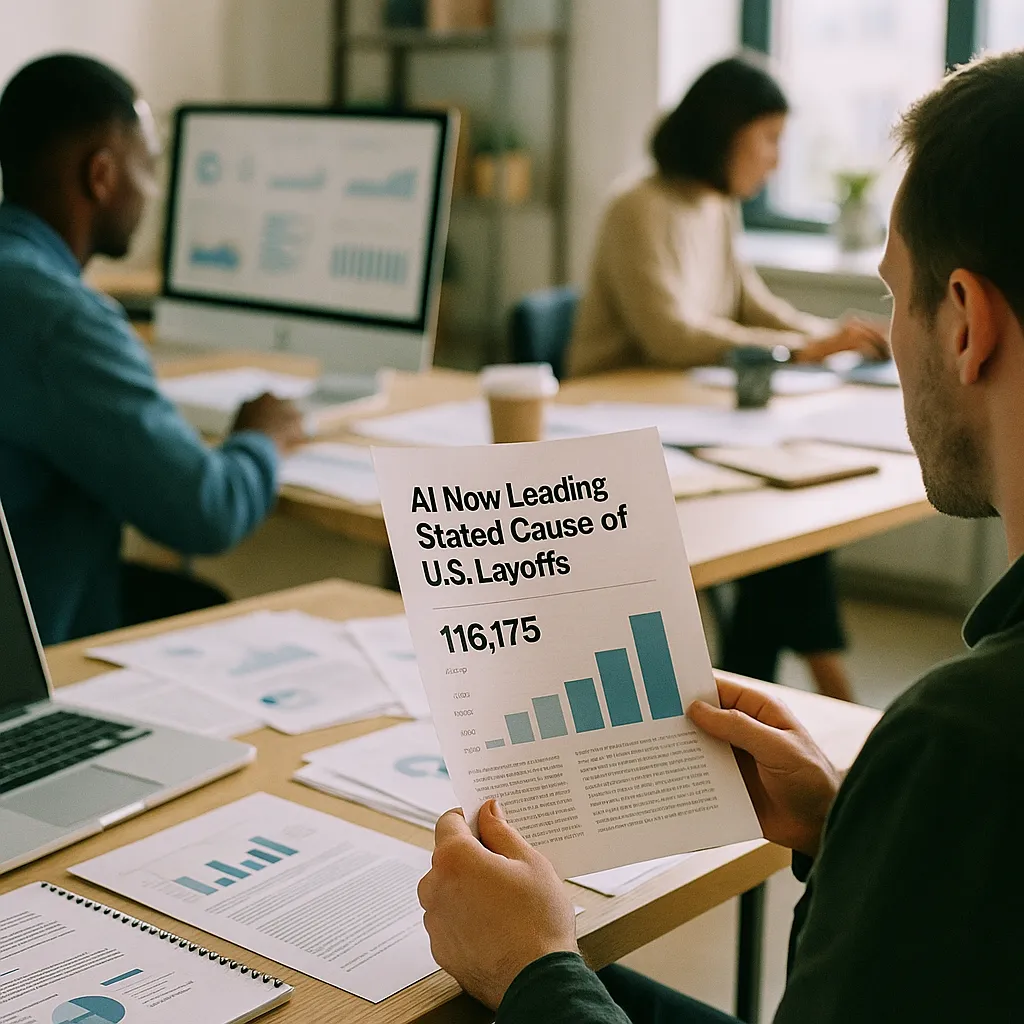
AI isn't firing workers who have jobs—it's eliminating the positions they would have been hired into, with Goldman Sachs tracking 16,000 net U.S. job losses per month. Gen Z, concentrated in the white-collar roles that automate most easily, bears the heaviest cost.
AI Is Eliminating the Entry-Level Job Pipeline — And Gen Z Is Paying the Price
By Hector Herrera | June 12, 2026 | Work
AI's employment impact in 2026 is becoming clearer, and it looks different from what most people expected. AI isn't firing people who have jobs — it is quietly eliminating the positions that new workers would have been hired into, with Goldman Sachs tracking roughly 16,000 net U.S. job losses per month attributable to AI. The mass layoffs that dominate headlines are one part of the story. The invisible part — the positions that simply aren't being posted — may be the bigger long-term threat to workforce mobility.
Generation Z bears the brunt because they are concentrated in exactly the role categories that automate most easily: data entry, customer service, legal support, billing, content moderation, basic research, and administrative coordination. These are the jobs that 22-year-olds get first, that teach them how organizations function, and that provide the visible track record needed to move into more complex roles. When those jobs disappear, the career ladder doesn't just lose a rung — it loses the ground floor.
The Numbers
Companies have announced nearly 50,000 AI-linked job cuts in 2026, according to data compiled from major employer announcements. But that figure undercounts the real impact. Job cut announcements require a press release and an explicit attribution to AI — they are the visible layer. What isn't counted is the far larger category of hiring slowdowns: positions that went unfilled when a manager decided an AI tool could cover the workload, roles that were consolidated when a department's AI deployment reduced the headcount needed.
Goldman Sachs's 16,000 net losses per month figure attempts to measure the net effect — job losses minus any AI-created jobs — but economists note that the new jobs created by AI adoption tend to require more education, more experience, or both, and are not accessible to the same workers displaced from entry-level roles.
The problem is structural, not cyclical. In previous waves of automation — manufacturing robots, spreadsheet software, ATMs — the displaced workers could often move into service roles that required human judgment and interpersonal skills. The current wave is automating those service and judgment-support roles directly, and doing it at the same time as entry-level white-collar work, which narrows the path for lateral moves.
What's Actually Being Automated
The role categories disappearing at the entry level are not exotic. They are the roles that hundreds of thousands of college graduates have used as starting points:
Legal support: Document review and first-pass contract analysis, which typically employed junior associates and paralegals, are now handled by AI platforms like Harvey AI and Ironclad — with law firms reporting contract review dropping from two days to two hours without quality loss. The headcount those firms are not rebuilding is entry-level legal staff.
Get this in your inbox.
Daily AI intelligence. Free. No spam.
Financial services: Junior analyst work — market data compilation, earnings summary generation, initial due diligence memos — is being handled by AI at investment banks and asset managers that have publicly stated they are not backfilling departed junior analysts. Goldman Sachs, Morgan Stanley, and others have been explicit about this in internal communications cited by financial press.
Customer service: AI voice and chat systems now handle a significant share of tier-1 customer service interactions. The entry-level customer service representative position — which for many service workers was a pathway into higher-responsibility customer-facing roles — is contracting rapidly.
Content and research: Entry-level content production roles, research assistant positions, and data summarization work across media, consulting, and corporate communications are being replaced or dramatically reduced by AI writing and synthesis tools.
Why Gen Z Specifically
Previous generations who faced automation pressure were, on average, older workers with accumulated savings, networks, and transferable credentials. Gen Z workers entering the labor market in 2025-2026 are starting with none of those buffers.
They also face a compounding dynamic. The iCIMS 2026 hiring data showed a marked decline in Gen Z confidence about job prospects — not because of pessimism, but because the experience of applying for jobs that used to be easy entry points and repeatedly not hearing back is a real, documented phenomenon. The number of applications per offer in entry-level white-collar categories has increased substantially over the past 18 months.
The demographic timing is genuinely bad. Gen Z is the most highly educated generation in U.S. history by college attainment rate, entering the workforce at exactly the moment that credential inflation and AI automation are colliding. The expected ROI on a four-year degree was premised on entry-level professional roles being available. That premise is weakening.
The Counterargument and Why It Falls Short
The standard response to automation displacement anxiety — "new jobs will be created" — is true in the long run but increasingly inadequate as a near-term policy response. History does support the claim that economies adapt and new categories of work emerge. It does not support the claim that workers displaced from specific roles are the people who get those new jobs, or that the transition happens on a timeline that is meaningful for an individual's career trajectory.
The new jobs being created by AI — AI trainers, prompt engineers, governance specialists, data quality auditors — are being filled by workers who already have technical or domain-specific credentials. They are not being filled by 22-year-olds who were displaced from a billing coordinator role.
The relevant policy question is not whether the economy will eventually adjust. It's who bears the cost of the transition, and how long that transition takes.
What To Watch
The 2026 election cycle is already generating legislative proposals around AI's labor impacts. Watch for developments on three fronts: federal legislation requiring employers to disclose AI-driven headcount reductions (currently proposed but not passed), state-level workforce retraining funding tied specifically to AI displacement, and any changes to federal student loan policy that acknowledge the shifting labor market value of certain degree categories.
Also watch corporate hiring transparency initiatives. Several major employers — under pressure from institutional investors and employee advocacy groups — are now reporting AI-related headcount decisions as part of ESG disclosures. As that reporting becomes more detailed, the invisible hiring slowdown will become increasingly visible and quantifiable.
Sources: AI Layoffs and Hiring Cuts, CBS News
Did this help you understand AI better?
Your feedback helps us write more useful content.
Get tomorrow's AI briefing
Join readers who start their day with NexChron. Free, daily, no spam.