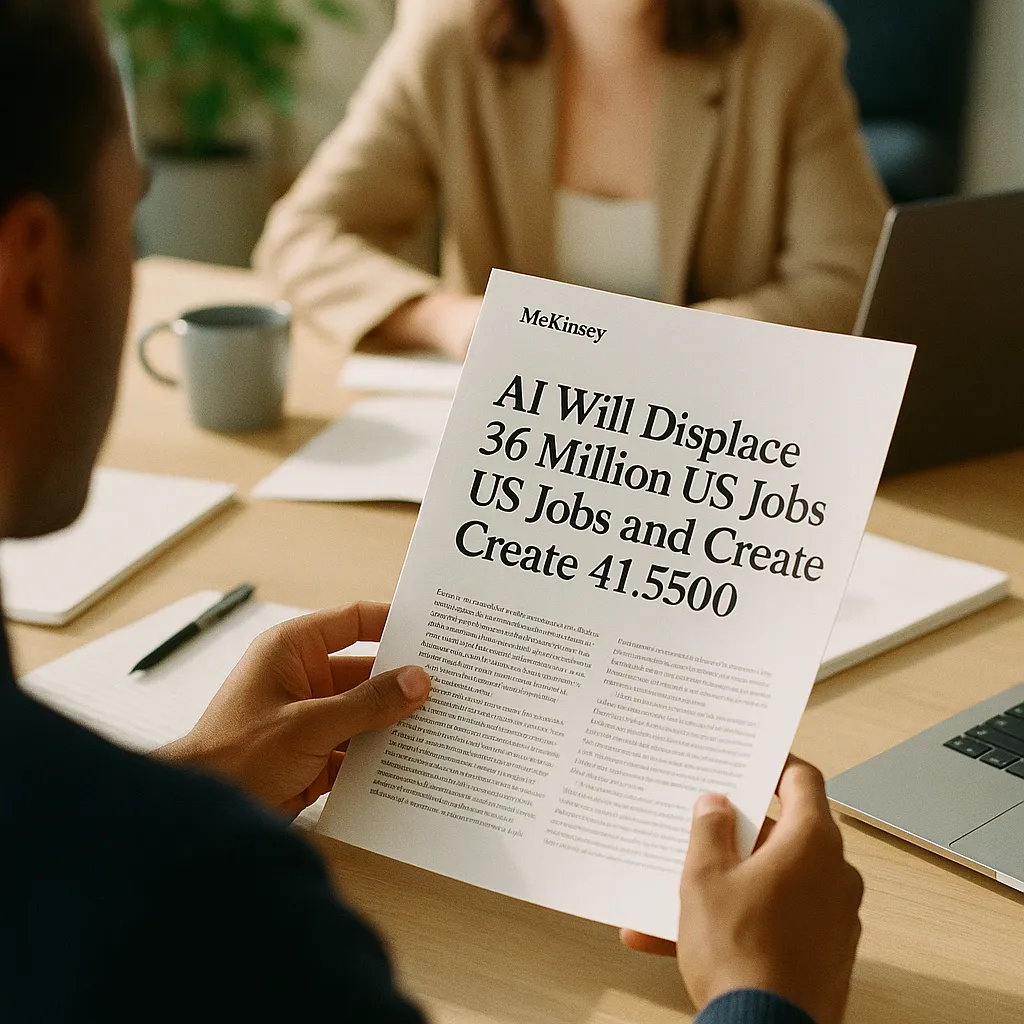
The Searchlight Institute has published a revenue-neutral federal tax blueprint to fund enhanced unemployment insurance and retraining for workers displaced by AI, as Goldman Sachs estimates the technology is eliminating roughly 16,000 net U.S. jobs per month.
The Searchlight Institute has published one of the first detailed, revenue-neutral proposals to use federal tax policy as a funding mechanism for an AI-era worker safety net — arriving as Goldman Sachs estimates AI is eliminating roughly 16,000 net U.S. jobs per month, concentrated in entry-level and administrative roles.
The Washington Post reported the blueprint's release and noted it is drawing bipartisan attention from Congressional staff, a notably positive signal in an environment where AI policy discussions frequently stall over ideological disagreements about regulation versus competitiveness.
What the Blueprint Proposes
The Searchlight Institute's proposal centers on targeted modifications to the federal tax code rather than new spending programs — a deliberate design choice to make the mechanism politically viable in a fiscal environment hostile to new outlays.
The core architecture:
Tax adjustment on AI-driven productivity gains: Companies that document material reduction in labor costs attributable to AI automation would face a graduated adjustment to their corporate tax treatment — structured not as a penalty but as a contribution mechanism toward worker transition programs. The adjustment is designed to be smaller than the labor cost savings, preserving the economic incentive to adopt AI while directing a portion of the productivity gain toward displaced workers.
Enhanced unemployment insurance funding: Revenues from the adjustment flow into a dedicated federal fund that extends unemployment benefit duration for workers displaced by AI — with duration tied to documented AI-driven displacement rather than standard cyclical unemployment criteria. The distinction matters: current UI was designed for workers who will return to similar jobs when economic conditions improve. AI displacement may require longer retraining timelines before workers can return to comparable roles.
Federally funded retraining programs: The fund also supports access to accredited retraining programs in fields identified as AI-complementary rather than AI-replaceable — including AI system operation, maintenance, healthcare support roles, skilled trades, and other occupations where AI augments rather than replaces human capability.
Revenue neutrality: The proposal is structured to be revenue-neutral over a five-year projection window by offsetting any increased expenditure on UI and retraining against reduced need for other federal safety net programs as displaced workers successfully transition to new employment.
The Problem It Is Solving
Current federal safety net infrastructure was designed for a different displacement pattern than AI is producing.
Get this in your inbox.
Daily AI intelligence. Free. No spam.
Traditional economic disruption — factory closures, recessions, industry downturns — creates concentrated regional unemployment that is cyclical: workers lose jobs, businesses eventually recover or new ones form, workers return to similar work in similar occupations. The federal UI system provides a bridge during that gap, typically weeks to a few months.
AI displacement has different characteristics. It tends to be:
- Occupationally specific: AI replaces discrete functions (document processing, customer service routing, basic financial analysis) across many industries simultaneously rather than closing specific facilities
- Structurally permanent: The function being automated does not return when economic conditions improve
- Broadly distributed: Affected workers are spread across geographies and industries, without the regional concentration that triggers federal economic disaster declarations
These characteristics mean displaced workers often do not qualify for or receive adequate support under existing programs. A call center worker in suburban Ohio whose function was automated by an AI system has the same federal UI entitlement as a construction worker laid off during a slow quarter — even though the former faces a structural rather than cyclical employment gap.
The 16,000 net U.S. jobs per month figure from Goldman Sachs reflects AI-attributed net job loss — the difference between positions eliminated through automation and new positions created in AI-adjacent fields. That figure has been climbing through 2026 as enterprise AI deployment has accelerated past the pilot stage into production operations.
The Searchlight proposal implicitly stakes its case on this number continuing to grow. If AI-driven displacement remains at current rates or accelerates, the funding mechanism collects more revenue and serves more displaced workers. If displacement slows because AI adoption plateaus or because the economy creates new jobs at a comparable rate, the mechanism naturally scales down.
That scaling property is a deliberate design choice, and one of the features drawing bipartisan interest. Unlike a fixed appropriation that requires annual reauthorization, the mechanism adjusts to actual labor market conditions — collecting more when displacement accelerates, less when it slows.
Political Viability
Tax-based approaches to social policy consistently attract more bipartisan interest than direct spending programs, particularly in the current Congressional environment. The Earned Income Tax Credit, the R&D tax credit, and the energy investment tax credit all achieve policy objectives through tax code modifications rather than spending lines — which makes them easier to defend against charges of government overreach.
The Searchlight proposal applies that same logic to AI workforce transition. It does not regulate AI. It does not restrict corporate adoption of automation. It creates a mechanism that partially redirects a portion of the productivity gains from AI toward the workers displaced in generating those gains.
Conservative critics are likely to focus on whether the corporate tax adjustment constitutes a de facto penalty on investment in American technology. Progressive critics may argue the mechanism is insufficient given the scale of displacement and that it leaves workers dependent on a market-rate corporate compliance structure.
Both lines of criticism are real, but neither is insurmountable with technical adjustments to the proposal's rate structure and thresholds.
What to Watch
The Searchlight blueprint is a policy proposal, not a bill — its impact depends entirely on whether it finds a legislative sponsor and survives markup. Two signals will indicate whether it has real traction:
- Congressional sponsorship: Does a Senate or House member introduce companion legislation drawing on the blueprint's framework before the end of the current legislative session?
- Budget scoring: Does the Congressional Budget Office score the proposal as revenue-neutral, or does its modeling produce a cost figure that changes the political calculation?
If the CBO score supports revenue neutrality and a bipartisan sponsor emerges, the Searchlight proposal moves from think-tank document to live legislative negotiation. That is a more realistic path to passage than comprehensive AI labor legislation — which has repeatedly failed to advance — and it may be the model that finally moves the U.S. toward an explicit AI workforce policy.
Did this help you understand AI better?
Your feedback helps us write more useful content.
Get tomorrow's AI briefing
Join readers who start their day with NexChron. Free, daily, no spam.