McKinsey projects AI and automation will net-create five million US jobs by 2035 — but only 1 in 7 displaced workers has a clear path to a growing occupation, and 120,000 job cuts have already cited AI in 2026 alone.
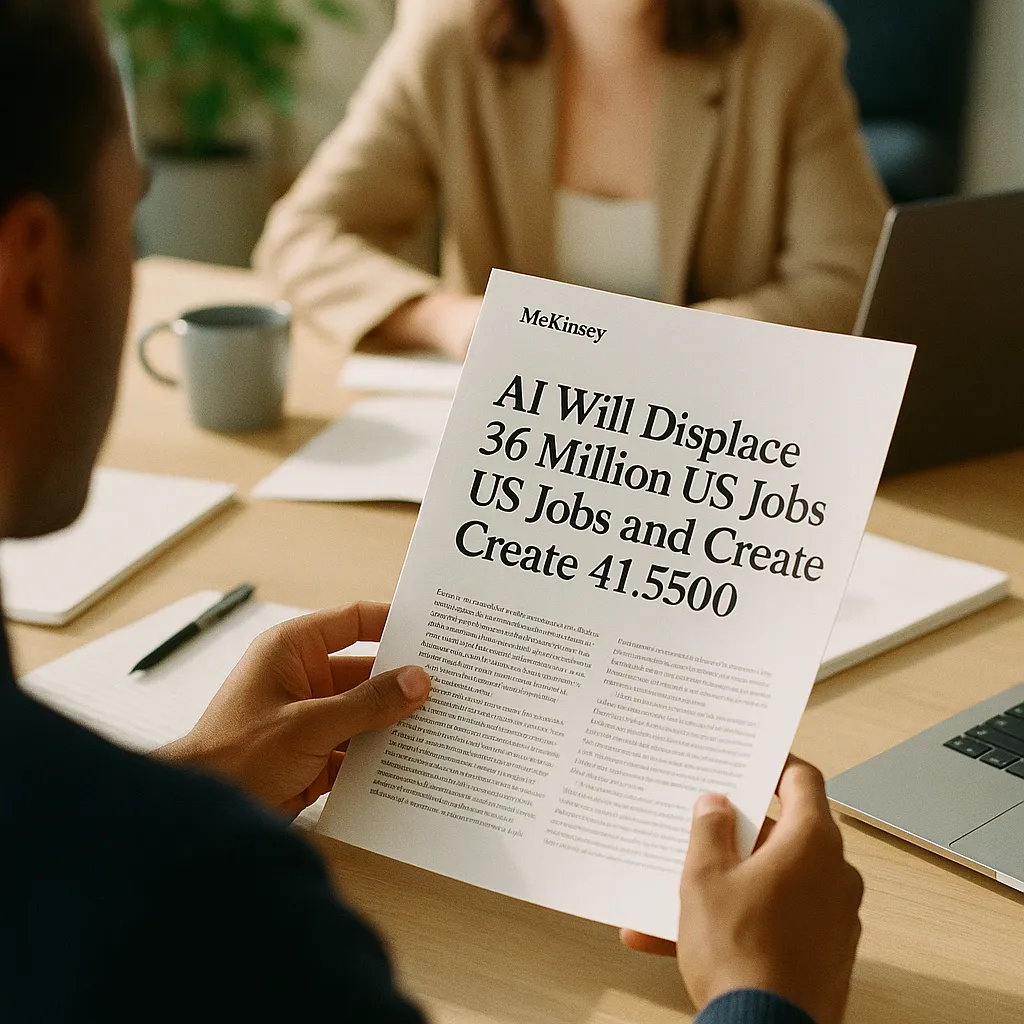
AI and automation will eliminate demand for roughly 36 million US jobs by 2035 while creating approximately 41 million new and expanded roles — a net positive that disguises a severe worker transition crisis. The complication: only one in seven workers displaced by AI has a clear path to a growing occupation, according to McKinsey Global Institute's latest labor projections.
The headline numbers from McKinsey's report, covered by Fortune, will show up in political speeches on both sides of every argument about AI's labor impact. Both will be right, narrowly. The net gain of five million jobs is real. So is the fact that the workers holding the 36 million disappearing jobs are largely not the workers qualified for the 41 million emerging ones.
The 1-in-7 Problem
McKinsey's most significant finding is not the aggregate job math but the transition math. Of the 36 million workers projected to face displacement, only 1 in 7 has a direct occupational path into a sector or role that is growing. The other six face retraining requirements that range from moderate to substantial — learning new technical skills, relocating to different labor markets, or competing for roles that have different entry barriers than the jobs they currently hold.
This is the gap between an economist's view of labor market equilibrium and a worker's actual experience of job loss. Markets do eventually rebalance. The workers caught in the transition window bear the cost of that rebalancing personally, and many will not complete it successfully without structural support.
What's Already Happening
The report's projections extend to 2035, but the displacement is not a future event — it is current. According to McKinsey's data, AI has been cited in more than 120,000 announced US job cuts in 2026 alone, making it the leading stated cause of layoffs year-to-date. That is a meaningful shift from prior years, when automation was more often listed as a contributing factor rather than the primary driver.
Get this in your inbox.
Daily AI intelligence. Free. No spam.
The sectors most exposed to near-term displacement include:
- Administrative and clerical work — document processing, scheduling, data entry, basic customer communication
- Customer service and support — first-tier resolution increasingly handled by AI agents
- Certain legal support roles — document review, paralegal research, contract management
- Entry-level financial analysis — report generation, data aggregation, market summary work
- Some healthcare support functions — prior authorization, coding, certain diagnostic support tasks
The roles being created skew toward AI oversight, engineering, healthcare delivery, infrastructure trades, and professional services requiring human judgment. The skills mismatch between the two lists is not subtle.
What McKinsey Recommends
The report calls for sustained federal investment in occupational retraining as the primary policy lever — not the only lever, but the one with the clearest causal line between investment and outcome. Specific recommendations include:
- Portable training accounts — funding that follows workers across employers and industries
- Expanded community college capacity in AI-adjacent technical fields
- Real-time labor market data systems to match training investments to actual job growth signals
- Employer co-investment mandates — incentives or requirements for companies benefiting from AI productivity gains to contribute to retraining costs
The federal government has not committed to this level of investment at the scale McKinsey suggests would be necessary. The current political environment makes large new workforce spending bills unlikely before the 2028 election cycle, which means the transition window is effectively unsupported at the policy level for at least the next two years.
The Business Angle
For companies, the report contains a data point that gets less attention than the job numbers: McKinsey's modeling suggests that the productivity gains from AI adoption are front-loaded to firms that deploy early and at scale, while the workforce costs are distributed across the broader economy. That is not unusual in technology transitions — businesses captured most of the gains from the PC and internet revolutions too — but the speed of the current transition compresses the timeline in ways that give policymakers less time to respond.
Companies that are currently deploying AI broadly face a secondary question the McKinsey numbers make concrete: what do you owe the workers whose roles change because of your AI investment? The answer is legally minimal in most US jurisdictions but reputationally significant as public attention to AI displacement grows.
What to Watch
The October jobs report from the Bureau of Labor Statistics will be watched specifically for AI-attributable displacement signals. McKinsey's projection that 120,000 cuts have already cited AI in 2026 suggests that number will keep rising through year-end. Whether Congress picks up the retraining investment thread before the session ends — or whether it waits for a more visible labor crisis — is the policy question that will define how much of the 1-in-7 problem gets solved versus absorbed as permanent unemployment.
Did this help you understand AI better?
Your feedback helps us write more useful content.
Get tomorrow's AI briefing
Join readers who start their day with NexChron. Free, daily, no spam.