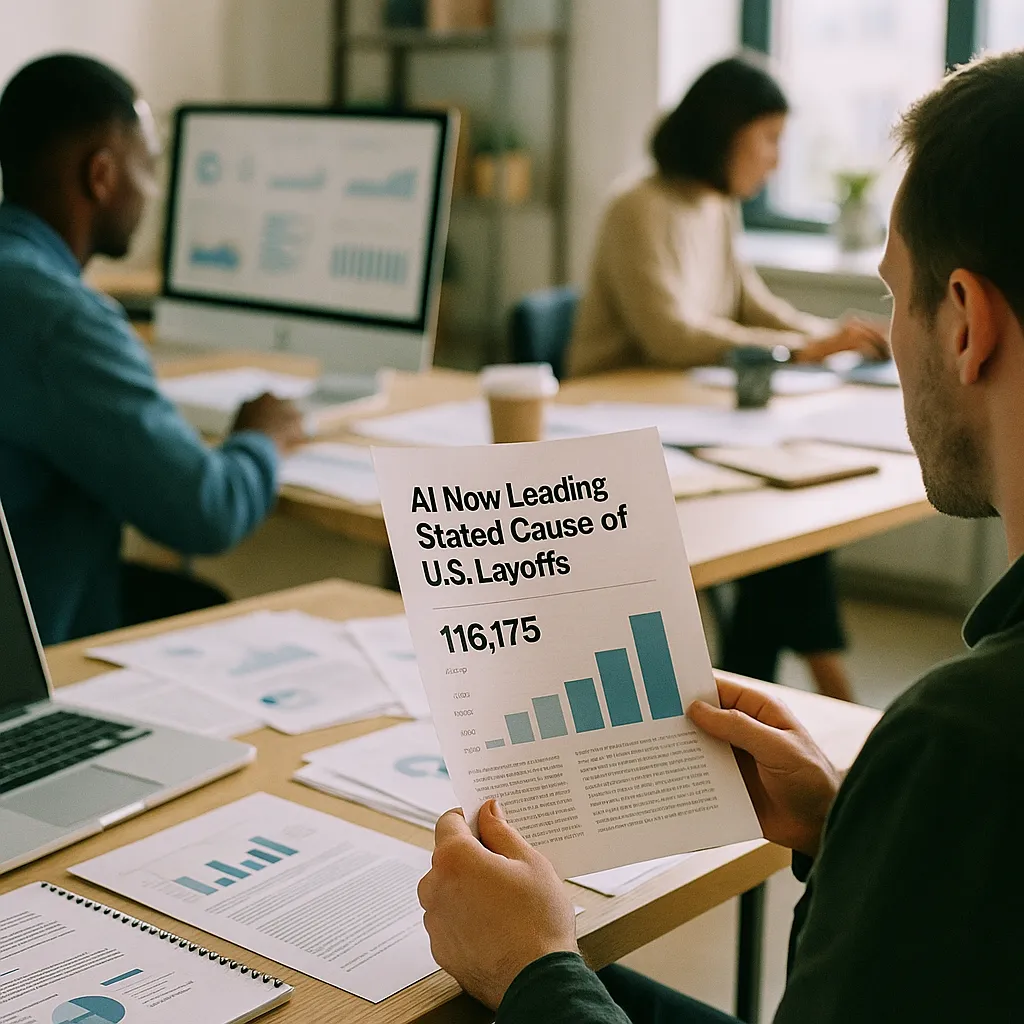
Anthropic's first empirical study of AI's labor market impact—drawn from real Claude usage data—finds entry-level knowledge roles already showing measurable task displacement while senior roles augment.
Anthropic Publishes First Direct Empirical Measurement of AI's Labor Market Exposure Effects
By Hector Herrera | June 9, 2026 | Work
Anthropic has published research introducing a direct empirical measure of AI's labor market impact — the first study of its kind to move beyond theoretical job-exposure models to observed data drawn from actual Claude usage patterns. The findings show that AI's effects on knowledge work vary dramatically by occupation, income level, and how deeply organizations have adopted AI tools. The key split: some roles are experiencing measurable task displacement today; others are seeing productivity augmentation that, at least so far, has not reduced headcount.
This matters because almost every prior study in this space — including influential frameworks from McKinsey, Oxford, and Brookings — has relied on theoretical models of AI capability against job task taxonomies. Anthropic is now publishing what actually happened when real workers used its systems at scale.
What the Study Measures
The research introduces what Anthropic calls a direct empirical exposure measure: rather than asking "could an AI theoretically do this task," the study tracks which knowledge worker tasks are actually being delegated to Claude, at what frequency, and by which occupational categories.
The core methodology maps real Claude usage to O*NET task descriptors — the Labor Department's standardized database of what workers across hundreds of occupations actually do day-to-day. By matching observed usage to that taxonomy, the researchers can identify where AI is genuinely absorbing tasks (displacement signal) versus augmenting worker output without replacing tasks (productivity signal).
Key findings from the study, according to Anthropic's published research:
- Task displacement is already measurable in a subset of high-frequency knowledge work categories, particularly roles centered on information synthesis, first-draft writing, and structured data analysis.
- Productivity augmentation dominates at higher income levels. Workers earning above roughly $75,000 annually are more likely to use AI to do more work in the same time, rather than use AI to eliminate their own role.
- Entry-level and mid-skill knowledge roles show the clearest displacement signals. Tasks like first-pass legal review, initial financial analysis writeups, basic code generation, and customer support scripting are appearing heavily in the displacement-pattern cluster.
- Adoption context matters as much as occupation. The same role at a high-AI-adoption organization shows a different impact profile than the same role at a low-adoption organization — meaning industry-wide averages mask significant variance at the firm level.
Why This Is Different from Prior Research
Previous job-impact studies have produced a wide range — from "AI will displace 300 million jobs" to "AI primarily augments workers" — partly because they disagree on what to measure. Theoretical capability models ask whether AI could perform a task; usage-based models ask whether workers are actually delegating that task.
Get this in your inbox.
Daily AI intelligence. Free. No spam.
Anthropic's empirical approach sidesteps the theoretical question entirely. The limitation, which the researchers acknowledge, is that it captures current usage patterns — which are shaped by today's Claude capabilities, current pricing, and existing organizational AI adoption rates. As model capabilities increase and adoption spreads, the distribution could shift materially.
The research also does not directly measure hiring or firing decisions — it measures task-level exposure, not employment outcomes. That is an important distinction: a worker whose tasks are being absorbed by AI may still retain their job while doing higher-value work, or they may be on a path toward role elimination. The study cannot yet distinguish between those trajectories at scale.
The Occupation Breakdown
While Anthropic has not published full occupational rankings in its public release, the research identifies several clusters where observed displacement patterns are strongest:
High displacement signal:
- Junior financial analysts (research writeups, data summaries)
- Paralegal and legal document review roles
- Entry-level software developers (routine code generation tasks)
- Customer service and support scripting
High augmentation signal:
- Senior engineers and architects (using AI to build faster, not to be replaced)
- Executives and managers (using AI for briefings, analysis, and communication)
- Creative professionals (using AI as production tool, retaining creative direction)
- Healthcare professionals (using AI for documentation and information retrieval)
The dividing line correlates strongly with judgment intensity: roles that require significant contextual judgment in every output are augmenting; roles where a high proportion of output is routine and templated are showing displacement patterns.
What This Means for Organizations
For HR and workforce strategy leaders, the study offers the most concrete signal yet that AI's labor market effects are not uniform and not coming in the future — they are already showing up in task-level data.
Organizations deploying AI should:
- Audit which roles in their workforce have high proportions of the task types showing displacement signals in Anthropic's taxonomy
- Build reskilling pipelines for affected roles before they become acute headcount decisions
- Design AI deployment to preserve judgment-intensive work rather than automate the entire role
Workers in high-displacement roles should:
- Treat AI tool proficiency as a core professional skill, not a nice-to-have
- Identify which components of their current role require contextual judgment — that is the durable portion
- Engage with employers now on role evolution rather than waiting for restructuring announcements
What to Watch
Anthropic is not the only AI lab with this usage data — OpenAI, Google, and Microsoft all have equivalent telemetry from their deployed systems. Whether they publish comparable empirical studies, or whether this research catalyzes a broader industry transparency standard on labor market effects, will significantly shape the policy debate heading into late 2026. The administration's new AI executive order does not require such disclosure; the EU AI Act's transparency provisions may eventually.
Sources: Anthropic labor market impact research
Did this help you understand AI better?
Your feedback helps us write more useful content.
Get tomorrow's AI briefing
Join readers who start their day with NexChron. Free, daily, no spam.