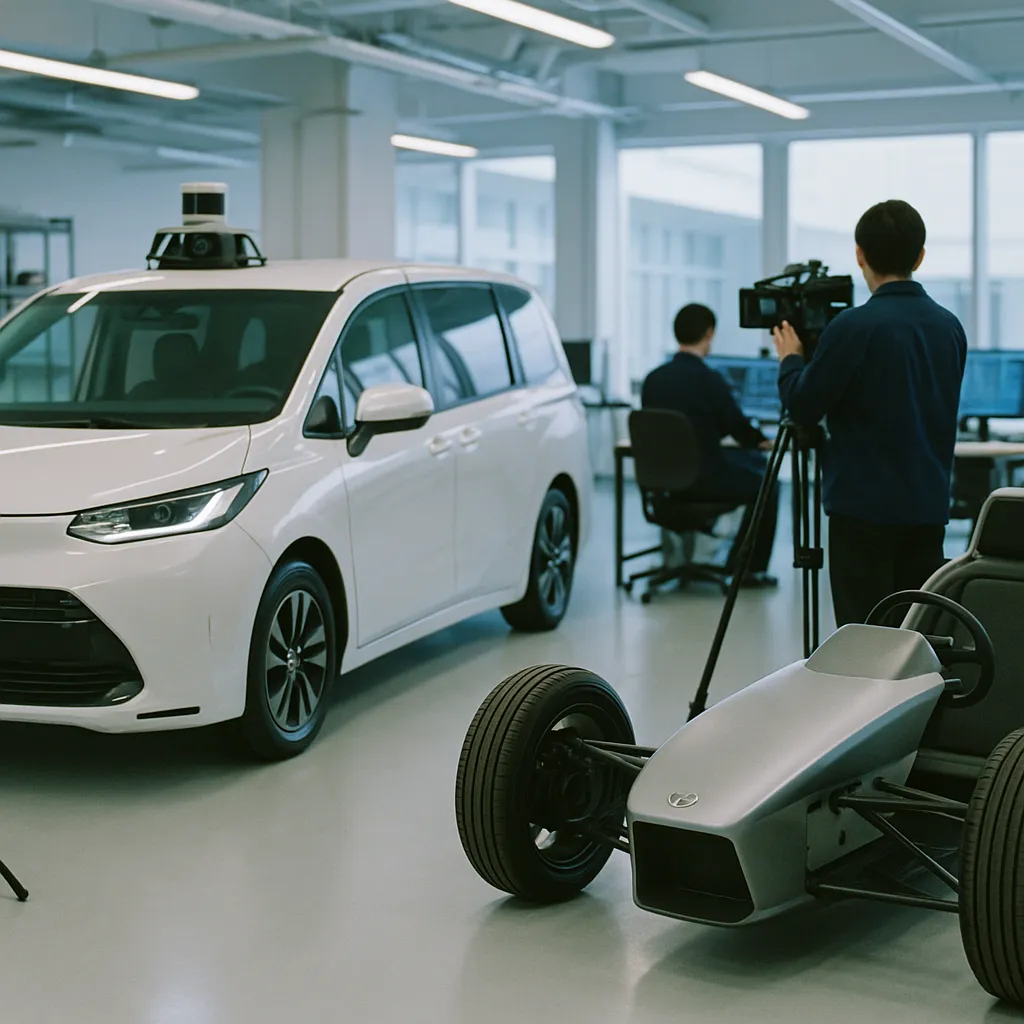
Toyota and Woven by Toyota launched a city-scale AI foundation model that processes real-time visual, behavioral, and environmental data to detect risks across Woven City's connected infrastructure.
Toyota's Woven City Gets an AI Brain: Foundation Model Processes Entire City's Real-Time Data
By Hector Herrera | April 22, 2026 | Transport
Toyota and its software subsidiary Woven by Toyota have launched a suite of AI technologies designed to run Woven City — their living laboratory near Mount Fuji — including a city-scale foundation model that processes visual, behavioral, and environmental data in real time. The announcement moves Woven City from a physical construction project to an operational AI testbed, and it signals where Toyota believes intelligent mobility is heading: not individual smart vehicles, but interconnected intelligent urban systems.
Background
Woven City is Toyota's prototype city currently under construction at the base of Mount Fuji in Susono, Japan. Announced in 2020 and begun in 2021, it is designed from the ground up to test mobility, robotics, smart home technology, and AI systems in real-world conditions — with Toyota employees and their families as initial residents. The project is led by Woven by Toyota, the company's software and technology subsidiary, which also develops the Arene automotive operating system.
The premise is straightforward: you cannot fully test city-scale AI on a simulator. Woven City gives Toyota a place to run it on real infrastructure with real people.
What Was Announced
Three systems were unveiled according to Woven by Toyota:
Woven City AI Vision Engine — A large-scale foundation model that ingests visual, behavioral, and environmental data from connected city systems in real time to detect risks and anomalies. Think of it as a city-wide perception layer: cameras, sensors, and environmental monitors feed into a single model that watches for what doesn't belong — a pedestrian about to step into a lane, an unusual crowd pattern, a hazard in an intersection.
Get this in your inbox.
Daily AI intelligence. Free. No spam.
Woven City Integrated ANZEN System — ANZEN means "safety" in Japanese. This system combines behavioral AI with driving assistance features, designed to run across connected vehicles and city infrastructure simultaneously. Rather than safety logic living only inside the vehicle, this pushes safety intelligence to the city level — the infrastructure and the car coordinating together.
Woven City Infra Hub — A unified data platform that ties the Vision Engine, ANZEN System, and broader city infrastructure together. Infra Hub is the data backbone: it collects, normalizes, and routes data between systems so the AI layers can see a complete city-wide picture.
The announcement also noted that four new companies have joined the Woven City Inventor program, bringing active co-creation partners to 24. These are companies building products and services specifically designed to be tested at Woven City.
What This Means
For Toyota, this is a bet that the future of automotive safety is infrastructure-level, not just vehicle-level. Every major automaker is investing in in-vehicle AI. Toyota is building the complementary layer — the city-side intelligence that makes those vehicles smarter by giving them a connected urban nervous system to talk to.
For the smart city sector, the Woven City AI Vision Engine is a notable entry. City-scale AI perception has been discussed for years but deployed only in fragments — traffic cameras here, a smart intersection there. A foundation model purpose-built to process an entire city's data stream in real time is a different architectural approach. Whether it scales beyond a controlled environment like Woven City remains the central open question.
For the 24 Inventor program partners, real-world deployment access at Woven City is a significant development advantage. Testing against actual city infrastructure and actual resident behavior is fundamentally different from lab conditions.
What to Watch
The near-term proof point is resident deployment. Woven City began accepting its first permanent residents in early 2025. As that population grows, the AI Vision Engine and ANZEN System will generate real operational data — and that data will either validate the architecture or reveal where it breaks. Watch for Toyota's annual Woven City technology updates for early performance signals.
The Infra Hub platform is also worth tracking independently: if Toyota makes it available to external municipalities or urban developers, it becomes a commercial product, not just internal infrastructure.
Hector Herrera is the founder of Hex AI Systems and editor of NexChron.
Did this help you understand AI better?
Your feedback helps us write more useful content.
Get tomorrow's AI briefing
Join readers who start their day with NexChron. Free, daily, no spam.