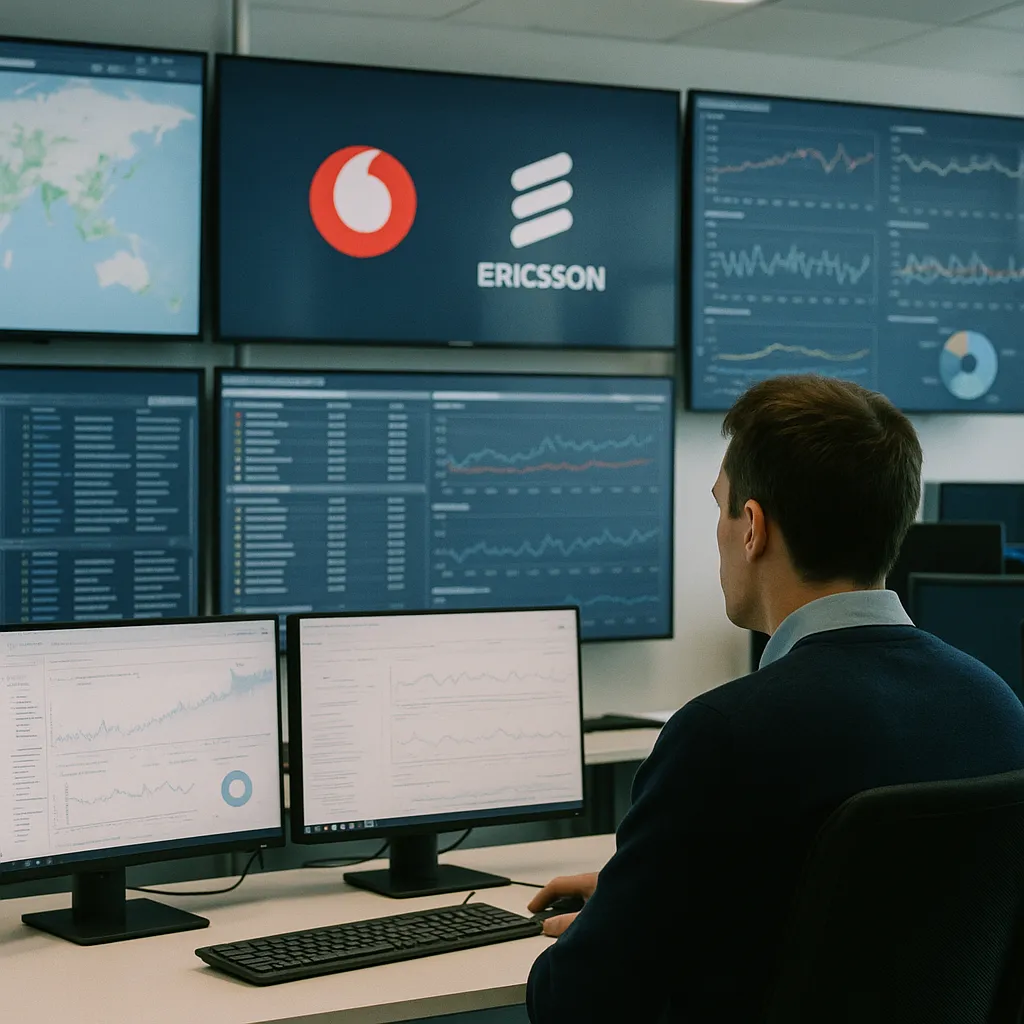
TM Forum is warning telecom operators to set explicit authority ceilings for AI agents before automation outpaces governance—arriving just as carriers execute tens of thousands of autonomous network decisions per hour.
TM Forum, the global telecom industry body whose standards underpin network operations at carriers worldwide, has issued guidance calling on operators to set explicit authority ceilings for AI agents and verify their actions before granting full production access. The warning arrives as carriers are already executing autonomous AI actions at a scale that would have been unthinkable two years ago—stc, the Saudi telecom giant, is running 10,000 autonomous RAN corrective actions per hour.
Why it matters: Telecommunications networks are critical infrastructure. An AI agent with uncapped authority over a live network is a single point of failure with continent-scale consequences. TM Forum's guidance isn't precautionary—it's catching up to deployments already in production.
How Fast Telecom AI Has Moved
The TelecomLead report on TM Forum's guidance provides concrete numbers that explain why the industry body acted now:
- stc — executing 10,000 autonomous RAN (Radio Access Network) corrective actions per hour, with AI agents adjusting signal parameters, load balancing, and interference management without human review of individual decisions
- AT&T — reports AI-driven routing has cut certain network costs by 90%, a figure that implies the AI is now the primary decision-maker in those workflows
- Vodafone's SuperTOBi — the carrier's AI customer service assistant resolves more than 70% of customer queries end-to-end without handing off to a human agent
These are not pilots. They are production systems operating at scale, making binding decisions that affect service quality for tens of millions of customers.
What TM Forum Is Asking For
The forum's guidance centers on three requirements before any AI agent reaches full production deployment:
1. Explicit authority ceilings. Every AI agent deployed in network operations must have documented boundaries on what actions it can take autonomously versus what requires human escalation. For a RAN optimization agent, this might mean: it can adjust power and frequency parameters within a defined range autonomously, but cannot initiate a full cell shutdown without a human sign-off.
2. Action verification before production. Operators should verify that an agent's autonomous decisions are consistent with operator intent before removing human oversight from the loop. This means a staged rollout: human-in-the-loop observation, then human-on-the-loop (reviewing after action), then full autonomy within verified bounds.
Get this in your inbox.
Daily AI intelligence. Free. No spam.
3. Auditability. Every autonomous action should generate a log sufficient to reconstruct the agent's reasoning—not just what it did, but the network state that triggered the decision and the outcome it was optimizing for. This is both an operational requirement (for diagnosing failures) and a regulatory one (telecommunications are subject to national security and consumer protection oversight in every market).
Why the Warning Is Timely
Telecom networks have been automating incrementally for decades. What's changed with AI agents is the nature of the decision-making. Traditional network automation is rule-based: "if interference exceeds threshold X, adjust parameter Y by amount Z." AI agents are inference-based: they assess a complex set of network conditions and decide what action best optimizes a target metric, often in ways that aren't transparently predictable from the training setup.
That shift matters for failure modes. A rule-based system fails in predictable ways—it applies its rule to a condition it wasn't designed for. An AI agent can fail in emergent ways—optimizing a metric correctly while creating a cascade effect that wasn't visible to the human who defined the optimization target.
The Three Carriers Setting the Standard
The three deployments highlighted in TM Forum's guidance illustrate different points on the autonomy spectrum:
stc's RAN automation operates at the highest volume—10,000 actions per hour—suggesting the carrier has already moved well past human-on-the-loop review for individual decisions. The relevant question is whether the authority boundaries are documented and tested.
AT&T's cost reduction suggests deep integration into routing decisions, an area where errors can cascade across interconnected carrier networks. A 90% cost reduction also implies the AI is taking actions that human engineers were previously unwilling to automate, which raises the stakes for authority ceiling design.
Vodafone's SuperTOBi sits at the customer-facing end of the stack rather than deep network infrastructure. Its 70% autonomous resolution rate is impressive, but the failure mode—a customer who gets a wrong answer or a wrongly applied service change—is more recoverable than a network misconfiguration.
What to Watch
TM Forum's guidance is voluntary. The binding enforcement will come from national telecommunications regulators, many of which are only beginning to develop AI-specific frameworks for network operations. In Europe, the European Electronic Communications Code is under pressure to address AI agent governance in network operations; in the U.S., the FCC has been examining AI in network management but has not issued binding rules.
The first major network outage attributable to an unconstrained AI agent—not an individual device failure, but a systematic failure driven by an agent acting outside intended parameters—will accelerate the transition from voluntary guidance to mandatory regulation faster than any industry body's roadmap.
Did this help you understand AI better?
Your feedback helps us write more useful content.
Get tomorrow's AI briefing
Join readers who start their day with NexChron. Free, daily, no spam.