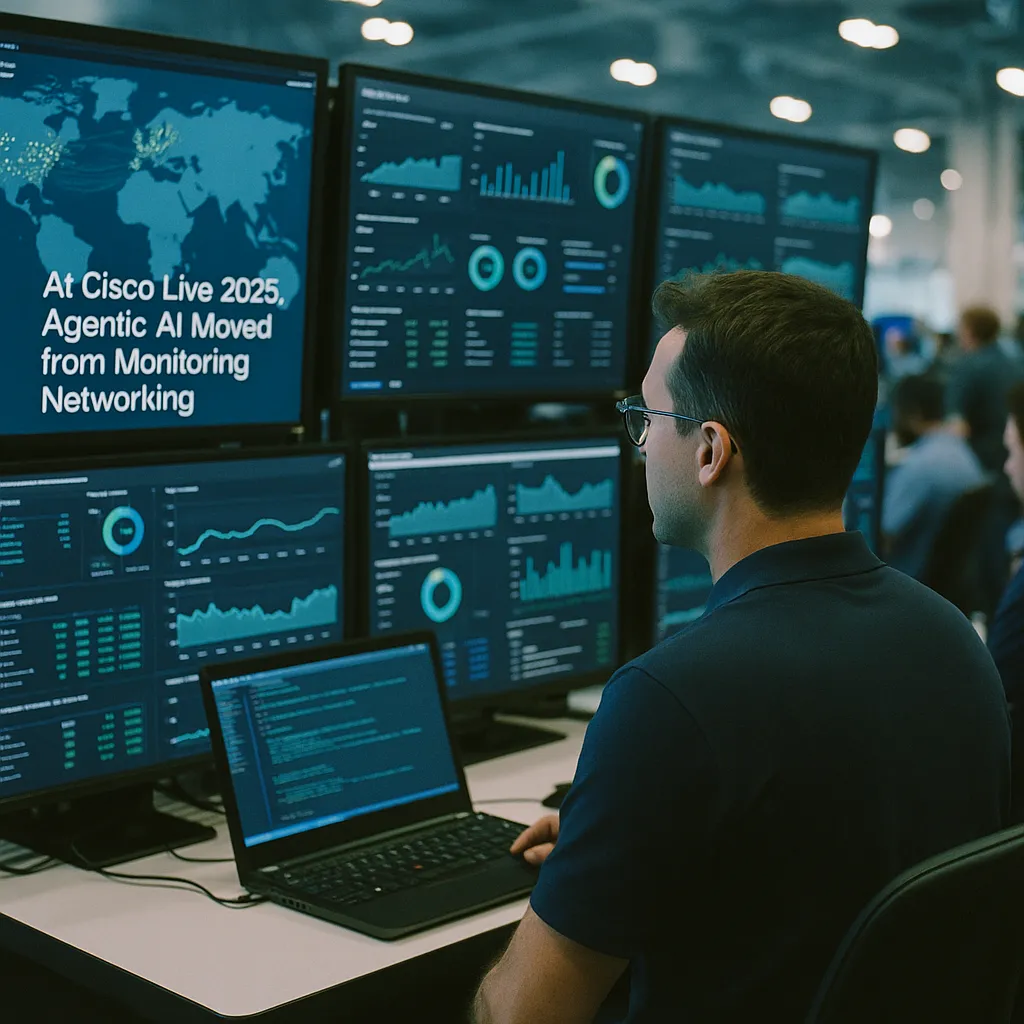
Cisco used its annual conference to demonstrate AI that doesn't just monitor enterprise networks — it runs them, autonomously reconfiguring traffic flows, responding to threats, and anticipating demand spikes in real time.
At Cisco Live 2026, Agentic AI Moved from Monitoring Networks to Running Them
By Hector Herrera | June 5, 2026 | Telecom
Cisco used its annual Live conference to demonstrate agentic AI systems that don't just observe enterprise networks — they autonomously reconfigure them in response to traffic patterns, security threats, and application demands in real time. The shift from passive monitoring to active control marks a structural change in how enterprise network infrastructure operates, and it reframes what telecom and managed service providers actually sell.
Network management has historically been reactive: alerts fire, human engineers respond, and fixes happen after users notice problems. Agentic AI reverses that sequence. When a network can reconfigure itself faster than a human can open a trouble ticket, the IT function changes structurally — and so does the business case for outsourced network management.
Context
Cisco is the dominant player in enterprise networking infrastructure — switches, routers, firewalls, and the software platforms that manage them. Its annual Live conference is where the company signals product direction to IT departments, managed service providers, and channel partners globally.
This year's theme centered on what Cisco calls AI-native networking: infrastructure designed to be managed by AI rather than configured by human administrators working through command-line interfaces. According to VoIP Review's coverage of the conference, the demonstrations highlighted systems already in customer deployments — not roadmap items. That distinction matters. What Cisco showed is what's already running.
What Cisco's Agentic Systems Do
Three autonomous capabilities were central to the demonstrations:
Traffic-responsive reconfiguration. AI systems that detect application latency degradation and autonomously reroute traffic across available paths — making decisions in milliseconds that previously required a network engineer to diagnose, plan, and implement over minutes or hours. The system doesn't alert a human and wait; it acts, then logs what it did.
Get this in your inbox.
Daily AI intelligence. Free. No spam.
Threat-driven segmentation. When anomalous behavior consistent with a lateral movement attack (a technique where intruders move from a compromised system toward higher-value targets on the same network) is detected, the AI agent can autonomously isolate the affected network segment without waiting for security team approval. The action is logged and reversible; humans are notified after the fact rather than asked permission first.
Demand-anticipating provisioning. Based on application usage patterns and calendar data, the system pre-allocates bandwidth and compute resources ahead of anticipated demand spikes. Users experience stable performance before they notice degradation rather than during a reactive scramble to fix it.
The SMB Problem Cisco Acknowledged
One of the more candid threads from Cisco Live was the explicit acknowledgment that AI-native networks create a new complexity tier for small and medium businesses. Large enterprises have dedicated IT teams that can manage, audit, and occasionally override autonomous network decisions. Many SMBs do not.
This matters because SMBs represent a substantial portion of Cisco's installed base. If AI-native networking requires a level of IT sophistication that most SMBs lack, those customers either depend on managed service providers to absorb that complexity on their behalf — or they stick with simpler, less capable systems and fall further behind the security and performance curve.
The Cisco Live framing was that MSPs are the answer. But that shifts the capability requirement to the managed service layer: MSPs now need AI-native network operations expertise, and the talent market for that skillset is competitive and expensive.
What This Means for Telecoms
The deeper implication of Cisco's demonstration is a redefinition of what telecom providers sell. Connectivity — reliable data pipes — is increasingly commoditized. Pricing pressure on raw bandwidth has been consistent for two decades. The margin opportunity, and the competitive differentiation, is in the intelligence layer that optimizes how connectivity is used.
This creates a strategic choice for every telecom provider: build or buy AI-native network management capabilities, or cede the value-added layer to vendors like Cisco (and increasingly to hyperscalers like AWS and Azure, which are building competing network intelligence products at the infrastructure layer). Providers that can credibly offer autonomous network management as a managed service will have pricing power that pure connectivity providers won't sustain.
For enterprises, the near-term question is organizational: who owns the relationship with an AI system that's making real-time architectural decisions about the network? The answer isn't settled industry-wide. And the liability question — who is responsible when an autonomous network reconfiguration causes a material outage — is going to become a live legal issue as these systems become standard infrastructure.
The Competition
Cisco is not the only vendor moving in this direction. Juniper Networks (now owned by HPE), Arista, and Palo Alto Networks all have competing visions of AI-native enterprise networking. The next 18 months will test whether Cisco's scale advantage translates into market leadership on the intelligence layer, or whether a more specialized competitor captures the agentic networking market before Cisco's installed base inertia can close the gap.
What to watch: Enterprise deployments of autonomous network management are expected to accelerate through late 2026 and into 2027. The first significant public incident — an autonomous network reconfiguration that causes a material enterprise outage — will trigger a governance and liability conversation the industry hasn't had yet, and will likely define how much autonomy these systems are allowed to exercise going forward.
Did this help you understand AI better?
Your feedback helps us write more useful content.
Get tomorrow's AI briefing
Join readers who start their day with NexChron. Free, daily, no spam.