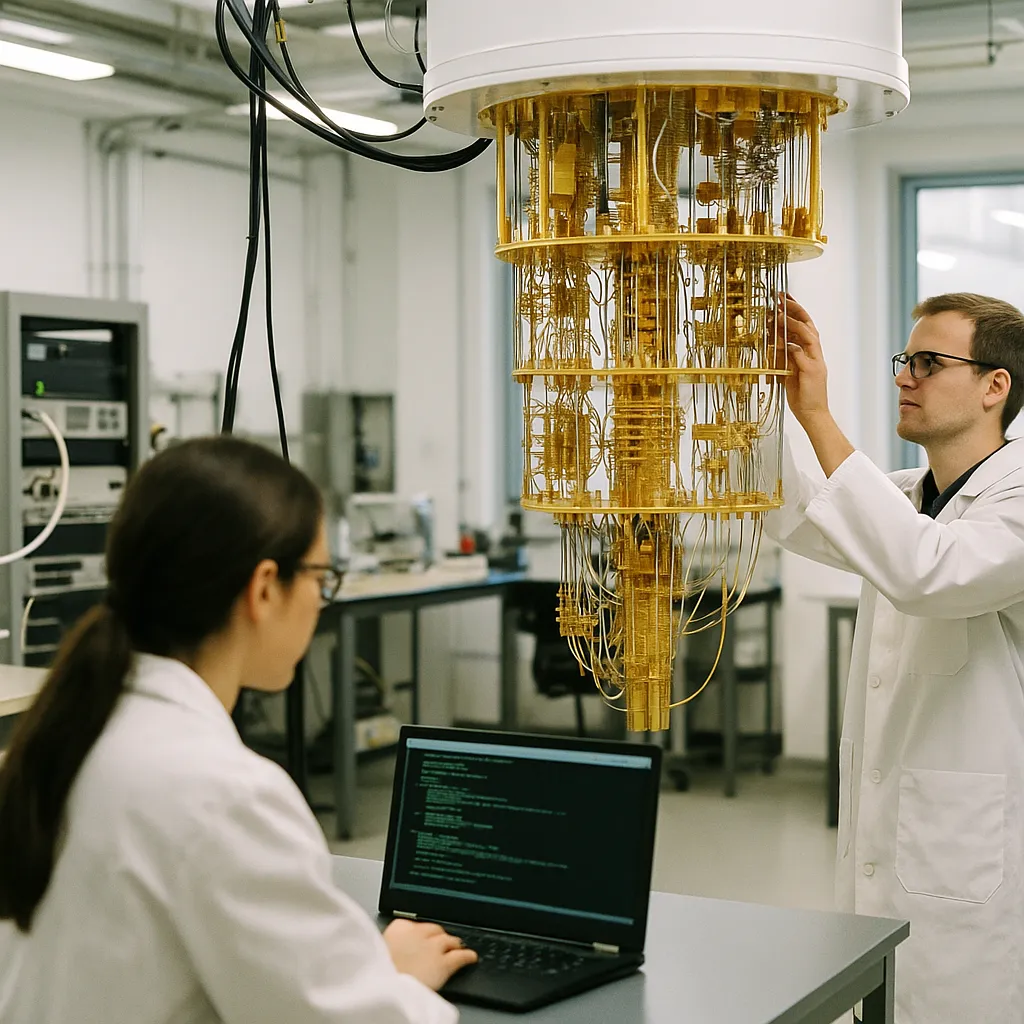
NVIDIA released Ising on World Quantum Day — the first open-source family of AI models built specifically for quantum computing, including a 35B-parameter vision-language model for processor calibration and a decoder that runs 2.5x faster than classical error correction methods.
By Hector Herrera | April 22, 2026 | Science
NVIDIA launched Ising on April 14 — World Quantum Day — the first publicly released family of AI models built specifically to accelerate quantum computing. The release includes a 35-billion-parameter vision-language model for processor calibration and a 3D convolutional neural network decoder for real-time quantum error correction that runs 2.5x faster and achieves 3x better accuracy than classical methods. Early adopters include Fermilab, Harvard, and Lawrence Berkeley National Laboratory.
What Quantum Computing Actually Needs AI For
To understand why Ising matters, you need to understand the two biggest obstacles stopping quantum computers from being useful: calibration and error correction.
Calibration is the process of characterizing and tuning a quantum processor — measuring how each qubit (the quantum equivalent of a classical bit) behaves, how qubits interact, and where noise sources exist. Today, calibration is largely manual and time-consuming. It requires specialized physicists and degrades rapidly as quantum systems scale up. NVIDIA's 35B-parameter vision-language model addresses this by learning to interpret calibration data and suggest corrections autonomously.
Error correction is more fundamental. Quantum states are extremely fragile — they decohere (lose their quantum properties) due to environmental noise in microseconds. Quantum error correction works by encoding logical qubits across many physical qubits and continuously detecting and correcting errors without collapsing the quantum state. The challenge: error correction requires processing enormous amounts of syndrome data (error indicators) fast enough to correct errors in real time, while the quantum computation is still running. Classical error correction methods can't keep pace at the scale needed for useful quantum computers.
NVIDIA's 3D CNN decoder closes that gap — at least partially — by being 2.5x faster and 3x more accurate than the classical alternatives currently used.
Why "Open" Matters Here
NVIDIA released Ising as open-source models. That decision is not accidental and not purely altruistic. Quantum computing is still deeply fragmented — dozens of competing hardware architectures (superconducting, trapped ion, photonic, neutral atom) with incompatible control systems, calibration tooling, and software stacks. A proprietary tool that works on one hardware platform is a niche product. An open-source foundation that the quantum community can adapt to any hardware is infrastructure.
Get this in your inbox.
Daily AI intelligence. Free. No spam.
NVIDIA has used this strategy before with CUDA, its GPU programming platform. By making the development environment free and open, NVIDIA entrenched GPUs as the default AI accelerator. With Ising, the company appears to be running the same playbook for quantum: give away the models, own the ecosystem, sell the hardware and services.
Who Is Using It
The early institutional adopters signal how seriously the quantum research community is taking this:
- Fermilab — U.S. Department of Energy national laboratory, one of the world's leading particle physics research institutions
- Harvard University — home to one of the most prominent neutral-atom quantum computing groups in the world
- Lawrence Berkeley National Laboratory — another DOE national lab with major quantum information science programs
These are not early-adopter startups testing new tools. These are institutions that set the direction of quantum computing research globally. Their adoption validates the technical credibility of NVIDIA's approach.
Hybrid Quantum-Classical AI: What It Means
The broader significance of Ising is what it represents architecturally: the formalization of hybrid quantum-classical computing as a real engineering discipline. Neither quantum computers nor classical AI models can solve the calibration and error correction problems alone. Quantum hardware generates data too complex and voluminous for classical analytical methods. Classical AI, running on NVIDIA GPUs, can process that data — but only if the models are specifically designed for the quantum domain.
Ising is not a quantum AI model. It's a classical AI model that understands quantum systems. The distinction matters: NVIDIA is not claiming quantum speedups for AI. It's claiming that classical AI, trained on quantum-specific data and tuned for quantum-specific tasks, can unlock capabilities in quantum hardware that pure physics methods cannot.
That's a narrower but more credible claim — and more immediately useful.
What to Watch
Two milestones will signal whether Ising delivers on its promise:
- Demonstration of sustained logical qubit operation at a research institution using Ising-assisted error correction — showing the decoder performs in a live quantum computation, not just a benchmark
- Adoption beyond the initial three institutions — if mid-tier quantum computing labs and hardware startups begin building on Ising, NVIDIA's infrastructure play is working
The quantum timeline is long. Even with Ising, "useful" quantum computing — systems that outperform classical computers on commercially relevant problems — remains years away for most applications. But the calibration and error correction problems are genuine blockers, and any tool that meaningfully reduces them shortens that timeline.
Hector Herrera covers AI in science and research for NexChron.
Did this help you understand AI better?
Your feedback helps us write more useful content.
Get tomorrow's AI briefing
Join readers who start their day with NexChron. Free, daily, no spam.