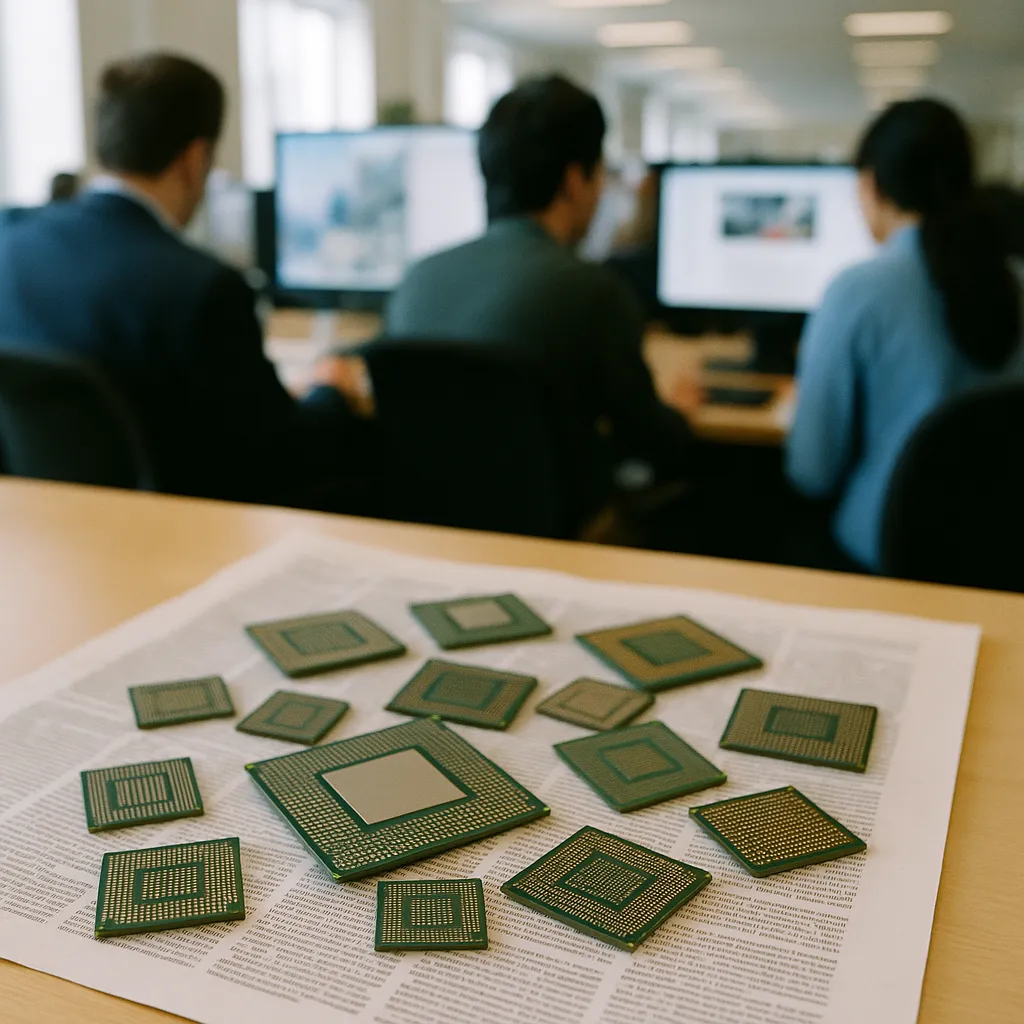
NVIDIA released Ising, described as the world's first open-source AI models designed to close the gap between current quantum hardware limitations and practical utility.
By Hector Herrera | April 19, 2026 | News
NVIDIA has released Ising, described as the world's first family of open-source AI models designed specifically to accelerate the development of quantum computers capable of running practical, real-world applications. The release extends NVIDIA's infrastructure dominance into the intersection of AI and quantum computing — two of the most consequential technology platforms of the next decade.
What Happened
NVIDIA released the Ising model family as open-source AI models targeting quantum computing development. The models are named after the Ising model, a mathematical framework from statistical mechanics that has become foundational in quantum computing research — it's used to represent optimization problems that quantum computers are theoretically well-suited to solve.
According to NVIDIA, these are the first AI models built specifically to help researchers and enterprises close the gap between current quantum hardware limitations and the utility threshold — the point at which a quantum computer can solve problems that matter, faster than a classical computer.
Context
Quantum computing has been "five to ten years away" from practical utility for about thirty years. The reason is a fundamental engineering challenge: quantum bits (qubits) are extremely sensitive to environmental noise, which causes errors that compound rapidly as computations become more complex. Current quantum hardware can run relatively small computations; useful computations at real-world scale require error correction schemes that themselves demand enormous qubit overhead.
What AI can do for quantum: AI models trained on quantum circuit behavior can help in several ways:
Get this in your inbox.
Daily AI intelligence. Free. No spam.
- Error mitigation: Identifying and correcting noise patterns in qubit behavior without the full overhead of error correction
- Circuit optimization: Finding more efficient circuit layouts for a given computation
- Noise characterization: Mapping the specific error profile of a quantum processor to calibrate performance
- Hybrid algorithm design: Optimizing the division of work between quantum and classical processors
By open-sourcing the Ising models, NVIDIA makes these capabilities available to the quantum computing research community and to enterprises building quantum applications — with no licensing cost and with the ability to fine-tune for specific hardware.
Details
- Product: Ising — a family of open-source AI models
- Purpose: Accelerate development of useful quantum computers
- Released by: NVIDIA
- Open source: Yes — available to researchers and enterprises
- Target users: Quantum hardware developers, quantum software companies, research labs, enterprises exploring quantum applications
- Named for: The Ising model (a mathematical model from statistical mechanics used extensively in quantum optimization research)
NVIDIA's involvement in quantum computing is notable because the company's primary business is GPU hardware for AI and graphics. The Ising release signals NVIDIA's intention to position its computing infrastructure — and now its AI models — as the bridge between classical AI and quantum computing, regardless of which quantum hardware platform ultimately succeeds.
Impact
For quantum computing researchers: Open-source AI models for quantum development reduce the barrier to entry for research groups that have quantum hardware access but limited machine learning expertise. A physics lab working on quantum error correction can use Ising models to improve their qubit calibration without building the AI infrastructure from scratch.
For quantum computing companies: IonQ, IBM, Google Quantum AI, Quantinuum, and others are all competing to reach practical quantum utility. NVIDIA's AI models could accelerate any of them — because Ising is hardware-agnostic. This is NVIDIA's characteristic strategy: provide infrastructure that the entire ecosystem depends on, independent of which vendor wins the underlying hardware race.
For enterprises: Most enterprises are not currently using quantum computing. But pharmaceutical companies, financial institutions, logistics operators, and materials scientists are all tracking quantum closely because the potential to solve optimization and simulation problems that are intractable for classical computers is real. Ising lowers the cost of quantum application research for these enterprise teams.
For NVIDIA's competitive position: NVIDIA's H100 and B100 GPUs are the primary compute infrastructure for AI training and inference today. If quantum computing becomes practical at commercial scale, it could in theory reduce demand for classical GPU compute in certain problem categories. By entering quantum computing with the Ising models, NVIDIA ensures it has a presence in the quantum ecosystem and can position its infrastructure as the classical-quantum interface layer.
What to Watch
The practical impact of the Ising models depends on how quickly quantum hardware quality improves. Watch for NVIDIA partnerships with specific quantum hardware companies that validate Ising on real quantum processors — those announcements will tell you whether this is research-grade tooling or production-ready infrastructure. Also watch for academic papers using Ising models that demonstrate measurable improvements in qubit error rates or circuit optimization — that's the technical validation that matters.
Hector Herrera covers emerging technology and AI for NexChron.
Did this help you understand AI better?
Your feedback helps us write more useful content.
Get tomorrow's AI briefing
Join readers who start their day with NexChron. Free, daily, no spam.