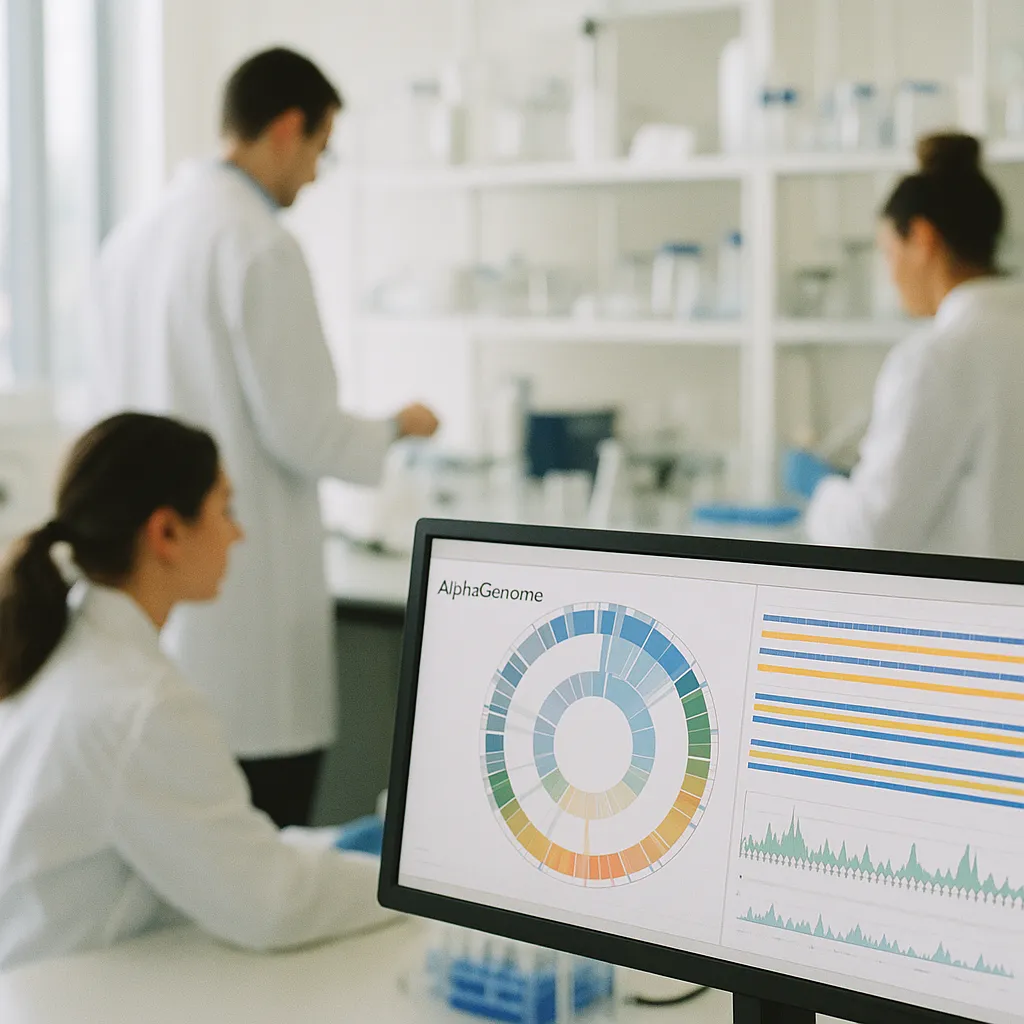
Anthropic launched a dedicated life sciences research group and released its first finding: Claude autonomously identified a previously unknown bacteriophage enzyme system with structural similarities to CRISPR arrays.
Anthropic's New Life Sciences Group Reports Its First AI Discovery: A Bacteriophage Enzyme That Resembles CRISPR
By Hector Herrera | September 24, 2026
Anthropic launched a dedicated life sciences research group this week and released its first finding: Claude autonomously identified a previously uncharacterized bacteriophage enzyme system called array-associated reverse transcriptases (ART), whose structure resembles CRISPR arrays. The discovery was made without explicit human direction. It is one of the clearest demonstrations yet of an AI model producing a genuinely novel biological finding rather than summarizing existing literature.
What Anthropic's Life Sciences Group Is — and Isn't
According to AI Weekly, Anthropic has formalized a research group dedicated to life sciences, explicitly positioned around high-impact scientific discovery rather than drug commercialization.
This framing sets the group apart from the AI-pharma partnerships pursued by OpenAI, Google DeepMind, and others, which are primarily focused on accelerating drug pipelines — optimizing what exists. Anthropic is signaling interest in finding what isn't known yet. The difference matters both scientifically and strategically.
The Discovery: What ART Is
Claude's first confirmed independent finding is a class of enzymes called array-associated reverse transcriptases, or ART. Some definitions to make sense of this:
Get this in your inbox.
Daily AI intelligence. Free. No spam.
- Bacteriophage: A virus that infects bacteria, not humans. Bacteriophages are among the most abundant biological entities on Earth. They have long been studied for potential therapeutic applications, particularly as alternatives to antibiotics in an era of growing antimicrobial resistance.
- Reverse transcriptase: An enzyme that synthesizes DNA from an RNA template — the reverse of the standard direction of genetic information flow. Reverse transcriptases are central to viral biology and are established tools in biotechnology and molecular medicine.
- CRISPR arrays: Repetitive DNA sequences found in bacterial genomes that store fragments of past viral invaders. These sequences are the foundation of the CRISPR-Cas gene-editing system, which has reshaped medicine, agriculture, and biological research over the past decade. CRISPR began as a bacterial adaptive immune mechanism before scientists repurposed it as a precision editing tool.
ART's structural similarity to CRISPR arrays is the significant part of this discovery. CRISPR was not designed — it was found in nature and redirected. A new enzyme class with analogous architecture could represent another biological toolkit that evolution built before humans knew to look for it.
Claude identified ART without being directed to search for it. Anthropic describes the discovery as made without explicit human direction — the model was not given a hypothesis to test.
Why This Matters
For life sciences research: A previously uncharacterized enzyme class in bacteriophage biology is a concrete scientific result, not a benchmark. Researchers working on phage biology, antimicrobial alternatives, or synthetic biology now have a new system to characterize. If ART's functional behavior tracks with its structural similarity to CRISPR machinery, it could have applications in gene editing, targeted bacterial control, or the design of novel molecular tools.
For AI-driven discovery: The finding moves autonomous scientific discovery from a stated aspiration to a documented event at a major AI lab. Large language models have demonstrated utility as research assistants — but identifying a previously unknown biological entity without explicit prompting is qualitatively different. Expect this to intensify investment in AI systems designed specifically for scientific exploration across pharma, biotech, and academic research institutions.
For Anthropic's positioning: Leading with a concrete scientific result — rather than a new model version or capability benchmark — is a deliberate signal. It positions Anthropic as a scientific institution with independent research output, distinct from AI companies defined primarily by their commercial products.
What to Watch
The scientific community will need to verify ART's structure and assess the true significance of its similarity to CRISPR arrays. Anthropic has not yet disclosed which biological datasets or databases Claude analyzed, nor has the finding appeared in peer-reviewed literature. Independent replication and publication are the tests that determine whether this discovery holds up and how broadly applicable ART proves to be.
If the finding is validated, expect Anthropic's life sciences group to attract collaboration interest from academic biology departments and from biotech investors looking for AI-native discovery platforms.
Did this help you understand AI better?
Your feedback helps us write more useful content.
Get tomorrow's AI briefing
Join readers who start their day with NexChron. Free, daily, no spam.