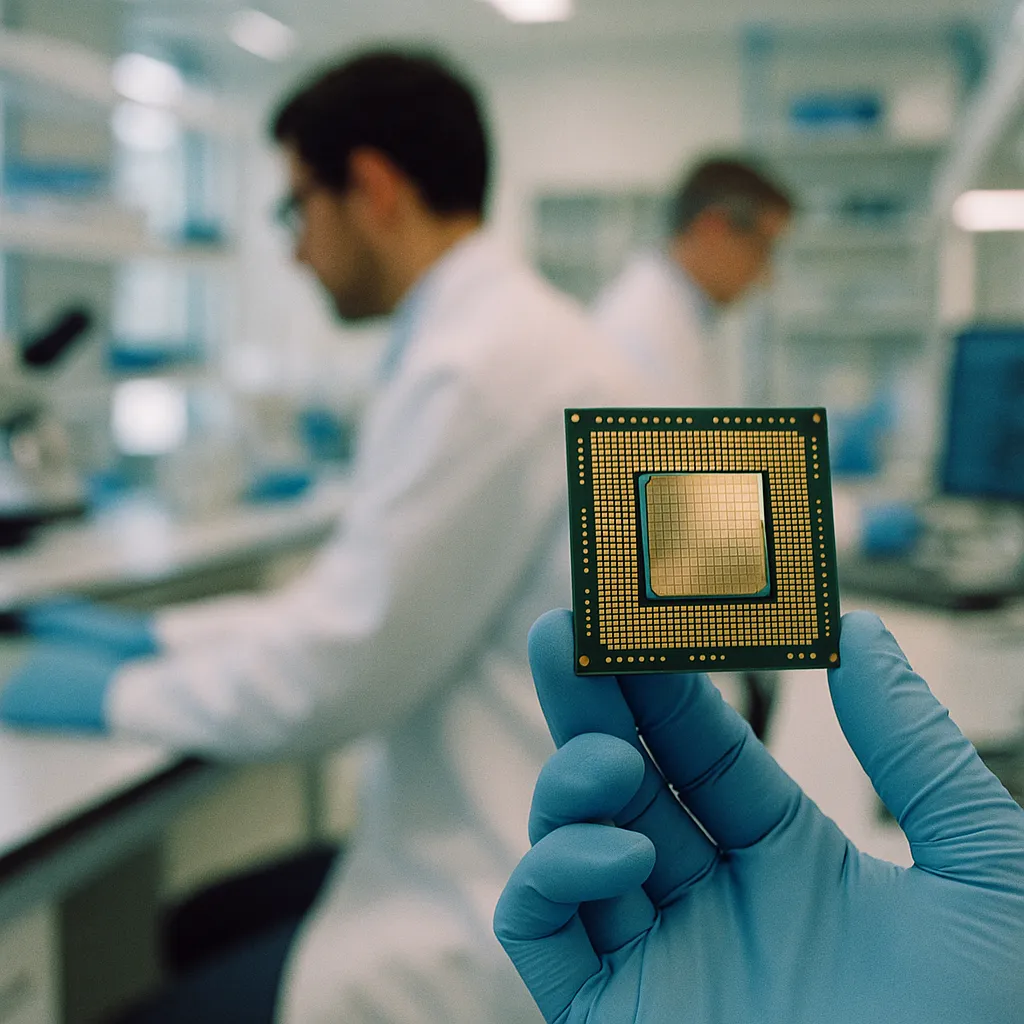
Cornelis Networks raised $205M for its Active Compute Fabric — GPU-agnostic networking that processes AI data in transit rather than stalling GPUs on synchronization overhead.
Cornelis Networks Raises $205M to Build AI Cluster Networking That Computes While It Connects
By Hector Herrera | September 16, 2026 | Science
Cornelis Networks has raised $205 million to commercialize a networking architecture that does something no current AI cluster fabric does: it processes data while that data is in transit between GPUs, eliminating one of the most persistent bottlenecks in large-scale AI training. The round, led by IAG Capital Partners with Qualcomm as a strategic partner, backs a company that spun out of Intel's Omni-Path networking group and is now targeting what may be AI infrastructure's most underappreciated constraint.
The significance is straightforward: every large AI training run spends a meaningful fraction of its time waiting for GPUs to receive data rather than computing with it. Cornelis's Active Compute Fabric moves programmable compute into the data fabric itself — so GPUs receive data that has already been partially processed in transit, rather than stalling on raw transfers and synchronization.
What Cornelis Is Building
The company's two flagship products:
- CN5000: A 400 Gbps switch that is already shipping to customers.
- CN6000: An 800 Gbps switch currently sampling with customers, with full availability targeted for Q4 2026.
Both run on an open architecture designed to work with GPUs from NVIDIA, AMD, Intel, and custom silicon — a direct contrast to NVIDIA's InfiniBand and NVLink ecosystem, which is tightly controlled and predominantly closed.
The "active" part of Active Compute Fabric refers to programmable compute logic embedded directly in the switch hardware. As data moves between GPU nodes, the fabric can perform collective operations — including the all-reduce operations that are central to distributed AI training — in the network itself rather than on the GPU. This frees GPU compute cycles for the training work the GPUs were bought to do.
The Problem It Solves
Modern AI training at scale runs across clusters of hundreds or thousands of GPUs. The GPUs are fast; the interconnects between them are the constraint.
Get this in your inbox.
Daily AI intelligence. Free. No spam.
In a standard distributed training run for a frontier language model, gradient synchronization — passing updated model weights back and forth between nodes after each training step — consumes a significant portion of total GPU time. The more GPUs in the cluster, the larger the synchronization overhead becomes. It's a scaling problem that gets worse, not better, as clusters grow.
The faster and smarter the fabric, the better the effective GPU utilization. This is why NVIDIA has invested aggressively in InfiniBand (acquired from Mellanox in 2020 for $6.9 billion) and NVLink: its networking business is as strategically critical as its chip business for AI customers running serious training workloads.
Cornelis is betting that a GPU-agnostic, open-architecture fabric with active compute capabilities can deliver comparable or better utilization gains without the vendor lock-in that comes with NVIDIA's stack.
What Qualcomm's Involvement Signals
Qualcomm participating as a strategic partner is a notable signal. The company has been building out its datacenter AI presence through its Cloud AI chip series and has a clear strategic interest in seeing GPU-agnostic infrastructure succeed — it removes the advantage NVIDIA gains from pairing its GPU hardware with its own proprietary networking.
For Cornelis, Qualcomm's involvement brings both enterprise credibility and a potential route to design-in at hyperscale customers evaluating non-NVIDIA AI training infrastructure.
Why This Moment
The AI infrastructure investment cycle is in a phase where hyperscalers are actively looking for alternatives to full NVIDIA dependency. Google has its own TPU infrastructure. Amazon has Trainium. Microsoft has the Maia chip in development. Every hyperscaler has a reason to want a credible, open alternative to NVIDIA's compute-and-networking bundle.
Cornelis isn't the first to attempt GPU-agnostic AI networking — but it is the first to embed programmable compute directly in the fabric and back it with a $205M raise and a named hyperscaler strategic partner at the same time.
What to Watch
The CN6000's Q4 2026 customer availability is the first real test. If a major cloud provider begins trialing it in production training clusters, it validates the Active Compute Fabric at the scale that matters. If the product slips or adoption is limited to smaller customers, the addressable market becomes significantly harder to capture. Watch also for any NVIDIA response — InfiniBand roadmap accelerations would be a clear signal that Cornelis is being taken seriously.
Hector Herrera covers AI infrastructure, systems, and hardware at NexChron.
Did this help you understand AI better?
Your feedback helps us write more useful content.
Get tomorrow's AI briefing
Join readers who start their day with NexChron. Free, daily, no spam.