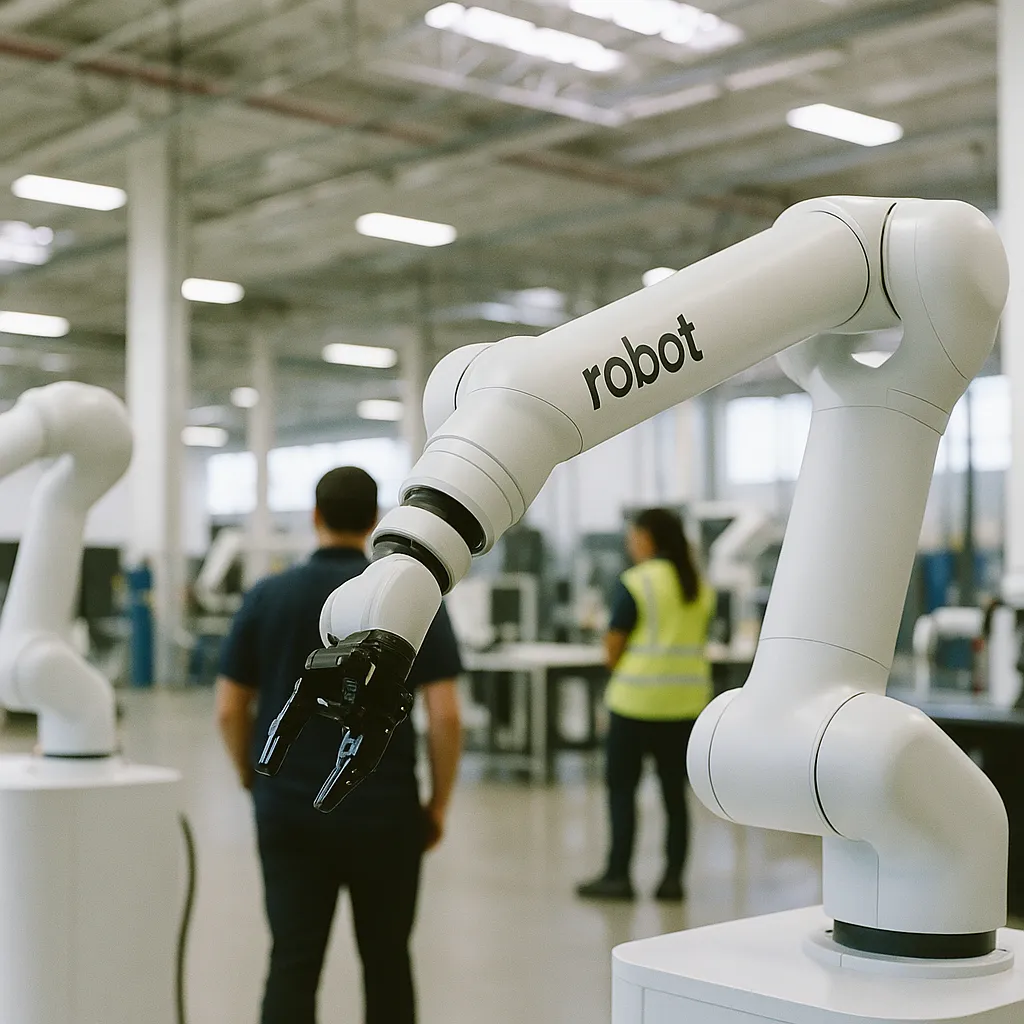
Alphabet's robotics subsidiary Intrinsic released its entire Intrinsic Core platform under Apache 2.0 at ROSCon 2026 — making enterprise-grade robotics software freely available to any developer or manufacturer.
Alphabet's Intrinsic Releases Full Robotics Stack as Open Source at ROSCon 2026
By Hector Herrera | September 23, 2026 | Science
Alphabet's robotics subsidiary Intrinsic released its full robotics software environment as open source on Tuesday at ROSCon 2026 in Toronto — one of the most significant robotics software drops of the year. By placing the entire Intrinsic Core stack under an Apache 2.0 license, Alphabet is making enterprise-grade robotics infrastructure freely available to any developer, research lab, or manufacturer who wants it.
Background
Intrinsic was spun out of Alphabet's X moonshot factory in 2021 with a mandate to make industrial robotics programming faster and cheaper. The company built a software platform designed to let engineers configure and deploy robots in days rather than months — abstracting away the low-level hardware complexity that has historically made robotics expensive to develop. The platform targets manufacturing, logistics, and industrial use cases. Until now, access required a commercial relationship with Intrinsic.
ROS — the Robot Operating System — is the open-source middleware standard that underlies most robotics research and many commercial deployments. ROSCon is its annual developer conference, making it the natural venue for an open-source release of this magnitude.
What Was Released
At ROSCon 2026, Intrinsic released Intrinsic Core under the Apache 2.0 license, meaning anyone can use, modify, and distribute it without royalty obligations. The release includes:
Get this in your inbox.
Daily AI intelligence. Free. No spam.
- Hardware-agnostic real-time control — the control layer works across robot hardware without rewriting for each manufacturer
- Nvidia FoundationPose-based pose estimation — using Nvidia's FoundationPose model for determining the position and orientation of objects in a scene, a prerequisite for reliable grasping
- Motion and grasp planning — the algorithms that plan how a robot arm moves and picks up objects
- Hardware drivers for Universal Robots and FANUC arms — two of the most widely deployed industrial robot families in the world
The combination is significant: this isn't a single library or a set of demos. It is a complete environment covering perception, planning, and control — the three core layers of a functional industrial robot system.
Why This Matters
Industrial robotics software has been fragmented for decades. Every major hardware vendor — ABB, FANUC, KUKA, Yaskawa — ships proprietary control environments. Integrators spend enormous effort writing glue code that connects hardware to vision systems to planning algorithms. That friction is a primary reason robotics deployments stay expensive and slow.
Intrinsic Core attacks that problem directly. A hardware-agnostic stack means the same software can run on a Universal Robots arm today and a FANUC arm tomorrow, without rewriting the application logic. For manufacturers evaluating different hardware vendors, that portability reduces lock-in risk significantly.
The Apache 2.0 license removes the other major barrier: cost. Small manufacturers, university labs, and emerging-market robotics developers who couldn't afford enterprise software contracts can now build on the same infrastructure as large Alphabet customers.
The inclusion of FoundationPose is also notable. Foundation models for robotics — pretrained models that generalize across tasks rather than being trained from scratch for each deployment — are an active area of research. Shipping FoundationPose integration in an open-source stack accelerates adoption of this approach across the industry.
Who Benefits
- Manufacturers with existing Universal Robots or FANUC installations get a free upgrade path to a modern, interoperable software layer.
- Systems integrators can build reusable solutions on a common stack rather than writing vendor-specific code for every project.
- Researchers get access to production-grade infrastructure that typically lives behind commercial licensing, enabling higher-fidelity experiments.
- Startups building robotics applications no longer need to build core infrastructure before building product.
Intrinsic's commercial business — consulting, support, training, cloud services — remains intact. The open-source release is a land-and-expand strategy: grow the developer ecosystem, then monetize through services on top.
What to Watch
Watch for whether other major robotics software players — particularly Boston Dynamics, Mujoco (owned by DeepMind), and the ROS 2 maintainers at Open Robotics — build integrations with Intrinsic Core or treat it as competitive pressure to accelerate their own open-source investments. Also watch whether FANUC and Universal Robots officially support the Intrinsic drivers, which would signal hardware vendor buy-in that would dramatically accelerate adoption in production environments.
Did this help you understand AI better?
Your feedback helps us write more useful content.
Get tomorrow's AI briefing
Join readers who start their day with NexChron. Free, daily, no spam.