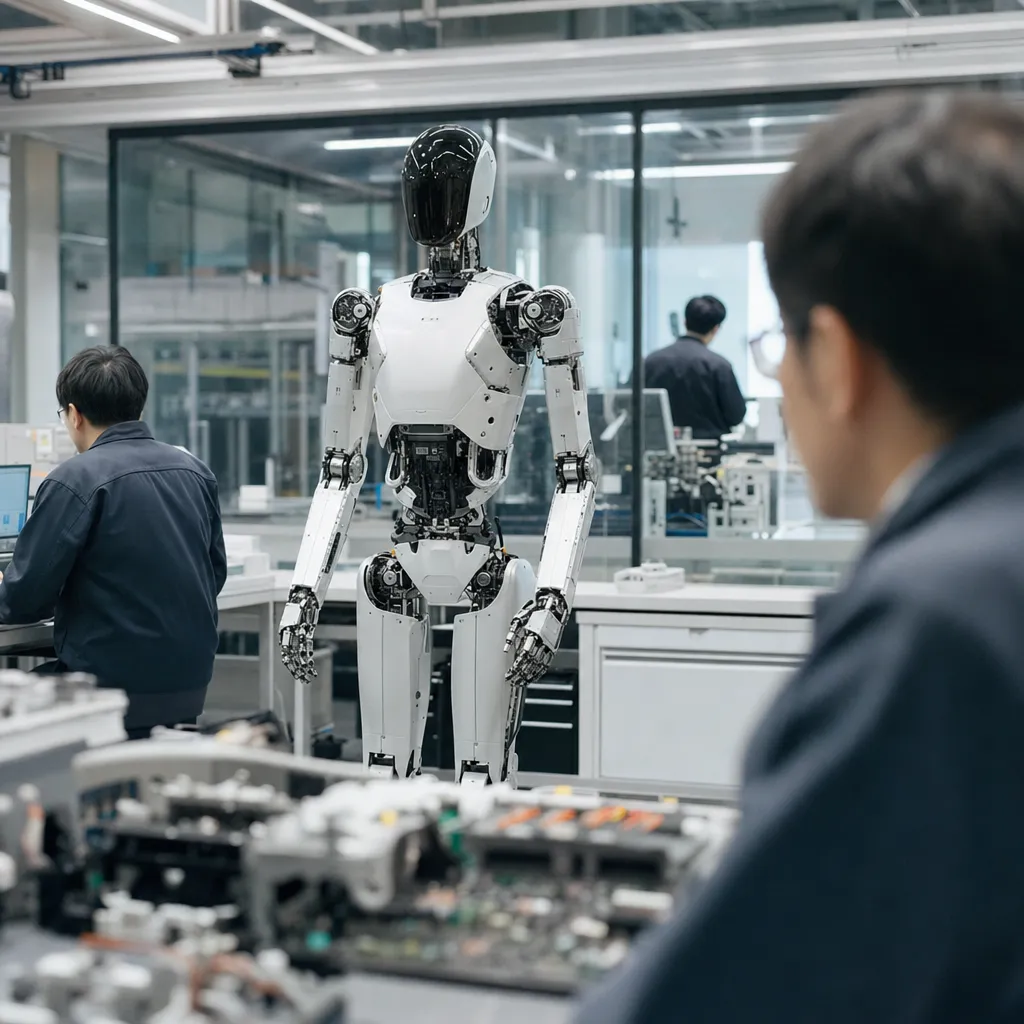
Nvidia unveiled GR00T 2 at CoRL 2026 — a 2-billion-parameter vision-language-action model that moves Nvidia from GPU hardware supplier to physical AI platform company.
Nvidia unveiled GR00T 2 at the Conference on Robot Learning (CoRL) in Austin on November 10 — a 2-billion-parameter foundation model for general-purpose robot manipulation that moves Nvidia from GPU hardware supplier to physical AI platform company. The announcement deepens Nvidia's position in the robotics stack at exactly the moment physical AI is emerging as the next major AI deployment frontier.
AI Weekly covered the GR00T 2 launch from CoRL 2026.
What GR00T 2 Is
GR00T — which stands for Generalist Robot 00 Technology — is Nvidia's foundation model for robot learning. The original GR00T was announced in March 2024. Version 2, unveiled at CoRL, represents a substantial architectural upgrade.
Key specifications:
- 2 billion parameters — roughly twice the scale of its predecessor
- Built on Cosmos-Predict2.5, Nvidia's physics-informed world model framework
- Vision-language-action (VLA) architecture — the model takes visual input and language instructions and outputs robot actions directly, without separate perception and planning modules
- General manipulation focus — grasping, sorting, assembly, tool use, and object handoff tasks across variable environments
The VLA architecture is significant. Earlier robot AI systems used separate models for perception (seeing the environment), planning (deciding what to do), and execution (generating motor commands). VLA models collapse these into a single model that learns the mapping from perception plus instruction to action end-to-end. This approach, pioneered by research from Google DeepMind and Stanford, has shown better generalization to new objects and environments than modular architectures.
Nvidia's Physical AI Stack
GR00T 2 is not a standalone product — it's the latest layer in a physical AI stack Nvidia has been assembling for three years:
Get this in your inbox.
Daily AI intelligence. Free. No spam.
- GPU hardware — H100, H200, and B200 chips power both AI training and inference in robots
- Isaac Sim — Nvidia's physics simulation platform, used to generate synthetic training data for robots at scale
- Isaac Lab — the robotics reinforcement learning framework
- Cosmos — the world model framework that generates physically realistic simulation environments
- GR00T — the foundation model that runs on top of all of the above
This vertical integration mirrors what made Nvidia dominant in AI training: not just the chip, but the full software and tooling stack (CUDA, cuDNN, TensorRT) that made the chip useful. With GR00T 2, Nvidia is attempting to create the same kind of ecosystem lock-in in physical AI.
Who Nvidia Is Competing With
The physical AI foundation model space is becoming crowded.
Google DeepMind has the RT-X series, trained on a massive multi-robot dataset assembled from academic labs worldwide. Physical Intelligence (π), the robotics AI startup founded by former Google Brain researchers and valued at over $2 billion, has the π0 and π0.5 models. Boston Dynamics has integrated AI planning into Atlas and Spot. Figure AI, 1X Technologies, and Apptronik are all training their own foundation models for humanoid robots.
What Nvidia has that none of its competitors can match: the simulation pipeline. Training a physical AI foundation model requires enormous amounts of data — far more than most real-world robot deployments can generate. Nvidia's Isaac Sim can generate that synthetic training data at scale, and Cosmos ensures the simulated physics are realistic enough that models trained in simulation transfer to real robots.
That simulation-to-real transfer capability — called "sim2real" in the robotics community — is Nvidia's structural advantage, independent of the GR00T model itself.
What to Watch
Watch for adoption announcements from robotics manufacturers. Nvidia's GR00T 1 was announced with a roster of partners including 1X Technologies, Apptronik, Agility Robotics, and Foxconn. GR00T 2 will likely launch with an expanded partner list.
Also watch how the competing foundation models benchmark on CoRL's manipulation tasks. Physical AI is at roughly the stage large language models were in 2020 — there is a leading frontier, the gap between models is large, and the field is moving quickly. Where GR00T 2 sits on that frontier compared to π0.5 and RT-X will shape which platform robotics manufacturers build on.
The physical AI race is no longer theoretical. The products are shipping.
Did this help you understand AI better?
Your feedback helps us write more useful content.
Get tomorrow's AI briefing
Join readers who start their day with NexChron. Free, daily, no spam.