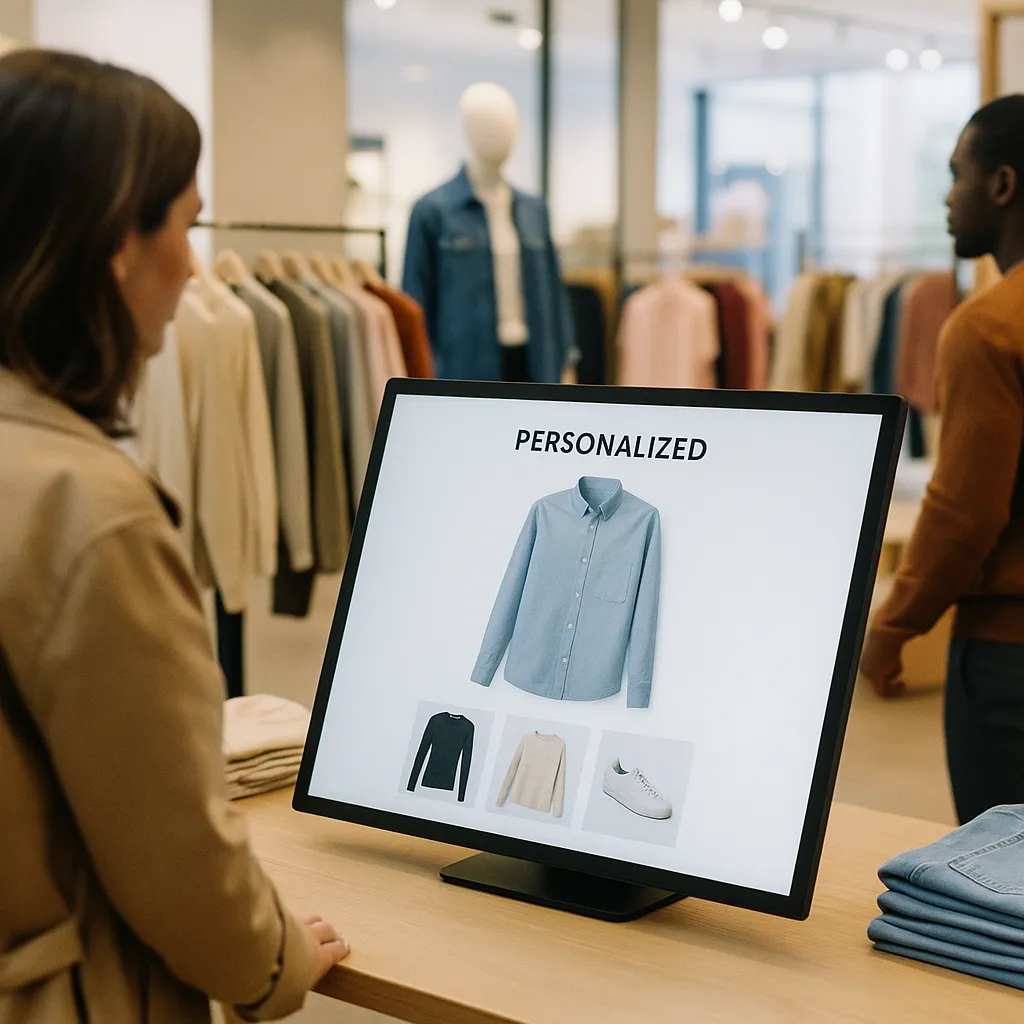
UK online retailer Very is deploying AI personalization across its entire platform after a trial using over 800 real-time behavioral signals delivered a 20% lift in revenue per customer — one of the clearest published ROI cases for retail AI at scale.
UK online retailer Very is rolling out AI personalization across its entire e-commerce platform after an initial trial produced a 20% lift in revenue per customer — one of the clearest published data points this year for the financial return on AI-driven retail personalization at scale.
Retail Gazette confirmed the sitewide expansion, which follows a trial using Made With Intent's personalization platform processing over 800 real-time behavioral signals per shopper.
What the System Actually Does
The platform moves beyond the recommendation widgets and "customers also bought" modules that most retailers deployed in the 2015-2020 era. Made With Intent's approach processes a dense stream of behavioral signals — how long a user pauses on a product image, what price tier they consistently filter toward, whether they open promotional emails before shopping, how often they use search versus category browsing — and builds a real-time intent model for each visit.
That intent model drives dynamic changes across the shopping session:
- Product listing sequencing: What appears first in category pages changes based on inferred shopper priorities
- Promotional display: Which promotions appear, and in what format, varies by inferred price sensitivity
- Discovery flow: How the site surfaces related products and categories adapts to detected interest patterns
- Homepage composition: Returning customers see a homepage structured around their inferred current intent, not a static editorial layout
The key distinction from earlier personalization systems is the density of signals (800+) and the real-time update cadence. Traditional retail personalization relied primarily on purchase history and click data, which updates slowly and loses fidelity for infrequent shoppers. The Made With Intent model infers intent from within-session behavior, which is available for every visit regardless of purchase history.
The 20% Number
A 20% lift in revenue per customer is a substantial figure in retail personalization, where many deployments produce single-digit improvements that take months to confirm against A/B test baselines.
Very has not published the full trial methodology, including the duration of the test period, the customer segment included in the trial, or the statistical confidence intervals around the result. Those details matter for interpreting how broadly the 20% figure applies — whether it reflects a particularly receptive customer segment, or performance across the full customer base.
Get this in your inbox.
Daily AI intelligence. Free. No spam.
What is disclosed: the trial result was substantial enough for Very to approve a full sitewide rollout rather than an extended multi-phase test, which signals internal confidence in the result's robustness.
For context, the industry benchmark for effective retail AI personalization — as reported by McKinsey, BCG, and Salesforce's commerce research — typically falls in the range of 5-15% revenue uplift depending on implementation depth. A 20% result from a single-platform trial, if it holds at scale, sits at the top of the published range.
Very's Market Position
Very is one of the UK's largest online-only retailers, operating the Very and Littlewoods brands with particular strength in clothing, home, and electronics. It serves a broad demographic across income ranges — partly because its credit and buy-now-pay-later products historically made higher-ticket purchases accessible to customers who might otherwise defer them.
That breadth creates both an opportunity and a challenge for AI personalization. The opportunity: a shopper base with highly variable intent profiles benefits more from dynamic personalization than a narrow-demographic retailer where most visitors look similar. The challenge: credit-linked purchasing behavior introduces signals around financial constraints that require careful handling to avoid surfaces that are predatory or that undermine customer financial health.
Very has not disclosed whether the Made With Intent deployment incorporates any guardrails around credit-linked purchase promotion, a question that will likely attract scrutiny from UK retail banking and consumer credit regulators as AI personalization in credit-linked e-commerce becomes more visible.
What This Means for UK Retail
Very is a mid-tier retailer by global standards but a meaningful benchmark in the UK market, where ASOS, Marks & Spencer, Next, and John Lewis are all investing in comparable personalization infrastructure.
The publication of a 20% revenue figure — with a named vendor, a named deployment — shifts the calculus for retailers that have been running internal pilots without publishing results. When a competitor publishes a number, the pressure to match or exceed it increases.
Made With Intent, a UK-based startup that raised Series A funding in 2025, now has a high-profile deployment it can use in every competitive sales process. Competing personalization vendors — including those from Adobe, Salesforce Commerce Cloud, and Bloomreach — will face questions about whether their platforms can match the signal density and result quality of the Very deployment.
For UK retail broadly, the Very results reinforce the case that AI personalization is not a luxury tier product for Amazon-scale retailers. A mid-size UK retailer with a standard technology stack can deploy and see returns in a trial period — which lowers the perceived barrier for the segment of retailers still evaluating whether to invest.
What to Watch
The critical question is whether the 20% result holds at sitewide scale and over multiple trading seasons. Trial conditions — smaller customer segments, focused product categories, intensive tuning — often produce better results than full production deployment.
Very's performance data through Q4 2026 — the peak UK retail season — will be the real test. If the revenue lift is sustained or improved across the holiday period, the sitewide deployment becomes a case study that the industry cannot ignore. If the number reverts toward the 8-12% range typical of well-implemented systems, it will recalibrate expectations while still validating the core investment case.
Did this help you understand AI better?
Your feedback helps us write more useful content.
Get tomorrow's AI briefing
Join readers who start their day with NexChron. Free, daily, no spam.