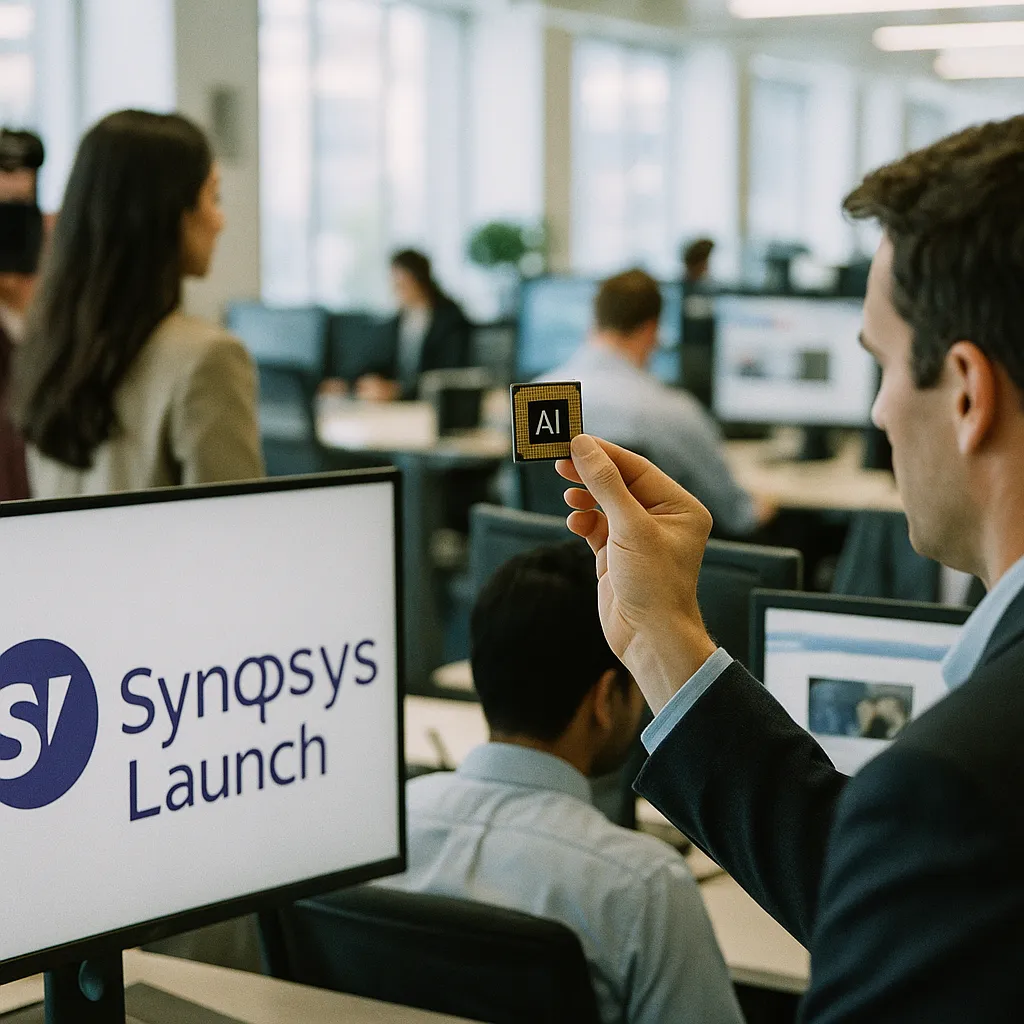
OpenAI and semiconductor EDA leader Synopsys announced GPT-Synopsys, a specialized model trained to automate chip design workflows — OpenAI's clearest move yet into vertical domain AI.
OpenAI and Synopsys Launch GPT-Synopsys to Automate Chip Design Workflows
By Hector Herrera | October 4, 2026
OpenAI just made its clearest bet on vertical AI. The company announced a multi-year strategic partnership with Synopsys — the dominant player in semiconductor design software — along with a specialized model called GPT-Synopsys, trained to operate Synopsys design tools and automate chip design workflows from end to end.
The deal is significant beyond its immediate commercial scope. Chip design automation is a force multiplier for AI hardware development: compress the design cycle, and you accelerate the timeline for every AI chip generation that follows. OpenAI is not just entering a new market — it's targeting the infrastructure that determines how fast AI hardware can advance.
Who Synopsys Is and Why It Matters
Synopsys is the company most people outside the semiconductor industry have never heard of, despite being essential to nearly every chip on the market. Their EDA (electronic design automation) software — tools with names like Fusion Compiler, VCS, and Synopsys Cloud — is what engineers use to design, simulate, and verify integrated circuits. If you've used a chip made by Apple, NVIDIA, AMD, Qualcomm, or Intel in the past decade, it almost certainly passed through Synopsys tooling at some stage of development.
EDA software is extraordinarily complex. A modern chip design involves billions of transistors, multiple clock domains, intricate power and thermal constraints, and verification suites that can take weeks to run. Expert EDA engineers spend years learning to use these tools efficiently. The barrier to entry is high; the talent pool is limited; and the design cycle for a leading-edge chip typically runs two to three years.
GPT-Synopsys is trained specifically to operate within this environment — not as a general-purpose AI assistant that can answer questions about chip design, but as an AI that can run Synopsys tools, interpret their outputs, and make workflow decisions autonomously.
What GPT-Synopsys Does
Based on the partnership announcement, GPT-Synopsys is designed to:
Get this in your inbox.
Daily AI intelligence. Free. No spam.
- Automate repetitive EDA tasks — running synthesis passes, managing design-rule check (DRC) violations, and adjusting timing constraints — that currently require expert engineers running hours-long iterations.
- Interpret tool outputs — reading the complex logs, reports, and waveforms that Synopsys tools generate and translating them into actionable next steps.
- Accelerate design iteration — enabling engineers to run more optimization passes in less time by automating the setup, execution, and analysis steps between iterations.
The partnership is multi-year, suggesting GPT-Synopsys is a starting point rather than a finished product. Synopsys has been developing its own AI-assisted EDA capabilities under the Synopsys.ai brand; GPT-Synopsys appears to integrate OpenAI's general reasoning capabilities with Synopsys's domain-specific toolchain knowledge.
The Competitive Landscape
OpenAI is not the first to pursue chip design AI. Google DeepMind's AlphaChip demonstrated AI-optimized floor planning for TPU chips in 2023, a narrow but high-impact application. Cadence Design Systems — Synopsys's main competitor — has been building its Cadence.AI platform with similar goals. Siemens EDA has its own AI roadmap.
But none of these efforts involve a leading general AI lab deploying a named vertical model trained specifically on a competitor's toolchain. GPT-Synopsys is differentiated by the combination of OpenAI's reasoning depth and Synopsys's market position.
Synopsys controls roughly 30% of the EDA market. A model that automates Synopsys workflows reaches the majority of chips designed anywhere in the world. That's not a niche vertical deployment — it's the production line for the semiconductor industry.
What This Means for Chip Development Timelines
The semiconductor industry measures progress in design cycles. Leading-edge chips (5nm, 3nm, 2nm) take two to three years to design, verify, and tape out. Every generation of AI hardware — from NVIDIA's Blackwell to Apple's M-series to Google's TPUs — is constrained by how long it takes to design, build, and validate the next chip.
If GPT-Synopsys can meaningfully compress iteration time on the design side — even by 20 to 30% — the downstream effect on AI hardware development timelines is significant. More iterations per unit time means more design quality; faster cycles mean sooner tape-outs; sooner tape-outs mean earlier access to more powerful compute.
The strategic logic is self-reinforcing. OpenAI accelerates chip design. Faster chips accelerate AI training. Better AI training improves OpenAI's models. More capable OpenAI models enable better chip design automation. The loop tightens.
Implications for the AI Hardware Race
The OpenAI–Synopsys partnership raises the competitive stakes for other AI labs immediately. Anthropic, Google, and Meta all have custom silicon programs. All of them use EDA toolchains. If GPT-Synopsys provides OpenAI with AI-assisted design advantages unavailable to competitors, the model quality gap between labs could eventually trace back to hardware design cycle speed.
It also positions OpenAI in a new category: vertical domain AI. General-purpose models have been the core of OpenAI's commercial strategy since GPT-3. GPT-Synopsys — and, presumably, future vertical models in other domains — suggests the company is ready to build specialized models trained deeply on proprietary tool environments. Other vertical industries with complex, expert-only software (CAD tools, scientific instruments, financial modeling platforms) should treat this announcement as a signal.
What to Watch
Watch for which Synopsys tools GPT-Synopsys covers first — synthesis and physical design automation are the highest-value targets. Cadence will likely announce a competitive AI partnership shortly; the EDA market is too concentrated for them to watch this without responding. The AI-assisted chip design race that has been building quietly since AlphaChip is now openly competitive.
Hector Herrera is the founder of NexChron and builds AI systems at Hex AI Systems.
Did this help you understand AI better?
Your feedback helps us write more useful content.
Get tomorrow's AI briefing
Join readers who start their day with NexChron. Free, daily, no spam.