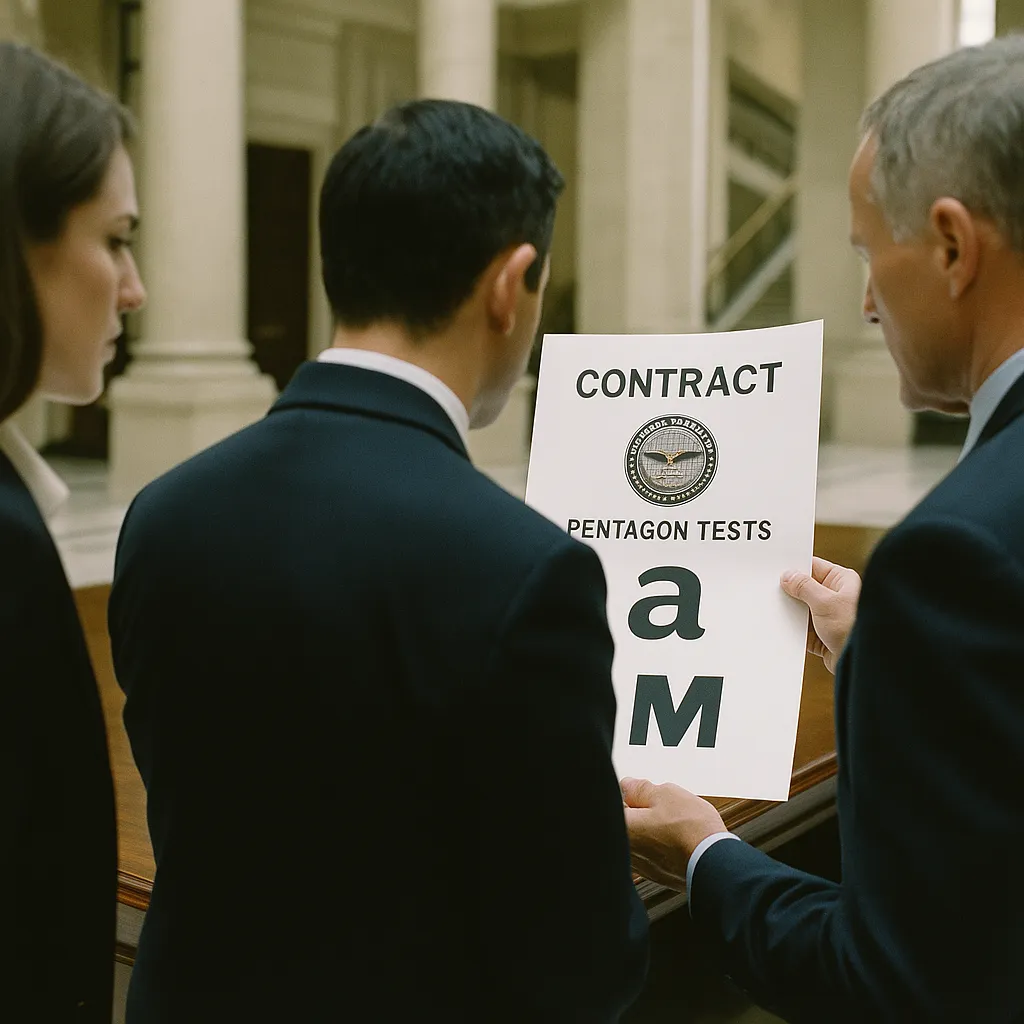
The Pentagon is actively testing OpenAI and Google AI models as potential replacements for Anthropic's Claude in classified defense systems, confirming that the most secure AI contract market is now openly competitive.
Pentagon Tests OpenAI and Google Models to Replace Claude in Classified Systems
By Hector Herrera | June 8, 2026 | Government
The Pentagon is actively testing OpenAI [and Google](/security/openai-anthropic-google-anti-distillation-coalition) AI models as potential replacements for Anthropic's Claude in classified defense systems — a signal that the highest-stakes AI contract market is far more competitive than it appeared six months ago. No replacement timeline has been announced, but the evaluation itself reshapes the competitive picture for every AI vendor pursuing government work.
Background
Anthropic secured a significant foothold in federal AI after its Claude models passed stringent security vetting required for handling classified information — a process that can take years and involves evaluations by intelligence community technical staff. That head start gave Anthropic an advantage in a market where security clearance is a prerequisite, not a differentiator. The Pentagon's decision to now test competing models suggests either that OpenAI and Google have cleared enough of the security hurdles to warrant a formal evaluation, or that the DoD is deliberately opening the field before any single vendor becomes entrenched.
What the Pentagon Confirmed
According to reporting published June 8, the Defense Department confirmed:
- Active testing of OpenAI and Google models — not a future plan, but an ongoing evaluation as of this week
- The testing is for classified defense systems, the highest tier of government AI deployment
- No decision timeline was provided; the DoD did not specify which OpenAI or Google models are under evaluation
- The evaluation raises questions about security vetting timelines — whether newer model versions require re-vetting or whether approval carries over to updated releases
The DoD did not disclose which specific classified programs are involved, the scale of current Claude deployments being considered for replacement, or whether Anthropic was given an opportunity to submit updated models for parallel evaluation.
Why This Matters
Government AI contracts are the highest-margin, most defensible business in the industry. A classified AI contract is not easily switched — integration with secure networks, hardware, and workflows creates real switching costs. But those same switching costs make the evaluation phase critical: whichever models win the initial deployment tend to stay for years.
Get this in your inbox.
Daily AI intelligence. Free. No spam.
Three dynamics are in play:
-
Vendor diversification is DoD policy. The Defense Department has explicitly stated it does not want single-vendor dependency in AI, the same philosophy it applies to cloud infrastructure (hence the multi-cloud JWCC contract spread across AWS, Azure, Google Cloud, and Oracle). Testing multiple models is consistent with that posture — it does not necessarily mean Claude is being cut.
-
Model capability is advancing faster than security vetting. If the DoD cleared Claude 2 or Claude 3 but Anthropic's current production model is Claude 4-series, the approved model may no longer be the best available. The same lag applies to OpenAI and Google. The pace of model releases has outrun traditional government procurement cycles.
-
Competition raises leverage. Even if the DoD ultimately keeps Claude as its primary classified AI, the public confirmation that it is evaluating alternatives gives defense procurement officers negotiating leverage on pricing and terms.
What Anthropic Stands to Lose
Anthropic has positioned government contracts as a core revenue pillar. The company's recent $1.5 billion raised at a $61.5 billion valuation was partly premised on its government business growing alongside commercial enterprise. A visible competitive challenge to that position — even one that results in Anthropic retaining contracts — adds uncertainty to revenue projections at a moment when the company is reportedly preparing for an IPO.
Claude's safety architecture — the Constitutional AI training method and Anthropic's interpretability research — has been a selling point in classified contexts where explainability and predictable behavior matter. Whether DoD evaluators weight that against raw capability benchmarks from OpenAI's o-series models or Google's Gemini Ultra is not publicly known.
What to Watch
The DoD's evaluation timeline is the key unknown. Watch for contract award announcements through the General Services Administration's IT procurement channels, or for any Anthropic, OpenAI, or Google disclosures about government contract wins in security filings. Anthropic's anticipated IPO prospectus, if filed in 2026, would be required to disclose material government contracts and known risks to those contracts.
Hector Herrera covers AI policy and government technology at NexChron.
Did this help you understand AI better?
Your feedback helps us write more useful content.
Get tomorrow's AI briefing
Join readers who start their day with NexChron. Free, daily, no spam.