Your daily AI intelligence for May 05, 2026.
Good morning. Here's your AI intelligence for Tuesday, May 05, 2026.
The workforce data is getting more specific — and more gendered.
UNICEF Innocenti published research finding that women hold 86 percent of the jobs most exposed to AI-driven displacement. These aren't the roles manufacturing automation disrupted decades ago. They're administrative, clerical, and customer-service positions that prior automation waves largely bypassed. The concentration is sharpest in developing economies, where those sectors account for a larger share of women's economic participation. The research adds a data layer to a displacement conversation that has too often been treated as gender-neutral.
Treasury Secretary Scott Bessent issued a warning of a different kind. In unusually direct public remarks, Bessent said AI is enabling cyberattacks capable of breaching U.S. bank accounts at scale — and that financial institutions' defenses are not keeping pace with the threat. It's a rare systemic caution from a cabinet official, and it signals that AI-enabled financial crime has moved from theoretical risk to active concern at the executive level.
Two robots, two different stories.
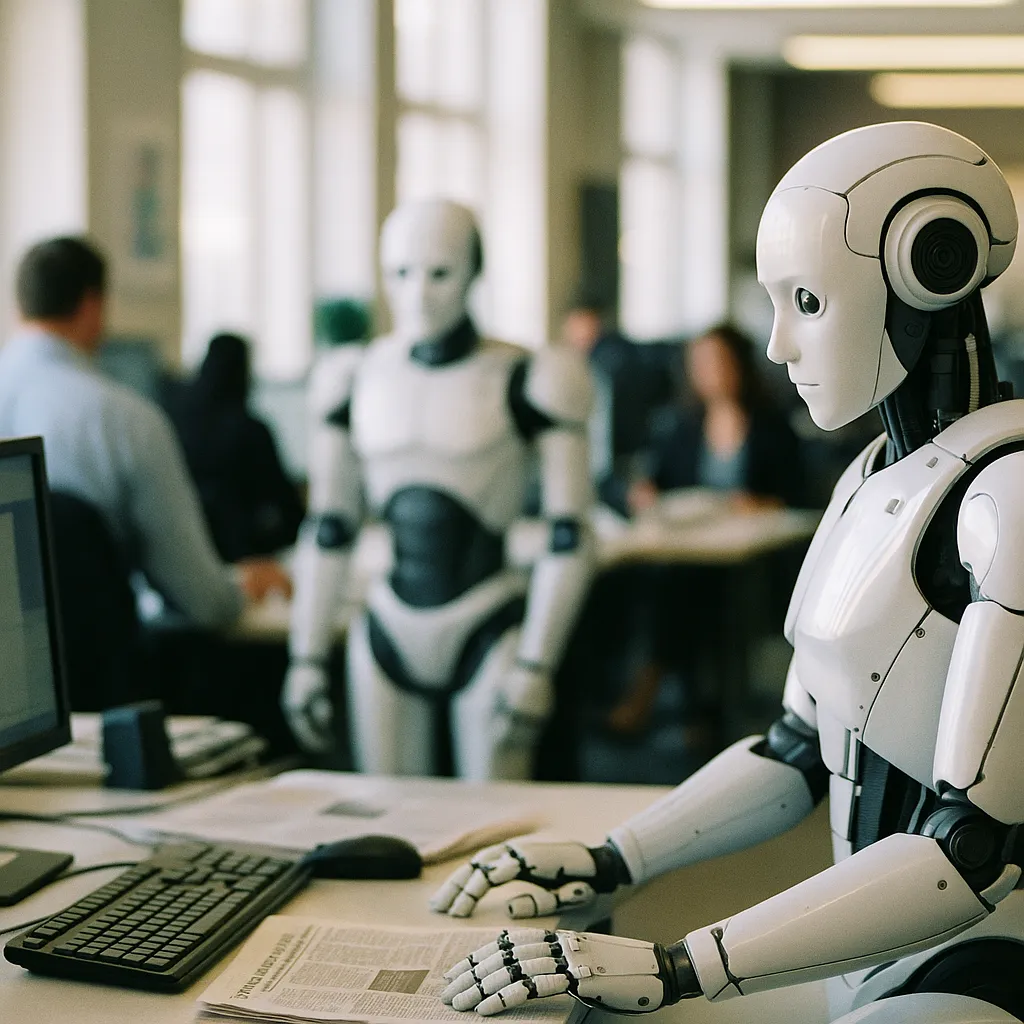
BMW deployed the AEON humanoid robot at its Leipzig plant for material delivery — the first humanoid in active use on a BMW German production floor. The task is intentionally modest: material delivery, not assembly. That's the right starting point. The gap between demo performance and real-floor reliability is still significant, and BMW is treating this as an integration test rather than a milestone photo. That discipline matters more than the headline.
Tesla's Austin robotaxi situation reads differently. A Marketplace investigation found approximately 12 vehicles in active service — far fewer than Elon Musk's public statements about commercial expansion have implied. Specific counts are now being documented and published, which changes the accountability environment for timeline claims. Tesla has a long history of adjusting product schedules. The difference now is that journalists are counting the cars.
Institutions are being asked to run faster than they can.
New York City parents packed a seven-hour school board meeting demanding a two-year pause on AI in classrooms. The NYC Department of Education has a draft AI guidance framework open for public comment through May 8. The meeting made clear that many families want accountability before expansion — not a framework that permits both simultaneously. The tension is legitimate: AI tools are already in student hands outside school. But so is the demand for institutional structure before further integration.
Courts are facing the same lag. AI hallucination incidents in legal filings are now being documented at four to five new cases per day — attorneys submitting fabricated citations without verification. Courts are considering requiring hyperlinked citations so fabricated sources become visible at the point of filing rather than after damage is done. At that volume, hallucination in legal documents is no longer an edge case. It's a systemic workflow failure.
Get this in your inbox.
Daily AI intelligence. Free. No spam.
Americans are also using AI between doctor visits in growing numbers — and sometimes instead of visits entirely. Diagnostic accuracy, liability, and health equity questions don't have settled answers. The clinical and regulatory infrastructure hasn't caught up to behavior that is already happening at scale.
Infrastructure is being built faster than the grid — and faster than communities want.
AI data centers are adding grid loads equivalent to mid-sized cities while simultaneously becoming the largest single driver of new renewable energy procurement globally. Utilities built around 20-year planning horizons are being asked to respond in 18 months. The grid is both under strain and being funded to expand — by the same industry creating the strain.
Location is becoming a second constraint. A Redfin survey found 47 percent of Americans oppose AI data center construction near their homes, and some projects have already been abandoned or relocated in response to community resistance. Power availability was expected to be the binding constraint on the AI infrastructure buildout. Neighborhood opposition may rival it sooner than the industry has planned for.
Hollywood and farms: the same gap, different terrain.
AI tools are now active at the script, casting, and VFX stages of Hollywood production. The contracts negotiated in the 2023 WGA and SAG-AFTRA strikes included AI provisions — but for capabilities that existed in 2023. What's in production use now has moved past those provisions. The labor questions that weren't resolved two years ago are surfacing again in a more technologically advanced form, and the next round of negotiations will have less ambiguity to hide behind.
In agriculture, the 2026 State of the Farm Report puts AI adoption at 14 percent of farmers — concentrated in large operations using it for financial analysis, not field management. The precision agriculture applications most cited in industry coverage aren't what's actually being deployed. Small and mid-size operations are largely outside the picture, which means the economic benefits of agricultural AI are accruing where they're least needed.
Telecom: Huawei makes its most aggressive AI move yet.
Huawei unveiled AgenticCore, an architecture designed to embed agentic AI simultaneously across mobile data, voice, network operations, and telco cloud infrastructure. It is the most comprehensive unified AI integration proposal the telecom sector has seen from a single vendor. Huawei frames it as 5G infrastructure today with 6G architecture built in. For carriers evaluating infrastructure decisions, this is a significant technical development — and in markets where Huawei equipment faces regulatory scrutiny, an equally significant geopolitical variable.
What to watch today.
NYC DOE public comment closes May 8. Whether the seven-hour school board session shifts the policy outcome will be visible in the next 72 hours. Watch for any signals from the DOE about whether the moratorium demand changes the framework before comments close.
Courts and citation mandates. Mandatory hyperlinked citations are being discussed as a structural response to the daily wave of AI hallucination filings. A formal rule in even one major jurisdiction would quickly change how AI tools are used in legal practice — and what malpractice exposure looks like.
BMW's Leipzig timeline as a benchmark. The AEON deployment sets realistic expectations for humanoid integration in automotive manufacturing. Watch how long it takes other major OEMs to announce comparable deployments — and whether they follow BMW's disciplined scope or overreach into assembly tasks before the technology is ready.
Did this help you understand AI better?
Your feedback helps us write more useful content.
Get tomorrow's AI briefing
Join readers who start their day with NexChron. Free, daily, no spam.