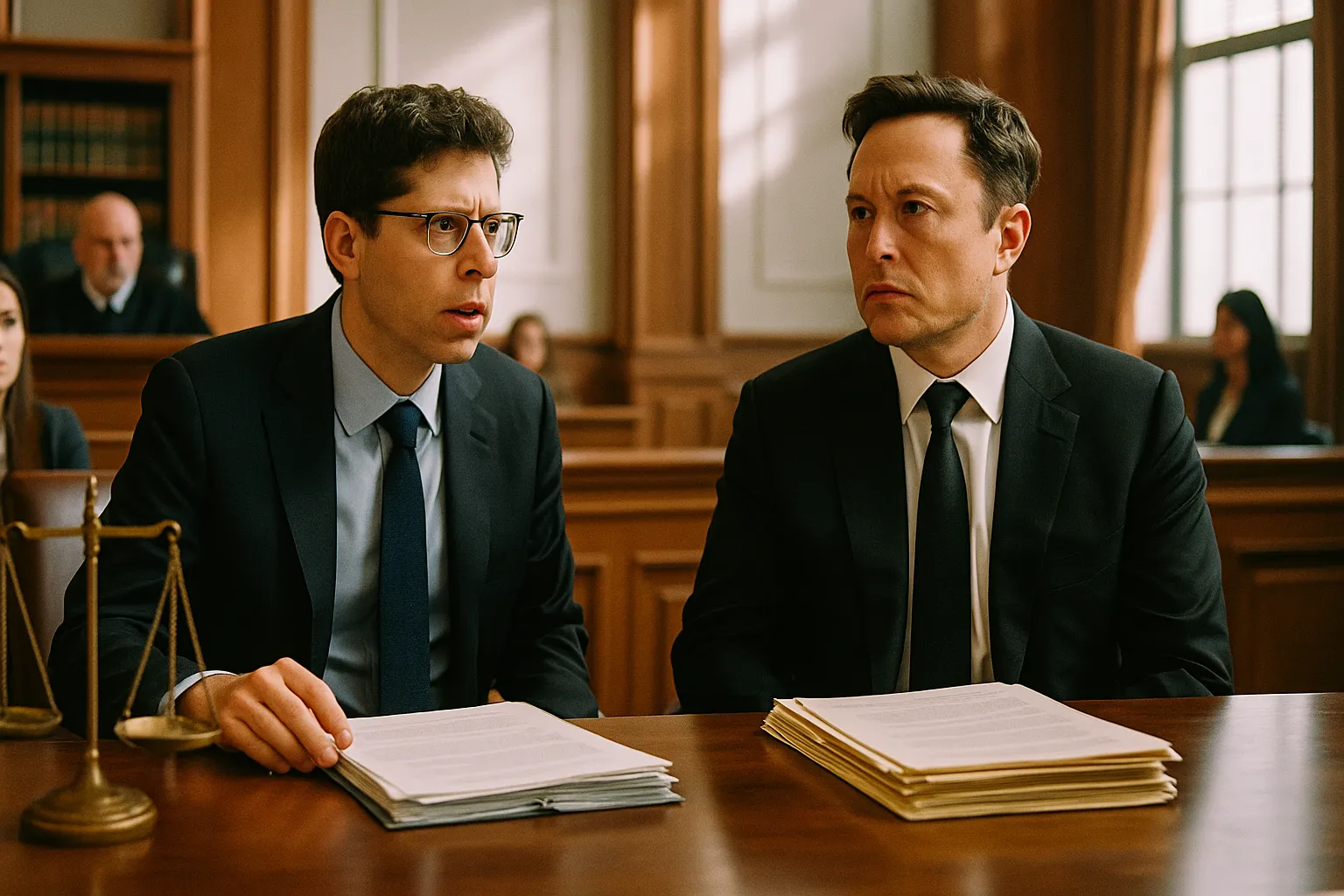
OpenAI accused Elon Musk of a last-minute 'legal ambush' after he amended his lawsuit to demand the ouster of CEO Sam Altman and up to $134 billion in damages, with trial set for April 27.
OpenAI accused Elon Musk of a last-minute "legal ambush" after he changed the relief he is seeking in his fraud lawsuit — now demanding the ouster of CEO Sam Altman and President Greg Brockman in addition to damages of $79 to $134 billion. The trial is set for April 27 in Oakland, California. What was already the most consequential lawsuit in AI history just got significantly more complex.
Background: what this case is about
Elon Musk was a co-founder and early funder of OpenAI, which was established in 2015 as a nonprofit research organization. Its stated mission was to develop artificial general intelligence — AI that matches or exceeds human-level capability across most tasks — for the benefit of humanity, not shareholders.
OpenAI began converting to a for-profit structure starting around 2019, a process that has accelerated sharply in recent years. Musk's lawsuit, filed in 2023, argues that this conversion violated the terms of OpenAI's founding mission — that he donated money and credibility to a nonprofit pursuing a specific public purpose, and that OpenAI's leadership diverted that organization into a commercial venture for private enrichment.
The new demands
According to Bloomberg, Musk recently amended his relief demands to include:
- The removal of Sam Altman as CEO and Greg Brockman as President
- $79 to $134 billion in damages — a range that reflects competing valuations of what OpenAI would be worth if it had remained a nonprofit versus its current for-profit trajectory
- Other equitable relief related to the nonprofit conversion
OpenAI characterized the amendment as an "ambush" — a last-minute change to the scope of the lawsuit that forces the company to defend against significantly broader claims with limited time to prepare before trial.
Get this in your inbox.
Daily AI intelligence. Free. No spam.
What OpenAI is arguing
OpenAI's defense rests on several pillars:
- Musk had full knowledge of the for-profit transition. OpenAI argues that Musk was aware of and involved in discussions about the structure change before he departed the board in 2018, and that his current objections are opportunistic rather than principled.
- The nonprofit mission is continuing. OpenAI argues that its nonprofit board retains oversight of the for-profit entity and that the mission of developing safe AGI for humanity's benefit remains intact.
- Musk's real motivation is competitive. OpenAI has repeatedly argued that Musk's litigation is driven by his desire to disadvantage a competitor — he co-founded xAI and its Grok AI system after departing OpenAI — rather than any genuine concern about nonprofit governance.
The stakes
This case has no clear precedent at this scale. The specific legal questions — whether a nonprofit co-founder can sue to reverse a corporate structure change, what damages are appropriate if they can, and whether a court can order the removal of executives — have not been adjudicated at this level.
The $79–$134 billion damage range alone would represent one of the largest civil judgments in US history if awarded. For context, OpenAI was most recently valued at approximately $300 billion in early 2026.
The executive removal demand raises a separate question: courts can order equitable relief in fraud cases, but ordering the removal of a private company's CEO is an extraordinary remedy. Whether a court would grant it — even in the event of a liability finding — is deeply uncertain.
What a loss looks like for each side
- If OpenAI loses: The worst-case scenario involves forced executive changes, a reversal of the for-profit conversion, and potentially billions in damages. Even a partial loss — say, a finding of liability but limited damages — would create significant governance uncertainty and empower regulators and critics pushing for stricter AI oversight.
- If Musk loses: xAI continues to compete against a structurally stable OpenAI. Musk loses credibility as an AI governance critic and faces the reputational cost of having pursued a case characterized as retaliatory.
What to watch
Trial begins April 27 in Oakland. Watch for any pre-trial settlement discussions — cases of this complexity and with this much at stake for both parties sometimes settle in the days before trial. If the trial proceeds, the first key question will be whether the judge narrows or accepts Musk's expanded relief demands. A ruling on that question alone will define the scope of what can be won or lost.
Source: Bloomberg
Did this help you understand AI better?
Your feedback helps us write more useful content.
Get tomorrow's AI briefing
Join readers who start their day with NexChron. Free, daily, no spam.