Your daily AI intelligence for April 30, 2026.
Daily AI Briefing — April 30, 2026
Good morning. Here's your AI intelligence for Thursday, April 30, 2026.
Today's briefing covers a full spectrum: new model architecture pushing agentic AI efficiency, autonomous AI operating in clinical settings without a clinician, state and federal policy collisions over education and labor, an insurance market unprepared for what it's being asked to cover, and the quiet climate reckoning that's been building inside every hyperscale data center.
AI Models and Infrastructure
NVIDIA's Nemotron Nano Omni Targets the Agentic Stack
NVIDIA released Nemotron 3 Nano Omni this week — a 30B-parameter open model delivering nine times the throughput of comparable omni models. This isn't a research announcement. It's a direct move to own the agentic AI software stack, not just the silicon underneath it. Multimodal, efficient, and openly available, Nemotron Nano Omni positions NVIDIA as the default infrastructure layer for autonomous AI systems running at enterprise scale.
Ericsson: Agentic AI Requires Rebuilding Telecom Networks From Scratch
A new Ericsson white paper makes a stark argument: AI agents won't optimize current telecom networks — they'll make them obsolete. Carriers that want to support agentic AI workloads will need to rebuild network architecture from the ground up, a transition Ericsson estimates at three to five years for fully committed operators. This is an infrastructure bill the industry hasn't finished pricing.
Delivery Robots Graduate From Pilot to Infrastructure
Last-mile delivery robots have crossed a threshold. They're no longer novelty deployments in a handful of cities — they're functioning logistics infrastructure, with AI-powered navigation and fleet coordination making them economically competitive with human couriers on dense urban routes. The economics tipped quietly. The operational scale didn't.
AI Data Centers Are Outpacing What Insurance Can Cover
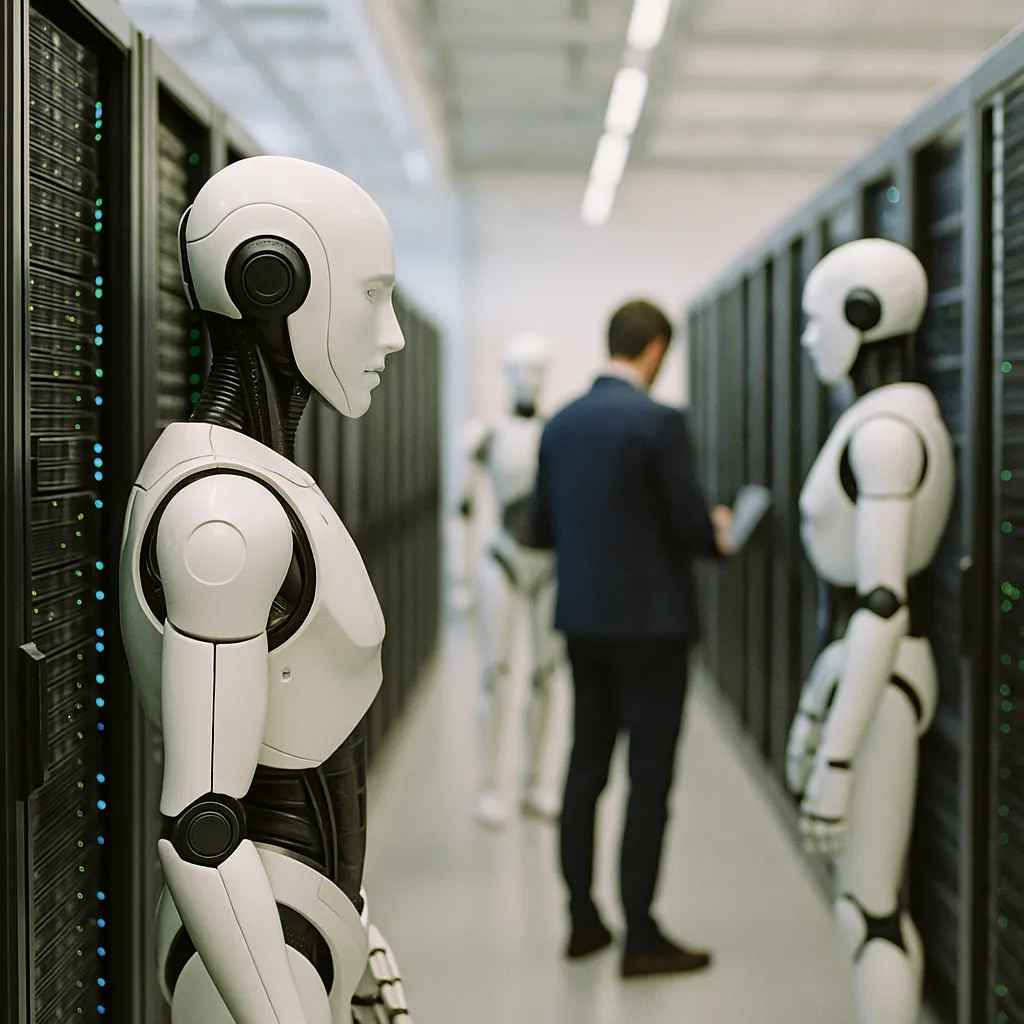
GPU-backed debt structures and hyperscale data center construction are presenting commercial insurers with risk profiles that existing products weren't built to handle. The AI infrastructure buildout is moving faster than the actuarial models that would normally price it. That gap — between construction velocity and insurable exposure — is growing.
Health and Clinical AI
Bupa Deploys the World's First Autonomous AI Medical Device for Skin Cancer
Get this in your inbox.
Daily AI intelligence. Free. No spam.
Bupa has put DERM into clinical operation — the world's only CE Class III autonomous AI medical device — delivering melanoma risk assessments in 60 seconds without a clinician in the loop. Class III is the highest risk classification for medical devices in the EU framework. An autonomous device at that classification operating at clinical scale is a milestone the industry has been approaching for years. It's here now.
Labor and Workforce
Gallup: Nearly One in Five US Workers Expects AI to Eliminate Their Job
A new Gallup survey finds 18% of US workers believe AI will eliminate their job within five years. At organizations that have already deployed AI tools, that number rises to 23%. The spread matters: workers with direct AI exposure are more worried, not less, than the national average. The narrative that AI familiarity reduces fear isn't holding in the data.
LLM Adoption in Manufacturing Doubled in a Single Year
The 2026 Smart Factory Outlook finds large language model adoption in manufacturing jumped from 16% to 35% in one year. Lights-out factories — fully autonomous production facilities — are now operating at scale across Asia-Pacific. This is not a future-tense story. The transition in manufacturing is actively underway, and the workforce implications follow directly from Gallup's numbers.
Retail and Commerce
McKinsey and ICSC: AI Is Splitting Retail Into Two Survival Models
A joint ICSC and McKinsey report finds physical retail bifurcating under AI pressure. Stores integrating AI into customer experience, inventory, and fulfillment are separating from those that haven't — and the gap is widening fast. Up to $1 trillion in US consumer spending is projected to flow through agentic AI commerce by 2030. The retailers not already in the first category have a narrowing window to cross over.
Policy and Regulation
Idaho Becomes the First State With a Comprehensive K-12 AI Framework
Idaho Governor Brad Little signed SB 1227 this week, making Idaho the first state to codify a complete AI governance structure for K-12 education. The law includes an explicit prohibition on AI replacing human teachers — a provision that will be watched closely by the 41 other states with AI education bills in progress. Idaho just set one version of the benchmark.
Global AI Regulation Is Now Five Simultaneous Compliance Regimes
Multinationals operating across the EU, US, UK, and Asia-Pacific now face simultaneous AI compliance obligations under as many as five distinct regulatory frameworks — each with different enforcement philosophies, timelines, and liability structures. The EU AI Act, US executive orders, the UK's sector-by-sector approach, and divergent Asia-Pacific rules are not converging. They're diverging. Legal and compliance teams that expected harmonization aren't going to get it.
Courts Are Issuing AI Rulings Without a Coherent Framework
Alston & Bird's April 2026 AI Quarterly documents something that's been building for months: courts are issuing consequential AI rulings on liability, evidence, and contracts — without a shared doctrinal framework. One ruling found that law firms using commercial AI tools may have waived attorney-client privilege. These aren't edge cases. They're precedents being set in the absence of doctrine.
Climate and Energy
AI's Energy Appetite Is Quietly Undermining Corporate Climate Pledges
Data centers are projected to account for 55% of all US electricity demand growth over the next five years. AI is the primary driver. A Carbon Direct analysis finds that corporate net-zero commitments are structurally misaligned with the energy footprint of the AI systems those same companies are deploying. This isn't a future risk. The emissions are accumulating now, and the accounting hasn't caught up.
What to Watch Today
- Idaho's SB 1227 ripple effect. Expect other states to respond quickly — either building on Idaho's framework or pushing back against the teacher-replacement prohibition. Thirty-plus active state education bills are watching.
- Insurance market signals. Watch for re-insurers and specialty carriers to begin publishing AI data center risk assessments. The gap between construction velocity and insurable exposure can't stay quiet much longer.
- Gallup workforce data follow-through. The 23% figure at AI-deployed organizations is the number to track. As enterprise AI deployment accelerates in Q2, similar surveys will either confirm or complicate that reading.
Hector Herrera is the founder of Hex AI Systems and editor of NexChron.
Did this help you understand AI better?
Your feedback helps us write more useful content.
Get tomorrow's AI briefing
Join readers who start their day with NexChron. Free, daily, no spam.