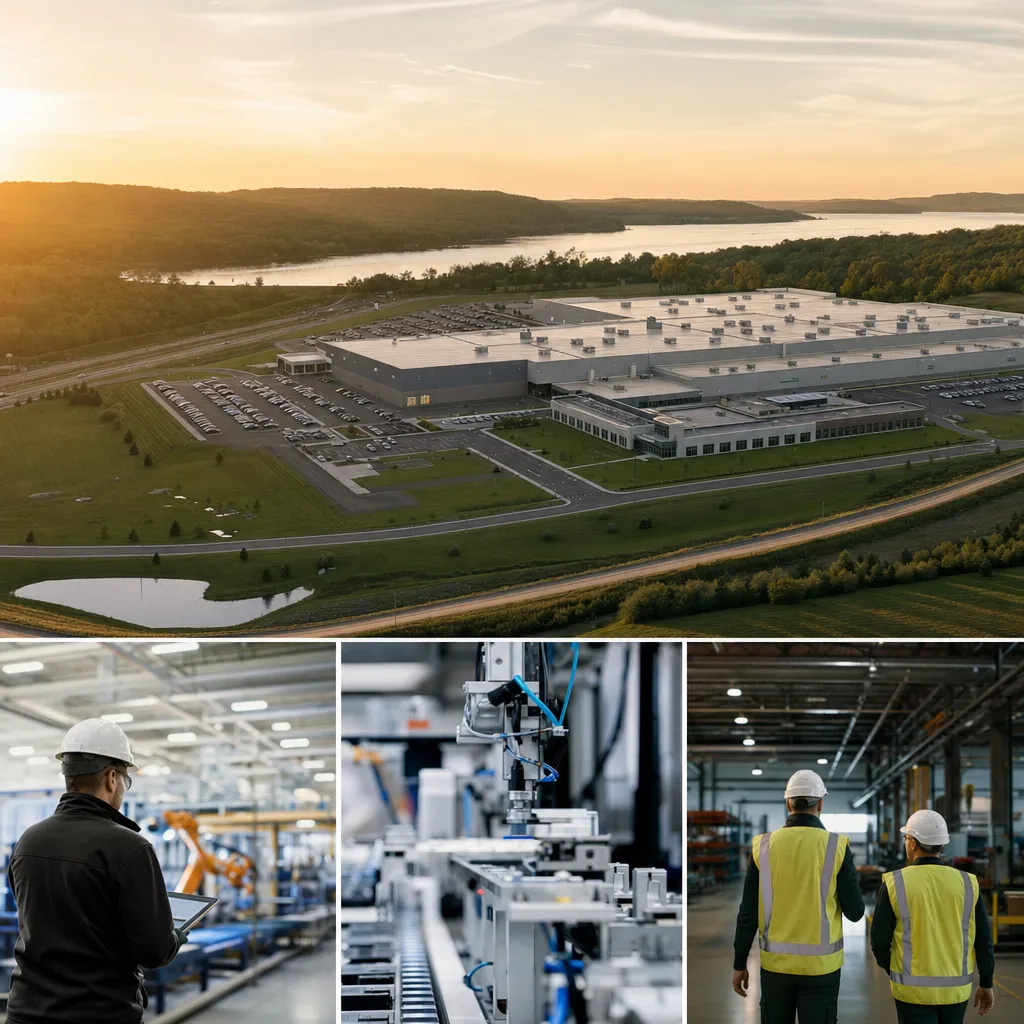
Rockwell Automation will build its largest-ever manufacturing facility in Wisconsin, fully equipped with AI, robotics, and automation — a move that doubles as a live demonstration of the company's own industrial AI stack.
Rockwell Automation will build its largest manufacturing facility ever in Wisconsin, fully equipped with the company's own AI-driven industrial systems, robotics, and digital automation stack. The announcement matters because it is simultaneously a capital investment and a proof-of-concept: Rockwell is building a facility where its own technology has to work at scale, with the company's credibility as an industrial AI vendor directly on the line.
What Rockwell Is Building
According to Ayoka Systems' reporting on the announcement, the Wisconsin facility will be Rockwell Automation's largest manufacturing plant, configured from the ground up with advanced robotics, full automation, and AI-driven digital systems throughout the production environment.
Rockwell Automation is one of the dominant players in industrial automation — its hardware, software, and control systems are embedded in manufacturing facilities across aerospace, automotive, food and beverage, life sciences, and consumer goods. The company's FactoryTalk software suite and Plex MES (manufacturing execution system — the software layer that manages production operations in real time) are among the most widely deployed industrial AI platforms globally.
The "Dogfooding" Strategy
The most significant aspect of this announcement is not the factory itself — it is what building it signifies about Rockwell's confidence in its own technology.
Industrial automation vendors have long faced a credibility question from manufacturing customers: if your AI systems are as effective as you claim, why aren't you running your own operations on them? Building a flagship AI-native facility that uses Rockwell's full stack is a direct answer to that question.
This practice — using your own product internally before selling it to customers — is called "dogfooding" in the technology industry, and it carries a specific signal: the vendor has skin in the game. If Rockwell's AI-driven factory runs efficiently, it becomes a living case study for every prospective customer. If it struggles, the company will learn lessons it can apply to customer deployments before those problems surface in the field.
Get this in your inbox.
Daily AI intelligence. Free. No spam.
Domestic Production and the Reshoring Context
Rockwell's Wisconsin investment also reflects the broader pattern of industrial manufacturers expanding US production capacity in 2026. The combination of reshoring incentives from US industrial policy, supply chain diversification pressures following the 2024-2025 logistics disruptions, and AI-driven reductions in labor cost premiums for domestic manufacturing have made US factory investment more attractive than it was five years ago.
For Rockwell specifically, domestic production capacity for its hardware components reduces supply chain exposure in a sector where long lead times on specialized industrial components have been a recurring pain point for customers planning large automation projects.
AI-Native vs. Retrofit: The Wider Industry Shift
Rockwell's decision to build AI-native rather than retrofit an existing facility reflects an emerging pattern among legacy industrial firms with significant AI technology portfolios. Retrofitting older plants with AI and automation is costly, disruptive, and often limited by the physical configuration of existing lines and the age of their sensor and connectivity infrastructure.
Greenfield AI-native facilities — built from the foundation with automation, sensor networks, digital twins, and AI management systems integrated into every layer — can achieve performance levels that retrofitted plants cannot match. This includes real-time production optimization, predictive maintenance that prevents downtime before it occurs, and quality inspection systems with computer vision embedded throughout the line.
The tradeoff is capital intensity. AI-native greenfield builds cost more upfront than retrofitting. But for a company like Rockwell — which is simultaneously building the facility and selling the technology stack that runs it — the economics are different from a typical manufacturer's calculation. The Wisconsin factory is as much a marketing asset as a production asset.
What the Industry Is Watching
Operational performance data from the Wisconsin facility will be closely watched by Rockwell's competitors and customers alike. If Rockwell begins releasing production efficiency, downtime, and quality metrics from the facility, it will accelerate or slow enterprise adoption decisions for Rockwell's AI industrial platform in ways that no marketing campaign could match.
Competitors — Siemens, Honeywell, Emerson, ABB — are likely to respond. The competitive dynamic among industrial automation vendors in 2026 increasingly includes demonstration facilities as a form of market signaling: who has the confidence to run their own operations on their own AI, at scale, and publish the results.
What to Watch
Watch for the facility's construction timeline and any early performance reporting once it enters operation. Also track whether Rockwell uses the Wisconsin facility for customer tours and live demonstrations — a standard enterprise sales motion that would signal the company intends to convert the facility directly into pipeline.
Did this help you understand AI better?
Your feedback helps us write more useful content.
Get tomorrow's AI briefing
Join readers who start their day with NexChron. Free, daily, no spam.