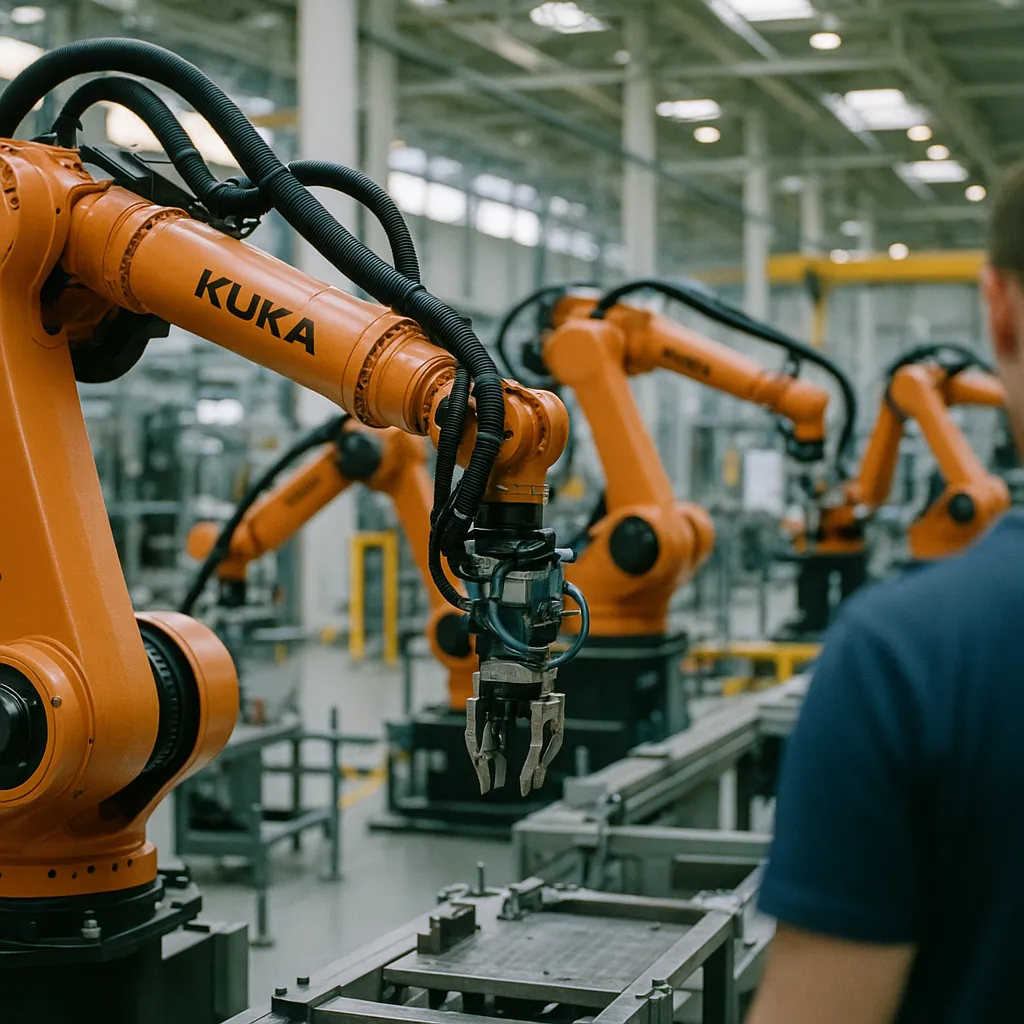
KUKA's new AMP platform lets manufacturers describe production goals in plain language rather than programming robot movements — unveiled at HANNOVER MESSE 2026.
KUKA, the German robotics company responsible for much of the world's automotive assembly automation, introduced its Automation 2.0 vision at HANNOVER MESSE this week — anchored by an AMP platform that lets manufacturers describe production goals in plain language rather than programming specific robot movements. The shift from instruction to intent represents the most meaningful evolution in industrial robot programming since offline simulation software arrived in the 1990s.
What's Actually Changing
Traditional industrial robots are capable and reliable, but rigid. They're programmed for specific motions on specific parts, and changing what they do requires re-engineering those motion programs — a process that takes skilled robotics engineers days or weeks per reconfiguration. Every new product, every design revision, every layout change carries that engineering cost.
That rigidity is increasingly a competitive liability. Supply chains are shortening. Product cycles are accelerating. Contract manufacturers need to pivot between product lines faster than the old programming model allows. The factories that reconfigure fastest win the order.
KUKA's Automation 2.0 strategy, unveiled at HANNOVER MESSE 2026 (April 20–24), pairs AI software with KUKA's industrial hardware through the AMP (Automation Made Practical) platform. Rather than programming specific movements, an operator describes a goal — "pick this part type and place it in this fixture position" — and AMP translates that into motion planning, adapting as floor conditions change. The underlying AI handles path optimization, collision avoidance, and real-time adjustment in response to the environment it actually sees, not the map it was given.
Who's Showing Up at HANNOVER MESSE 2026
The timing matters. HANNOVER MESSE 2026 has organized its entire program around the theme of physical AI in manufacturing — the integration of real-time AI decision-making with physical industrial systems. KUKA's announcement isn't an isolated product launch. It's one entry in a week-long series of announcements from the world's largest industrial technology trade show.
Competing systems from ABB, Fanuc, and Yaskawa — KUKA's main robotics rivals — will appear over the course of the week. By April 24, it will be possible to assess whether Automation 2.0 represents a genuine differentiator or whether the industry is converging on roughly equivalent approaches simultaneously.
Get this in your inbox.
Daily AI intelligence. Free. No spam.
What KUKA disclosed at launch:
- AMP platform combines AI software with KUKA's existing robot hardware
- Natural language or goal-based operator interface replaces motion programming
- Designed for flexible factory environments, not just fixed single-task assembly
- No specific performance benchmarks or named production deployments announced
The Flexibility Premium
The business case for intent-driven robots comes down to changeover economics. Current industrial robot installations are amortized over years of fixed-task production. When a product changes or a line needs to be retasked, the sunk cost of the programming work becomes a factor in the decision — sometimes a more significant factor than the hardware itself.
If AI-driven flexibility genuinely reduces retasking time from weeks to hours, it changes that equation. Industrial robots stop being capital assets that constrain operational flexibility and start functioning more like infrastructure that enables it — closer to how manufacturers think about conveyors or workstations than how they think about custom-built fixtures.
Most likely early adopters:
- Tier 1 automotive suppliers facing the most frequent model changes in EV transition
- Electronics contract manufacturers dealing with product cycles measured in months, not years
- Small-batch precision manufacturers who currently can't justify robot automation because changeover costs exceed production efficiency gains
Where the Uncertainty Lives
KUKA's announcement is a platform vision and product launch, not a deployment report. The gap between AI-assisted robotics working in controlled demonstrations and AI-assisted robotics working reliably on a production floor — with the contamination, vibration, lighting variation, and part-to-part inconsistency that real manufacturing involves — is where most of the meaningful skepticism sits.
The industry has a history of overpromising on flexible automation. Machine vision systems for bin-picking — the task of identifying and gripping randomly oriented parts from a bin — have been described as "almost production ready" for a decade. What's different now is the quality of the underlying AI vision and language models. The question is whether KUKA's integration translates that quality into industrial-grade reliability at scale.
What to Watch
HANNOVER MESSE runs through April 24. Watch for customer deployment announcements alongside the technology presentations — production implementations are more credible than lab demonstrations. KUKA's largest customer relationships are in automotive (Volkswagen Group, BMW Group, and others). Any confirmed production deployment at a named OEM would be the validation signal the announcement currently lacks.
Watch also for ABB's and Fanuc's counter-announcements this week. If multiple robotics companies are showing equivalent capabilities simultaneously, it suggests the underlying AI technology has matured enough that the competitive advantage shifts from "who has it" to "who integrates it best."
By Hector Herrera | April 20, 2026
Did this help you understand AI better?
Your feedback helps us write more useful content.
Get tomorrow's AI briefing
Join readers who start their day with NexChron. Free, daily, no spam.