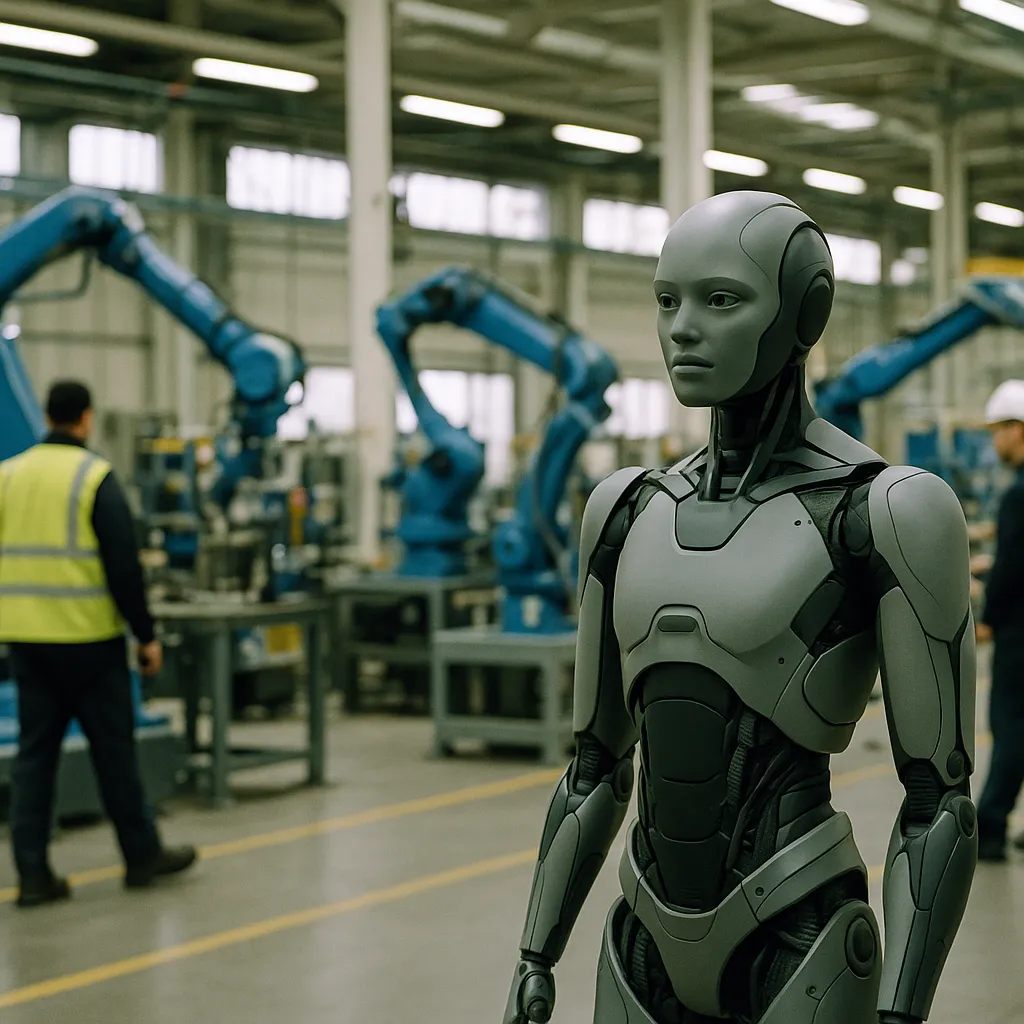
UK robotics startup Humanoid has signed a binding Robot-as-a-Service agreement with Schaeffler to deploy 1,000–2,000 wheeled humanoid robots across global manufacturing facilities by 2032 — one of the largest humanoid robot deployments ever announced.
UK Startup Humanoid Locks In Deal to Deploy 2,000 Robots Across Schaeffler's Global Factories
By Hector Herrera | May 14, 2026 | Manufacturing
UK robotics startup Humanoid has signed a binding Robot-as-a-Service agreement with Schaeffler — the German industrial conglomerate that makes precision bearings and drivetrain components for the automotive and aerospace industries — to deploy 1,000 to 2,000 wheeled humanoid robots across Schaeffler's global manufacturing facilities by 2032. According to Schaeffler, the first units will go live in Germany before the end of 2026. It is one of the largest disclosed humanoid robot deployments ever announced.
The deal also includes a separate five-year actuator supply agreement — covering more than 50% of Humanoid's joint actuator demand — that deepens the commercial relationship beyond deployment and into the hardware supply chain itself.
Why This Deal Is Significant
Humanoid robot announcements have accumulated over the past two years, but most have involved pilot programs, letters of intent, or early-stage lab demonstrations. Binding commercial agreements with defined volume targets and deployment timelines have been rarer. The Schaeffler deal is significant precisely because of its structure:
- Binding Robot-as-a-Service contract — not a pilot, not an MOU
- Defined scale: 1,000–2,000 units across global facilities
- Hard timeline: first Germany deployment by end of 2026; full rollout by 2032
- Supply chain depth: separate actuator supply deal covering majority of Humanoid's component demand
Robot-as-a-Service (RaaS) is a deployment model in which the robot vendor provides hardware, software, and maintenance under a recurring fee structure — analogous to cloud computing rather than traditional capital equipment purchase. That model lowers the barrier to adoption for manufacturers who want to avoid large upfront hardware commitments, while giving robotics companies predictable revenue and continued system access for software updates and monitoring.
Who Humanoid Is
Humanoid is a UK-based robotics startup. The company has developed wheeled humanoid robots — a design category that combines human-like upper body dexterity with wheeled mobility rather than bipedal walking. The wheeled approach trades some of the terrain flexibility of bipedal designs for greater stability and energy efficiency, which suits structured factory environments well.
The company is not a household name in the way that Figure, 1X, or Apptronik are in the United States, but the Schaeffler deal positions it as a significant commercial player in European industrial robotics. The actuator supply agreement signals that Schaeffler is not simply a customer — it is becoming a strategic partner in Humanoid's hardware supply chain.
Who Schaeffler Is
Schaeffler Group is a publicly traded German industrial company with approximately 83,000 employees and manufacturing operations across more than 50 countries. It makes precision components for automotive powertrains, electric vehicles, industrial machinery, aerospace systems, and wind energy equipment. Its facilities span Germany, the Americas, Asia, and Eastern Europe — giving a global robotics deployment agreement significant geographic reach.
Get this in your inbox.
Daily AI intelligence. Free. No spam.
Schaeffler has been publicly active on manufacturing automation and electrification strategy. Deploying humanoid robots across its global facilities at scale would represent a meaningful operational transformation, particularly in assembly and material handling tasks where humanoid form factor offers flexibility advantages over fixed robotic arms.
The Industrial Humanoid Moment
The Humanoid-Schaeffler deal arrives as several forces are converging to accelerate humanoid robot deployment in manufacturing:
Labor cost pressure. In high-wage manufacturing markets — Germany being a prime example — the economics of automation have shifted. Labor costs have risen while robot hardware and software costs have fallen. The breakeven point for automation investment has moved in favor of deployment.
Dexterity improvements. Early industrial robots were effective at repetitive, fixed-position tasks but struggled with variability. Newer AI-driven manipulation systems can handle a wider range of tasks — picking irregular parts, assembling components with human-like grip adjustments — that previously required human workers.
Flexibility demand. Traditional fixed robotic systems require significant reprogramming when production changes. Humanoid robots, particularly those using learning-based AI, can be retrained faster and physically repositioned to new tasks — a major operational advantage in facilities that run multiple product lines.
The RaaS model's role. By removing large upfront capital requirements, RaaS contracts like Humanoid's agreement with Schaeffler can unlock adoption among facilities that would not otherwise qualify a major robotics capex investment.
What This Means for the Workforce
Humanoid's deployment at Schaeffler will not immediately displace workers on the floor. The initial phase involves deploying robots in roles alongside existing staff — typically material handling, component delivery, and repetitive assembly support. The longer-term displacement math, at 1,000–2,000 units across dozens of global facilities, is more complex.
Schaeffler has not disclosed which specific operations or geographies will see the first deployments beyond the initial Germany pilot. The extent of workforce impact will depend heavily on what tasks the robots handle and how Schaeffler manages the transition.
What to Watch
The end-of-2026 Germany deployment is the near-term milestone. If Humanoid meets that deadline with units performing at production standards — not just demonstration standards — it will validate the commercial timeline and put pressure on competing humanoid vendors to accelerate their own factory programs.
The actuator supply deal is worth tracking separately. If Schaeffler becomes a major supplier of joint actuators to Humanoid's hardware stack, it creates an unusually tight integration between a robotics startup and one of its largest customers — and raises interesting questions about Schaeffler's longer-term strategic position in the humanoid supply chain.
Hector Herrera covers AI and automation in manufacturing and industry for NexChron.
Did this help you understand AI better?
Your feedback helps us write more useful content.
Get tomorrow's AI briefing
Join readers who start their day with NexChron. Free, daily, no spam.