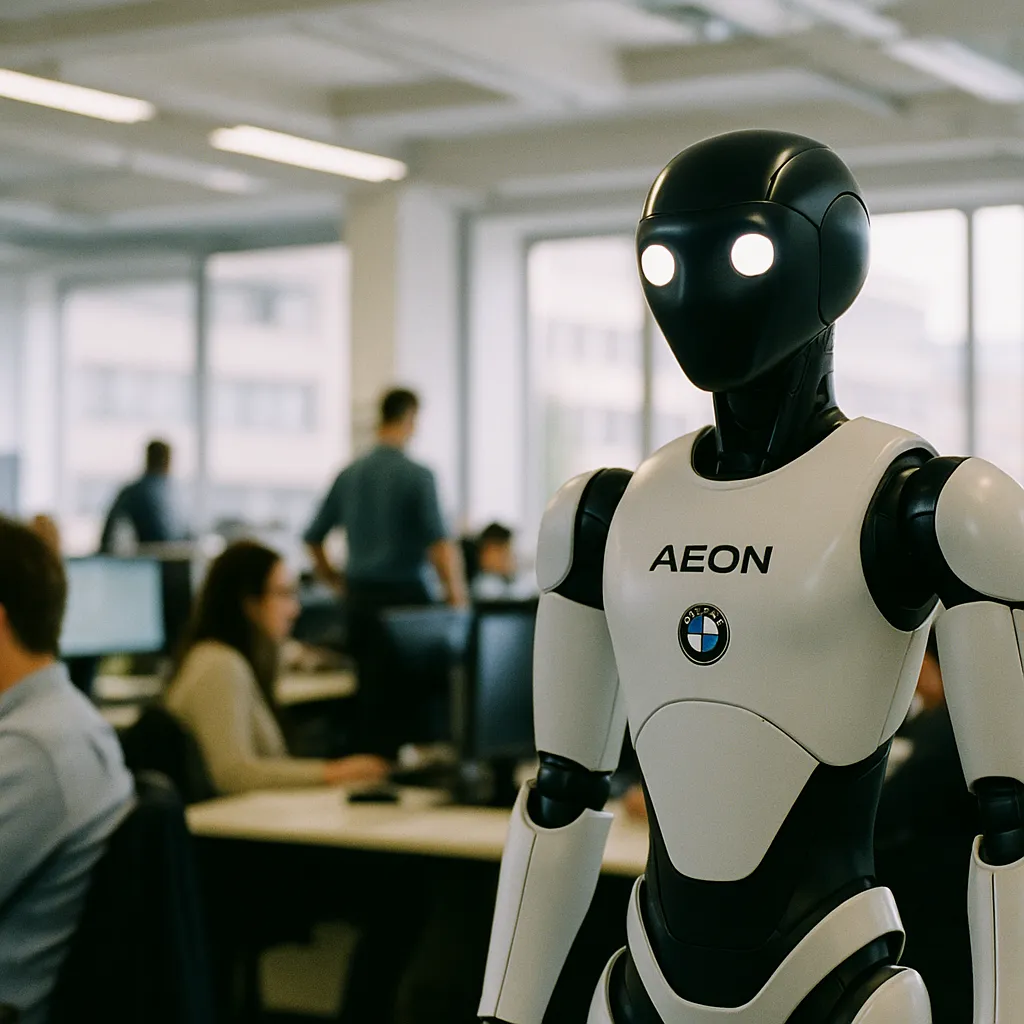
BMW has deployed Hexagon Robotics' AEON humanoid robot at Plant Leipzig — the first humanoid in European automotive production — and is opening a global Center of Competence for Physical AI.
BMW Deploys AEON Humanoid Robot at Leipzig — First in European Automotive Production
By Hector Herrera | June 7, 2026 | Vertical: Manufacturing | Type: Company News
BMW has put a humanoid robot to work on the floor of its Leipzig plant, becoming the first automaker to deploy a humanoid in European automotive production. The robot — AEON, built by Hexagon Robotics — can swap tools to perform assembly, scanning, and material-handling tasks, and its arrival signals that the robotics transition that began in U.S. plants is now crossing the Atlantic.
Background
BMW has been running a structured humanoid robot program since at least 2024, when it partnered with Figure — the humanoid robotics startup backed by Microsoft, OpenAI, and Jeff Bezos — for a 10-month pilot at its Spartanburg, South Carolina plant. The Spartanburg pilot tested a Figure 02 robot on production tasks, generating operational data and engineering insights before BMW committed to broader deployment.
The Leipzig deployment with AEON is the next step: a different hardware platform, a different continent, and a different set of manufacturing tasks — but the same underlying thesis that general-purpose humanoid robots can perform a useful subset of automotive production work.
The AEON Robot: What It Is
According to the BMW Group Newsroom, the AEON robot from Hexagon Robotics is:
Get this in your inbox.
Daily AI intelligence. Free. No spam.
- Height: 1.65 metres (approximately 5'5")
- Weight: 60 kilograms (approximately 132 lbs)
- Key capability: Modular end-effector swapping — the robot can change its "hands" to match the task, moving between assembly operations, dimensional scanning, and material transport without requiring a different machine
- Status: Pilot operations as of the Leipzig deployment announcement
The modular tool-swapping capability is significant. Traditional industrial robots are purpose-built for a single task. Reconfiguring a line for a new model or component requires significant mechanical and programming work. A robot that can change its own end-effectors represents a step toward the flexibility that automotive manufacturers need as vehicle configurations become more complex and model cycles shorter.
The Center of Competence for Physical AI
BMW announced alongside the Leipzig deployment that it is establishing a global Center of Competence for Physical AI in Production. The center will consolidate the learnings from Spartanburg and Leipzig into a formal R&D function focused on:
- Evaluating and qualifying humanoid platforms across different vendors
- Developing shared training datasets and simulation environments
- Establishing safety standards for human-robot collaboration on active production lines
- Identifying tasks where humanoid robots deliver a measurable productivity or safety advantage over existing automation
The creation of a dedicated organizational unit — not just a project team — signals that BMW is treating physical AI as a durable capability investment rather than a sequence of pilots.
Why This Matters for Manufacturing
European automotive production faces a different set of constraints than U.S. plants. Labor regulations, union structures, and workplace safety requirements differ significantly across Germany, the UK, and other EU markets. BMW's Leipzig deployment is, among other things, a proof-of-concept that humanoid deployment is viable within European regulatory and labor environments — not just in the more flexible U.S. context.
For the industry broadly:
- OEM competition. BMW's publicly announced humanoid deployments create pressure on competitors — Mercedes, Stellantis, Volkswagen — to show progress on their own robotics programs or risk falling behind on labor productivity.
- Supplier implications. If OEMs standardize on humanoid platforms for certain classes of tasks, tier-1 and tier-2 suppliers face the same adoption question. A humanoid that can perform assembly at a BMW plant can in principle be deployed at the stamping or electronics suppliers that feed it.
- Task selection matters. The critical lesson from the Spartanburg pilot was that humanoids are not ready for every task — they are ready for specific tasks, in specific environments, with specific tolerance for cycle time variation. Leipzig adds to that empirical picture.
For workers: BMW has framed both deployments as supplements to human workers rather than replacements, emphasizing that humanoids are being tested on tasks that are ergonomically hazardous or difficult to fill — a positioning consistent with most European automotive labor agreements that require consultation before automation changes headcount.
What to Watch
The Center of Competence is the organizational indicator to track. If BMW is publishing vendor qualification criteria, sharing safety standards, or publishing research from the center by the end of 2026, it signals that the program is scaling from pilot to production practice. Watch also for announcements from Mercedes-Benz, which has its own humanoid partnership with Apptronik, and for whether any European plant matches or surpasses Leipzig's deployment scope before year's end.
Hector Herrera covers manufacturing AI and industrial automation for NexChron.
Did this help you understand AI better?
Your feedback helps us write more useful content.
Get tomorrow's AI briefing
Join readers who start their day with NexChron. Free, daily, no spam.