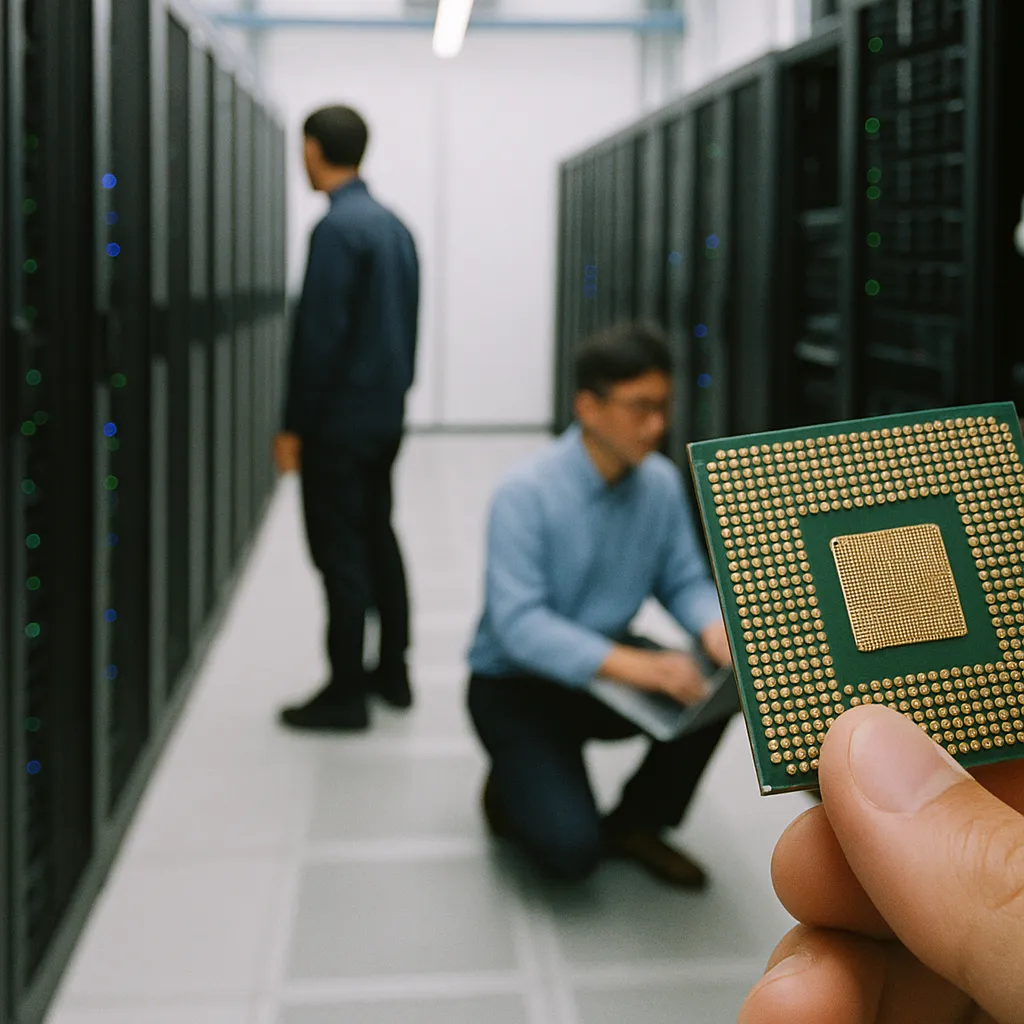
Asia's electronics manufacturing hubs posted PMI expansion in September, with AI chip demand providing the durable demand signal that's absent in conventional industrial sectors.
Factory activity across Asia expanded in September, with Japan, South Korea, and Taiwan all posting PMI readings above 50—the threshold that separates growth from contraction—driven by sustained demand for semiconductors and AI-related hardware. The data confirms that AI infrastructure investment has become a durable demand signal for Asia's electronics manufacturing base, even as conventional industrial sectors in the region remain soft.
Why it matters: Asia's semiconductor and electronics manufacturers are now effectively proxy indicators for global AI capital expenditure. When hyperscalers and data center operators spend on AI infrastructure, that spending shows up first in Asia's factory PMI readings.
What the September Numbers Show
According to manufacturing PMI data reported by the Manila Times, three of Asia's major electronics manufacturing hubs posted expansion in September:
- Japan — manufacturing PMI above 50, supported by orders for semiconductor equipment and advanced packaging components used in AI chip production
- South Korea — driven by strong demand for DRAM and HBM (High Bandwidth Memory) chips, the memory architecture that enables large-scale AI model inference
- Taiwan — reflecting continued TSMC-adjacent supply chain activity as the world's leading foundry runs near capacity on advanced nodes used for AI accelerators
The expansion in these three markets contrasts with softer readings in Southeast Asian manufacturing hubs more exposed to consumer electronics cycles, where AI spending hasn't offset weakness in smartphone and PC-related production.
Get this in your inbox.
Daily AI intelligence. Free. No spam.
The AI Infrastructure Demand Signal
High Bandwidth Memory (HBM) is the specific product that explains South Korea's PMI expansion most directly. NVIDIA's H100, H200, and Blackwell-series GPUs—the chips that power most AI training and inference infrastructure—require HBM stacked on the processor package. SK Hynix and Samsung dominate global HBM production, and their output feeds directly into data center GPU supply.
Advanced packaging explains much of Japan's expansion. AI chips require more sophisticated packaging than conventional processors—chiplet architectures, interposers, and 3D stacking—that depend on Japanese-developed equipment and materials that have no equivalent elsewhere.
TSMC's capacity utilization shapes Taiwan's numbers. The company's 3nm and 5nm nodes—where AI chip production is concentrated—have remained heavily booked through 2026, with Apple, NVIDIA, AMD, and Broadcom all competing for leading-edge capacity.
The Non-AI Industrial Picture
The same September data reveals the uneven nature of Asia's manufacturing recovery. Industries outside the AI supply chain—automotive components, industrial machinery, textiles—are reporting flat or contracting conditions in most Asian markets. The bifurcation is widening: manufacturers tied to AI hardware spend are expanding headcount and capital investment, while those serving more traditional industrial customers are cutting capacity.
For Asian governments and central banks, this creates a policy challenge: AI-driven demand is concentrated in a small number of products and a small number of companies, which means the manufacturing sector expansion visible in aggregate PMI data doesn't necessarily translate into broad employment or wage growth.
What to Watch
The durability of this manufacturing expansion depends on whether hyperscaler AI capital expenditure remains elevated into 2027. Current projections from Microsoft, Google, Amazon, and Meta suggest continued infrastructure spending, but any slowdown in cloud AI revenue growth or enterprise AI adoption rates would flow through to Asia's semiconductor supply chain quickly. Watch Q3 earnings from TSMC, SK Hynix, and Tokyo Electron for the forward signal on whether this expansion continues.
Did this help you understand AI better?
Your feedback helps us write more useful content.
Get tomorrow's AI briefing
Join readers who start their day with NexChron. Free, daily, no spam.