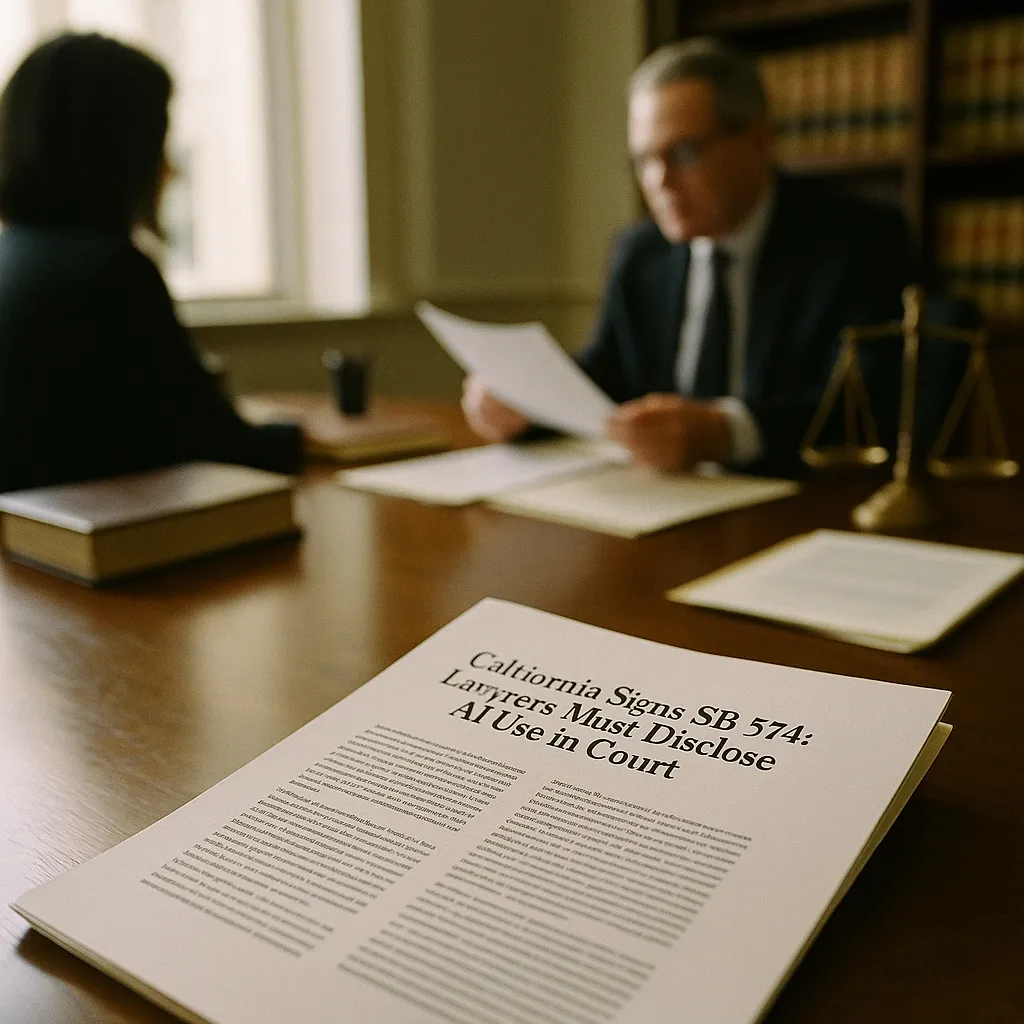
Governor Newsom signed SB 574 requiring California attorneys to disclose AI use in court filings and personally verify every AI-generated citation, effective January 1, 2027.
California Signs SB 574: Lawyers Must Disclose AI Use in Court Documents Starting 2027
California now has the most comprehensive attorney AI accountability law in the country. Governor Newsom signed SB 574 into law, requiring attorneys to disclose when generative AI was used to draft court submissions — and making them personally liable for verifying every AI-generated citation. The law takes effect January 1, 2027, and legal observers say it will reshape how law firms structure their AI workflows before the year is out.
The disclosure requirement lands in a legal market where AI adoption has moved far faster than accountability frameworks. California's courts have already seen sanctions issued for AI-hallucinated citations — fabricated case citations that looked real but weren't — and the bar's existing supervision rules were not written to address the specific failure modes of large language models.
What SB 574 Requires
The law creates three distinct obligations for California attorneys:
1. Disclosure of AI use. Any court submission — briefs, motions, declarations, discovery filings — that was drafted in substantial part using generative AI must include a disclosure statement identifying the AI tool used and the nature of its involvement.
2. Personal verification of citations. Attorneys cannot delegate citation checking to an AI. Lawyers must personally verify that every case cited in an AI-assisted document exists, says what the filing claims it says, and remains valid law. The "I relied on the AI" defense is explicitly foreclosed by the statute.
3. No AI arbitration decisions. Arbitrators operating under California law are prohibited from delegating substantive decisions to AI systems. An arbitrator may use AI to assist with research or drafting, but the decision itself must be a human judgment.
Violations create grounds for sanctions, bar discipline, and — in cases where clients are harmed by undisclosed AI reliance — malpractice exposure.
Get this in your inbox.
Daily AI intelligence. Free. No spam.
Why California Moved First
The pressure to act has been building since federal courts began issuing AI citation sanctions in 2023. The Mata v. Avianca case — in which attorneys were sanctioned by a federal judge for submitting a brief full of ChatGPT-generated but nonexistent case citations — became the cautionary example cited in virtually every subsequent state bar AI guidance document.
California's bar association issued interim guidance on AI use in late 2024, but guidance is not enforcement. SB 574 converts the principle into a statutory obligation with teeth.
Other state bars that have issued guidance without legislation include: New York, Texas, Florida, Illinois, and Massachusetts. Each is now watching California's implementation closely. The federal judiciary's AI working group is also monitoring, with several circuit courts expected to issue their own AI disclosure requirements in 2027 — potentially modeled on SB 574's framework or designed to address gaps in it.
The law was not without opposition. Some legal technology companies argued the disclosure requirement would stigmatize AI use and slow adoption of tools that, when used responsibly, genuinely improve legal work quality. Law firms on the plaintiff's side of mass litigation worried that mandatory disclosure could be weaponized by opposing counsel to attack the credibility of AI-assisted filings regardless of their substantive quality. Those objections were not enough to stop the bill.
What It Means for Law Firms
The practical implementation challenge is significant. Large California law firms — many of which have deployed AI writing assistants, research tools, and document review systems across their practice groups — now need to build disclosure workflows into every matter management system that touches court filings before January 1.
The compliance tasks include:
- Auditing which AI tools are currently used in document drafting across practice groups
- Building disclosure-trigger checkpoints into filing workflows
- Training attorneys on the citation verification requirement, including what "personal verification" means for AI-generated research
- Updating engagement letters and matter documentation to reflect AI usage disclosures to clients
Small firms and solo practitioners face the same statutory obligations with far fewer administrative resources to implement them. The State Bar of California has indicated it will issue implementation guidance, but that guidance has not yet been published.
The malpractice angle is the one most likely to change actual firm behavior. Disclosure and verification requirements create a paper trail. If an attorney fails to disclose AI use, fails to verify a citation, and a client is harmed as a result, that sequence becomes the factual predicate for a malpractice claim. Insurance carriers writing legal malpractice policies in California are expected to adjust their underwriting to account for SB 574 compliance as a risk factor.
What to Watch
The first January filings after the law takes effect will establish how California courts handle disclosure enforcement in practice — whether judges treat non-disclosure as a procedural deficiency to be cured or as grounds for immediate sanctions. The California Supreme Court's response to early cases will set the template for how aggressively the statute is applied.
Did this help you understand AI better?
Your feedback helps us write more useful content.
Get tomorrow's AI briefing
Join readers who start their day with NexChron. Free, daily, no spam.