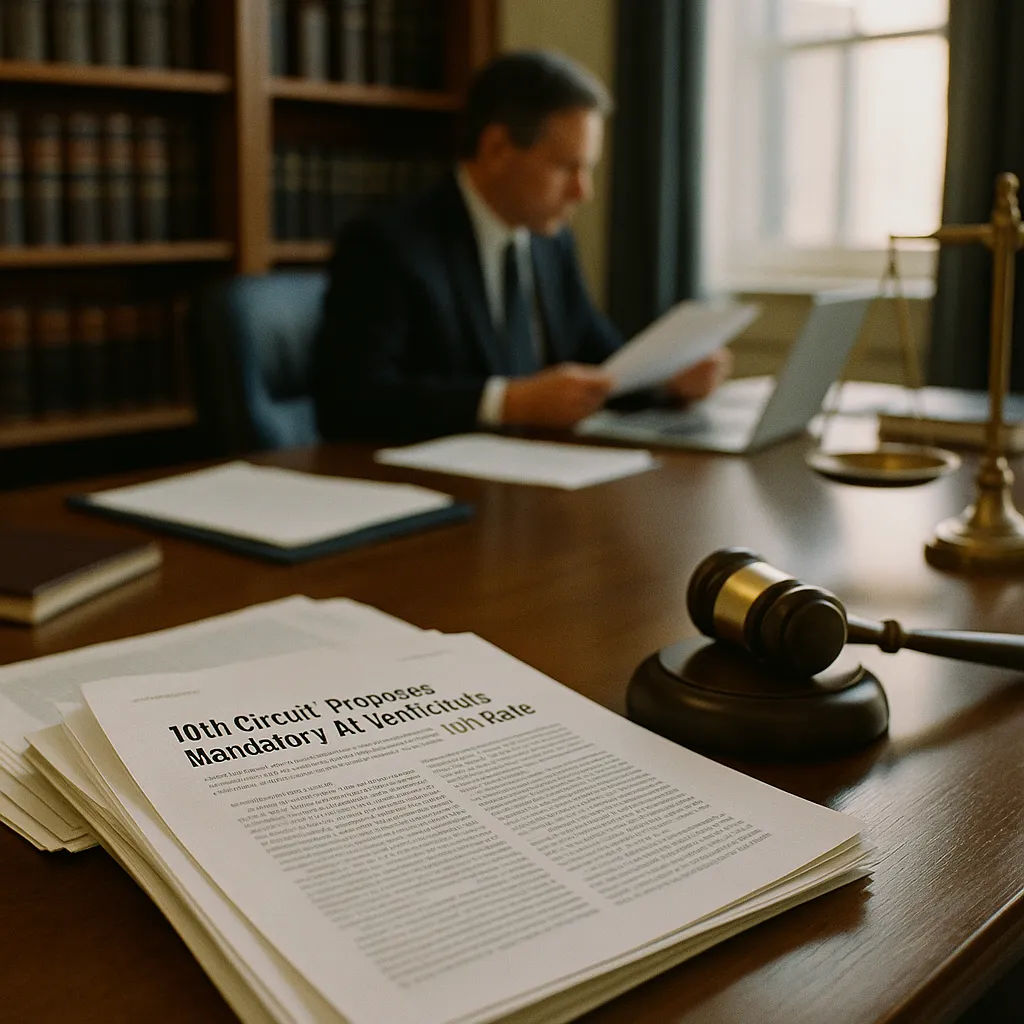
The 10th Circuit Court of Appeals requires lawyers to certify AI-generated citations have been human-verified before filing — following sanctions in a Mississippi AI hallucination case.
The U.S. 10th Circuit Court of Appeals has proposed a rule requiring lawyers and self-represented parties to certify that any AI-generated legal content — authorities, quotes, citations, and analysis — has been reviewed by a human before it's filed with the court. Public comments close October 18, with final rules targeted for December 1, 2026. The proposal is one of the most specific AI filing rules yet from a federal appellate court, and its structure signals where courts across the country are heading.
The immediate trigger was a Mississippi federal case in which four attorneys were sanctioned for submitting AI-hallucinated citations — fabricated case references that do not exist. Two of those attorneys were barred from practicing in the district. The 10th Circuit's proposed rule is a direct institutional response to a pattern that courts are now encountering with regularity.
The Problem AI Hallucinations Create in Court
AI-generated legal research tools — including ChatGPT, Harvey, and legal-specific platforms built on large language models (LLMs, software trained to predict plausible text) — can produce confident-sounding citations to cases that were never decided. The court opinions they cite may not exist at all, or may exist but say the opposite of what the AI claims.
In traditional legal research, fabricating a citation is an obvious act of bad faith. In the AI context, attorneys have argued in court that they were deceived by the tool — that they used it in good faith without realizing it had invented the source material. Courts have not been sympathetic to that defense, holding that the professional obligation to verify citations belongs to the attorney, not the software.
The 10th Circuit covers federal cases in Colorado, Kansas, New Mexico, Oklahoma, Utah, and Wyoming. A rule here sets precedent that other circuits are likely to track.
What the Proposed Rule Requires
The certification requirement means attorneys must affirmatively state — in writing, in the filing — that:
Get this in your inbox.
Daily AI intelligence. Free. No spam.
- Any AI-generated legal authorities have been verified to exist
- Any quotes attributed to those authorities accurately reflect what was written
- Any legal analysis generated by AI has been reviewed by a human with legal training
This is structurally similar to Rule 11 of the Federal Rules of Civil Procedure, which already requires attorneys to certify that filings aren't frivolous and that factual allegations have evidentiary support. The AI certification extends that existing obligation into a new domain.
What the proposed rule does not do: it doesn't ban AI tools from the legal research process. Attorneys can still use AI to draft arguments, find case law, and summarize documents. The obligation is on the human to check the output before it goes to the court.
Where Courts Stand Right Now
The 10th Circuit's proposal is part of a broader and accelerating pattern. As of September 2026, at least 21 jurisdictions have adopted some form of AI disclosure or verification requirement for court filings — a number that has roughly doubled in the past 12 months. The rules are not uniform. Some require disclosure that AI was used at all; others require verification only for cited authorities; others impose sanctions schedules for AI-hallucination violations.
The Mississippi case that preceded this proposal resulted in two attorneys being barred from the district — one of the stiffest sanctions imposed in an AI filing case to date. Those outcomes are shaping how seriously courts are treating the issue.
What Lawyers and Litigants Need to Know
If the 10th Circuit rule is finalized as proposed, it will apply to all attorneys and self-represented parties filing in the circuit. For firms already using AI research tools:
- Verification workflows — specifically checking that cited cases exist and say what the AI claims — will need to be formalized and documented
- Junior associates and paralegals using AI drafting tools should understand that the supervising attorney carries the certification obligation
- Self-represented litigants (pro se parties) are explicitly covered by the proposal — not just lawyers — which is notable given that pro se filers are more likely to rely on consumer AI tools like ChatGPT
The practical verification step isn't technically difficult: looking up a cited case in Westlaw or Lexis takes seconds. The failure cases documented so far suggest attorneys filed AI output without that basic check. The rule formalizes the obvious.
What to Watch
Comments close October 18. Expect pushback from attorneys who argue the rule is redundant with existing Rule 11 obligations, and from legal tech vendors who want AI tools in court workflows but don't want certification requirements that add friction. If the December 1 implementation timeline holds, the 10th Circuit becomes one of the first federal appellate courts with a formalized AI verification rule — and other circuits will be watching closely.
Source: JD Journal — 10th Circuit Proposes AI Filing Rule for Lawyers
Did this help you understand AI better?
Your feedback helps us write more useful content.
Get tomorrow's AI briefing
Join readers who start their day with NexChron. Free, daily, no spam.